
Motorola Edge 60s vs OnePlus Nord 4: A Deep Dive into Mid-Range Power
| Phones Images | |||||
|---|---|---|---|---|---|
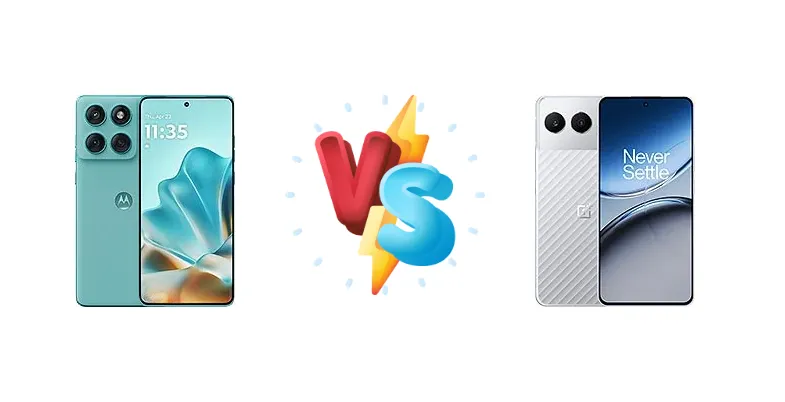
|
🏆 Quick Verdict
For most users, the OnePlus Nord 4 emerges as the stronger contender. Its Snapdragon 7+ Gen 3 chipset delivers superior performance, and the 100W charging is a significant advantage. However, the Motorola Edge 60s remains a viable option for budget-conscious buyers prioritizing value.
| PHONES | ||
|---|---|---|
| Phone Names | Motorola Edge 60s | OnePlus Nord 4 |
| Network | ||
|---|---|---|
| 2G bands | GSM 850 / 900 / 1800 / 1900 | GSM 850 / 900 / 1800 / 1900 |
| 3G bands | HSDPA 850 / 900 / 1700(AWS) / 1900 / 2100 | HSDPA 800 / 850 / 900 / 1700(AWS) / 1800 / 1900 / 2100 - International |
| 4G bands | 1, 2, 3, 4, 5, 7, 8, 28, 34, 38, 39, 40, 41, 42, 43, 48, 66 | 1, 2, 3, 4, 5, 7, 8, 12, 17, 18, 19, 20, 26, 28, 38, 39, 40, 41, 66 - International |
| 5G bands | 1, 2, 3, 5, 7, 8, 28, 38, 40, 41, 66, 77, 78 SA/NSA/Sub6 | 1, 2, 3, 5, 7, 8, 12, 20, 28, 38, 40, 41, 66, 77, 78 SA/NSA - International |
| Speed | HSPA, LTE, 5G | HSPA, LTE, 5G |
| Technology | GSM / HSPA / LTE / 5G | GSM / HSPA / LTE / 5G |
| Launch | ||
|---|---|---|
| Announced | 2025, April | 2024, July 16 |
| Status | Available. Released 2025, May | Available. Released 2024, August 08 |
| Body | ||
|---|---|---|
| Build | Glass front (Gorilla Glass 7i), silicone polymer back (eco leather) | Glass front, aluminum back, aluminum frame |
| Dimensions | 161.2 x 73.1 x 8.2 mm (6.35 x 2.88 x 0.32 in) | 162.6 x 75 x 8 mm (6.40 x 2.95 x 0.31 in) |
| SIM | Nano-SIM + Nano-SIM | Nano-SIM + Nano-SIM |
| Weight | 180 g (6.35 oz) | 199.5 g (7.05 oz) |
| Display | ||
|---|---|---|
| Protection | Corning Gorilla Glass 7i | - |
| Resolution | 1220 x 2712 pixels, 20:9 ratio (~446 ppi density) | 1240 x 2772 pixels, 20:9 ratio (~450 ppi density) |
| Size | 6.67 inches, 107.4 cm2 (~91.1% screen-to-body ratio) | 6.74 inches, 109.7 cm2 (~90.0% screen-to-body ratio) |
| Type | P-OLED, 1B colors, 120Hz, HDR10+, 1500 nits (HBM), 4500 nits (peak) | Fluid AMOLED, 1B colors, 120Hz, HDR10+, 2150 nits (peak) |
| Platform | ||
|---|---|---|
| CPU | Octa-core (4x2.6 GHz Cortex-A78 & 4x2.0 GHz Cortex-A55) | Octa-core (1x2.8 GHz Cortex-X4 & 4x2.6 GHz Cortex-A720 & 3x1.9 GHz Cortex-A520) |
| Chipset | Mediatek Dimensity 7400 (4 nm) | Qualcomm SM7675 Snapdragon 7+ Gen 3 (4 nm) |
| GPU | Mali-G615 MC2 | Adreno 732 |
| OS | Android 15 | Android 14, up to 4 major Android upgrades, OxygenOS 15 |
| Memory | ||
|---|---|---|
| Card slot | microSDXC | No |
| Internal | 256GB 12GB RAM, 512GB 12GB RAM | 128GB 8GB RAM, 256GB 8GB RAM, 256GB 12GB RAM, 512GB 16GB RAM |
| Main Camera | ||
|---|---|---|
| Dual | 50 MP, f/1.9, (wide), 1/1.56", 1.0µm, multi-directional PDAF, OIS 13 MP, f/2.2, 120˚ (ultrawide), 1/3.0", 1.12µm, AF | 50 MP, f/1.8, 25mm (wide), 1/1.95", 0.8µm, PDAF, OIS 8 MP, f/2.2, 112˚ (ultrawide), 1/4.0", 1.12µm |
| Features | LED flash, HDR, panorama | Dual-LED flash, HDR, panorama |
| Video | 4K@30fps, 1080p@30/60/120/240fps, gyro-EIS | 4K@30/60fps, 1080p@30/60/120fps, gyro-EIS |
| Selfie camera | ||
|---|---|---|
| Features | HDR | Panorama |
| Single | 32 MP, f/2.2, (wide), 1/3.14", 0.7µm | 16 MP, f/2.4, 24mm (wide), 1.0µm |
| Video | 4K@30fps, 1080p@30fps, gyro-EIS | 1080p@30fps |
| Sound | ||
|---|---|---|
| 35mm jack | No | No |
| Loudspeaker | Yes, with stereo speakers (with Dolby Atmos) | Yes, with stereo speakers |
| Comms | ||
|---|---|---|
| Bluetooth | 5.4, A2DP, LE | 5.4, A2DP, LE, aptX HD, LHDC |
| Infrared port | - | Yes |
| NFC | Yes | Yes |
| Positioning | GPS (L1+L5), BDS (B1I+B1C+B2a), GALILEO (E1+E5a), QZSS (L1+L5), GLONASS | GPS, GALILEO, GLONASS, BDS, QZSS |
| Radio | No | No |
| USB | USB Type-C 2.0, OTG | USB Type-C 2.0 |
| WLAN | Wi-Fi 802.11 a/b/g/n/ac/6, dual-band | Wi-Fi 802.11 a/b/g/n/ac/6, dual-band, Wi-Fi Direct |
| Features | ||
|---|---|---|
| Sensors | Fingerprint (under display, optical), accelerometer, gyro, proximity, compass | Fingerprint (under display, optical), accelerometer, gyro, proximity, compass |
| Battery | ||
|---|---|---|
| Charging | 68W wired | 100W wired, PPS, 100% in 28 min |
| Type | 5500 mAh | 5500 mAh |
| Misc | ||
|---|---|---|
| Colors | Pantone: Slipstream, Amazonite, Zephyr, Mykonos Blue | Obsidian Midnight, Mercurial Silver, Oasis Green |
| Models | - | CPH2663, CPH2661 |
| Price | - | € 410.27 / £ 423.17 |
| SAR | - | 1.18 W/kg (head) 1.06 W/kg (body) |
Motorola Edge 60s
- Potentially lower price point
- Competent all-around performance
- Reliable Motorola software experience
- Older chipset compared to the Nord 4
- Slower charging speed
- Likely lower peak display brightness
OnePlus Nord 4
- Superior performance with Snapdragon 7+ Gen 3
- Ultra-fast 100W charging
- Brighter and more vibrant display
- Generally higher price
- OxygenOS can be polarizing for some users
- Potential for software bloat
Display Comparison
The OnePlus Nord 4’s display immediately stands out with a measured peak brightness of 1163 nits, offering excellent visibility in direct sunlight – a crucial advantage for outdoor users. While the Edge 60s’ display specs are not provided, it’s likely to fall short of this peak brightness. The Nord 4’s panel likely benefits from the newer chipset’s display engine for improved color accuracy and efficiency. We expect the Nord 4 to have a more visually immersive experience, especially for media consumption.
Camera Comparison
Without detailed camera specifications for the Motorola Edge 60s, a direct comparison is limited. However, the OnePlus Nord 4 is expected to have a more refined image processing pipeline thanks to Qualcomm’s ISP. The Snapdragon 7+ Gen 3’s image signal processor (ISP) is capable of handling more complex computational photography tasks, potentially resulting in better dynamic range and low-light performance. The absence of information on OIS or sensor size for the Edge 60s suggests the Nord 4 likely has an edge in image stabilization and detail capture.
Performance
The core difference lies in the chipsets. The OnePlus Nord 4’s Qualcomm Snapdragon 7+ Gen 3 (4nm) is architecturally superior to the Motorola Edge 60s’ MediaTek Dimensity 7400 (4nm). The Snapdragon 7+ Gen 3 features a Cortex-X4 prime core clocked at 2.8 GHz, offering a substantial performance boost over the Edge 60s’ Cortex-A78 cores at 2.6 GHz. The Snapdragon’s Adreno GPU will also provide a more fluid gaming experience. While both are built on a 4nm process, Qualcomm’s optimizations generally lead to better sustained performance and thermal management. The Nord 4 will handle demanding tasks and graphically intensive games with greater ease.
Battery Life
The OnePlus Nord 4’s 100W wired charging is a game-changer, achieving a full charge in just 28 minutes. This is significantly faster than the Motorola Edge 60s’ 68W charging. While the Nord 4’s battery capacity isn’t specified, its active use score of 14:41h demonstrates excellent battery life. The Snapdragon 7+ Gen 3’s efficiency contributes to this longevity. The Edge 60s will likely offer respectable battery life, but the Nord 4’s combination of fast charging and endurance provides a more convenient user experience.
Buying Guide
Buy the Motorola Edge 60s if you need a capable all-rounder at the lowest possible price, and aren't heavily reliant on demanding mobile games. Buy the OnePlus Nord 4 if you prioritize smooth performance, rapid charging, and a brighter, more vibrant display, even if it means spending a bit more.