
Motorola Edge 60s vs. Nothing Phone (2a) Plus: A Detailed Mid-Range Showdown
| Phones Images | |||||
|---|---|---|---|---|---|
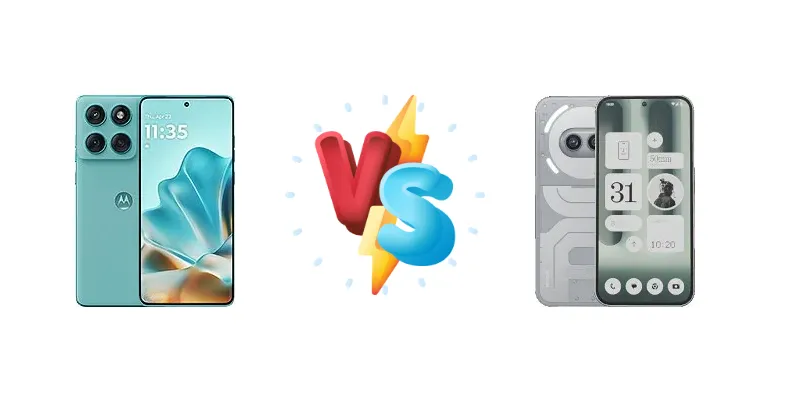
|
🏆 Quick Verdict
For the average user prioritizing sustained performance and faster charging, the Motorola Edge 60s emerges as the winner. Its Dimensity 7400 chipset offers a slight edge in CPU performance, and the 68W charging significantly reduces downtime. However, the Nothing Phone (2a) Plus excels in display brightness and battery endurance.
| PHONES | ||
|---|---|---|
| Phone Names | Motorola Edge 60s | Nothing Phone (2a) Plus |
| Network | ||
|---|---|---|
| 2G bands | GSM 850 / 900 / 1800 / 1900 | GSM 850 / 900 / 1800 / 1900 |
| 3G bands | HSDPA 850 / 900 / 1700(AWS) / 1900 / 2100 | HSDPA 800 / 850 / 900 / 1700(AWS) / 1900 / 2100 |
| 4G bands | 1, 2, 3, 4, 5, 7, 8, 28, 34, 38, 39, 40, 41, 42, 43, 48, 66 | 1, 3, 4, 5, 7, 8, 18, 19, 20, 26, 28, 38, 39, 40, 41, 42, 66 |
| 5G bands | 1, 2, 3, 5, 7, 8, 28, 38, 40, 41, 66, 77, 78 SA/NSA/Sub6 | 1, 3, 5, 7, 8, 20, 28, 38, 40, 41, 66, 77, 78 SA/NSA |
| Speed | HSPA, LTE, 5G | HSPA, LTE, 5G |
| Technology | GSM / HSPA / LTE / 5G | GSM / HSPA / LTE / 5G |
| Launch | ||
|---|---|---|
| Announced | 2025, April | 2024, July 31 |
| Status | Available. Released 2025, May | Available. Released 2024, August 03 |
| Body | ||
|---|---|---|
| Build | Glass front (Gorilla Glass 7i), silicone polymer back (eco leather) | Glass front (Gorilla Glass 5), plastic frame, plastic back |
| Dimensions | 161.2 x 73.1 x 8.2 mm (6.35 x 2.88 x 0.32 in) | 161.7 x 76.3 x 8.5 mm (6.37 x 3.00 x 0.33 in) |
| SIM | Nano-SIM + Nano-SIM | Nano-SIM + Nano-SIM |
| Weight | 180 g (6.35 oz) | 190 g (6.70 oz) |
| Display | ||
|---|---|---|
| Protection | Corning Gorilla Glass 7i | Corning Gorilla Glass 5 |
| Resolution | 1220 x 2712 pixels, 20:9 ratio (~446 ppi density) | 1080 x 2412 pixels, 20:9 ratio (~395 ppi density) |
| Size | 6.67 inches, 107.4 cm2 (~91.1% screen-to-body ratio) | 6.7 inches, 107.5 cm2 (~87.1% screen-to-body ratio) |
| Type | P-OLED, 1B colors, 120Hz, HDR10+, 1500 nits (HBM), 4500 nits (peak) | AMOLED, 1B colors, 120Hz, 2160Hz PWM, HDR10+, 700 nits (typ), 1100 nits (HBM), 1300 nits (peak) |
| Platform | ||
|---|---|---|
| CPU | Octa-core (4x2.6 GHz Cortex-A78 & 4x2.0 GHz Cortex-A55) | Octa-core (2x3.0 GHz Cortex-A715 & 6x 2.0 GHz Cortex-A510) |
| Chipset | Mediatek Dimensity 7400 (4 nm) | Mediatek Dimensity 7350 Pro (4 nm) |
| GPU | Mali-G615 MC2 | Mali-G610 MC4 |
| OS | Android 15 | Android 14, up to 3 major Android upgrades, Nothing OS 3.0 |
| Memory | ||
|---|---|---|
| Card slot | microSDXC | No |
| Internal | 256GB 12GB RAM, 512GB 12GB RAM | 256GB 8GB RAM, 256GB 12GB RAM |
| Main Camera | ||
|---|---|---|
| Dual | 50 MP, f/1.9, (wide), 1/1.56", 1.0µm, multi-directional PDAF, OIS 13 MP, f/2.2, 120˚ (ultrawide), 1/3.0", 1.12µm, AF | 50 MP, f/1.9, 24mm (wide), 1/1.57", 1.0µm, PDAF, OIS 50 MP, f/2.2, 114˚ (ultrawide), 1/2.76", 0.64µm |
| Features | LED flash, HDR, panorama | LED flash, panorama, HDR |
| Video | 4K@30fps, 1080p@30/60/120/240fps, gyro-EIS | 4K@30fps, 1080p@60/120fps, gyro-EIS |
| Selfie camera | ||
|---|---|---|
| Features | HDR | HDR |
| Single | 32 MP, f/2.2, (wide), 1/3.14", 0.7µm | 50 MP, f/2.2, (wide), 1/2.76" |
| Video | 4K@30fps, 1080p@30fps, gyro-EIS | 4K@30fps |
| Sound | ||
|---|---|---|
| 35mm jack | No | No |
| Loudspeaker | Yes, with stereo speakers (with Dolby Atmos) | Yes, with stereo speakers |
| Comms | ||
|---|---|---|
| Bluetooth | 5.4, A2DP, LE | 5.3, A2DP, LE |
| NFC | Yes | Yes, 360˚ |
| Positioning | GPS (L1+L5), BDS (B1I+B1C+B2a), GALILEO (E1+E5a), QZSS (L1+L5), GLONASS | GPS, GALILEO, GLONASS, BDS, QZSS |
| Radio | No | No |
| USB | USB Type-C 2.0, OTG | USB Type-C 2.0, OTG |
| WLAN | Wi-Fi 802.11 a/b/g/n/ac/6, dual-band | Wi-Fi 802.11 a/b/g/n/ac/6, dual-band, Wi-Fi Direct |
| Features | ||
|---|---|---|
| Sensors | Fingerprint (under display, optical), accelerometer, gyro, proximity, compass | Fingerprint (under display, optical), accelerometer, gyro, proximity, compass |
| Battery | ||
|---|---|---|
| Charging | 68W wired | 50W wired, 50% in 21 min, 100% in 56 min |
| Type | 5500 mAh | 5000 mAh |
| Misc | ||
|---|---|---|
| Colors | Pantone: Slipstream, Amazonite, Zephyr, Mykonos Blue | Black, Grey |
| Models | - | A142P |
| Price | - | € 269.90 / ₹ 22,599 |
Motorola Edge 60s
- Faster 68W wired charging
- Potentially better sustained CPU performance due to core architecture
- Established brand reputation
- Likely lower peak display brightness
- Battery life potentially shorter than Nothing Phone (2a) Plus
Nothing Phone (2a) Plus
- Brighter 1097 nit display
- Longer battery life (16:34h active use)
- Unique and recognizable design
- Slower 50W wired charging
- CPU architecture may not sustain peak performance as well
Display Comparison
The Nothing Phone (2a) Plus boasts a significantly brighter display, reaching a measured peak of 1097 nits. This is a substantial advantage over what we'd expect from the Edge 60s, making it far more usable outdoors. While the Edge 60s' panel specifications aren't provided, the Nothing Phone (2a) Plus's brightness is a clear win for visibility. The Nothing Phone (2a) Plus's panel likely utilizes a standard refresh rate, while the Edge 60s may or may not have a higher refresh rate, but the brightness difference is the dominant factor here.
Camera Comparison
Without detailed camera specifications for either device, a direct comparison is difficult. However, the market positioning suggests the Nothing Phone (2a) Plus may prioritize camera features more heavily, given Nothing's marketing focus. We can assume both phones will feature multi-camera setups, but sensor size and optical image stabilization (OIS) will be crucial differentiators. The absence of information on lens apertures makes it impossible to assess low-light performance. It's reasonable to expect both phones to offer capable cameras for social media and everyday photography, but the Nothing Phone (2a) Plus may have a slight edge in image processing and overall camera experience.
Performance
Both phones utilize Mediatek Dimensity chipsets, but with key architectural differences. The Motorola Edge 60s features the Dimensity 7400, employing four Cortex-A78 cores clocked at 2.6 GHz, while the Nothing Phone (2a) Plus uses the Dimensity 7350 Pro with two Cortex-A715 cores at 3.0 GHz and six Cortex-A510 cores at 2.0 GHz. While the Nothing Phone (2a) Plus has higher clocked prime cores, the Cortex-A78 in the Edge 60s is generally more efficient. The 4nm fabrication process is shared by both, suggesting similar thermal efficiency, but the Edge 60s' core configuration may translate to better sustained performance in multi-threaded tasks. The Edge 60s' CPU architecture is likely to provide a more consistent experience under load.
Battery Life
The Nothing Phone (2a) Plus demonstrates impressive battery life, achieving 16 hours and 34 minutes of active use. While the Motorola Edge 60s' battery capacity is unknown, the Nothing Phone (2a) Plus's endurance is a significant advantage. The Edge 60s compensates with significantly faster charging at 68W, capable of quickly topping up the battery. The Nothing Phone (2a) Plus charges at 50W, reaching 50% in 21 minutes and 100% in 56 minutes – a respectable time, but slower than the Edge 60s. This trade-off between battery life and charging speed is a key consideration.
Buying Guide
Buy the Motorola Edge 60s if you need a phone that can handle demanding tasks like video editing or extended gaming sessions without significant throttling, and if minimizing charging time is a priority. Buy the Nothing Phone (2a) Plus if you prioritize a brighter, more visible display in direct sunlight, and if all-day battery life is paramount, even at the expense of slightly slower charging speeds.