
Motorola Edge 60s vs. Edge 50 Fusion: A Deep Dive into Mid-Range Motorola
| Phones Images | |||||
|---|---|---|---|---|---|
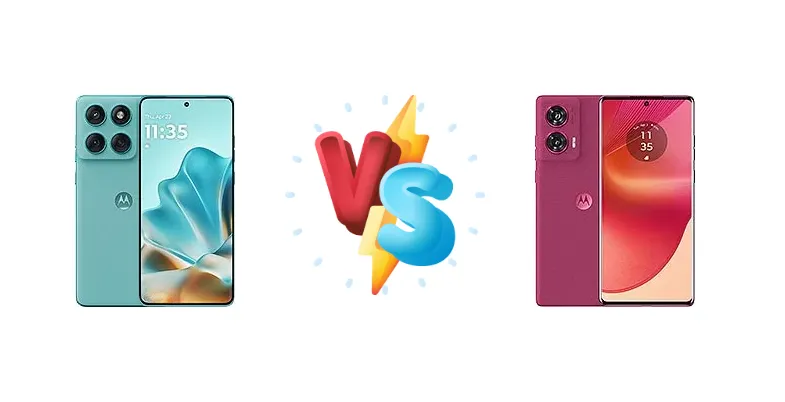
|
🏆 Quick Verdict
For most users, the Motorola Edge 50 Fusion emerges as the stronger choice. Its brighter 1322-nit display and generally comparable performance (depending on region) coupled with a solid 12:40h active use battery life, make it a more well-rounded device. However, the Edge 60s remains competitive, particularly for those prioritizing a specific chipset.
| PHONES | ||
|---|---|---|
| Phone Names | Motorola Edge 60s | Motorola Edge 50 Fusion |
| Network | ||
|---|---|---|
| 2G bands | GSM 850 / 900 / 1800 / 1900 | GSM 850 / 900 / 1800 / 1900 |
| 3G bands | HSDPA 850 / 900 / 1700(AWS) / 1900 / 2100 | HSDPA 850 / 900 / 1900 / 2100 |
| 4G bands | 1, 2, 3, 4, 5, 7, 8, 28, 34, 38, 39, 40, 41, 42, 43, 48, 66 | 1, 2, 3, 5, 7, 8, 18, 19, 20, 26, 28, 32, 38, 40, 41, 42, 71 - International |
| 5G bands | 1, 2, 3, 5, 7, 8, 28, 38, 40, 41, 66, 77, 78 SA/NSA/Sub6 | 1, 3, 5, 7, 8, 20, 26, 28, 38, 40, 41, 77, 78 SA/NSA |
| Speed | HSPA, LTE, 5G | HSPA, LTE, 5G |
| Technology | GSM / HSPA / LTE / 5G | GSM / HSPA / LTE / 5G |
| Launch | ||
|---|---|---|
| Announced | 2025, April | 2024, April 16 |
| Status | Available. Released 2025, May | Available. Released 2024, May 15 |
| Body | ||
|---|---|---|
| Build | Glass front (Gorilla Glass 7i), silicone polymer back (eco leather) | Glass front, silicone polymer back (eco leather), plastic frame |
| Dimensions | 161.2 x 73.1 x 8.2 mm (6.35 x 2.88 x 0.32 in) | 161.9 x 73.1 x 7.9 mm (6.37 x 2.88 x 0.31 in) |
| SIM | Nano-SIM + Nano-SIM | · Nano-SIM + eSIM· Nano-SIM + Nano-SIM |
| Weight | 180 g (6.35 oz) | 174.9 g (6.17 oz) |
| Display | ||
|---|---|---|
| Protection | Corning Gorilla Glass 7i | Corning Gorilla Glass 5 |
| Resolution | 1220 x 2712 pixels, 20:9 ratio (~446 ppi density) | 1080 x 2400 pixels, 20:9 ratio (~393 ppi density) |
| Size | 6.67 inches, 107.4 cm2 (~91.1% screen-to-body ratio) | 6.7 inches, 108.4 cm2 (~91.6% screen-to-body ratio) |
| Type | P-OLED, 1B colors, 120Hz, HDR10+, 1500 nits (HBM), 4500 nits (peak) | P-OLED, 1B colors, 120Hz (LATAM), 144Hz (INT), 1600 nits (peak) |
| Platform | ||
|---|---|---|
| CPU | Octa-core (4x2.6 GHz Cortex-A78 & 4x2.0 GHz Cortex-A55) | Octa-core (4x2.40 GHz Cortex-A78 & 4x1.95 GHz Cortex-A55) - InternationalOcta-core (4x2.2 GHz Cortex-A78 & 4x1.8 GHz Cortex-A55) - LATAM |
| Chipset | Mediatek Dimensity 7400 (4 nm) | Qualcomm SM7435-AB Snapdragon 7s Gen 2 (4 nm) - InternationalQualcomm SM6450 Snapdragon 6 Gen 1 (4 nm) - LATAM |
| GPU | Mali-G615 MC2 | Adreno 710 |
| OS | Android 15 | Android 14, upgradable to Android 15, up to 3 major Android upgrades |
| Memory | ||
|---|---|---|
| Card slot | microSDXC | No |
| Internal | 256GB 12GB RAM, 512GB 12GB RAM | 128GB 8GB RAM, 256GB 8GB RAM, 256GB 12GB RAM, 512GB 8GB RAM, 512GB 12GB RAM |
| Main Camera | ||
|---|---|---|
| Dual | 50 MP, f/1.9, (wide), 1/1.56", 1.0µm, multi-directional PDAF, OIS 13 MP, f/2.2, 120˚ (ultrawide), 1/3.0", 1.12µm, AF | 50 MP, f/1.9, (wide), 1/1.56", 1.0µm, multi-directional PDAF, OIS 13 MP, f/2.2, 120˚ (ultrawide), 1/3.0", 1.12µm, AF |
| Features | LED flash, HDR, panorama | LED flash, HDR, panorama |
| Video | 4K@30fps, 1080p@30/60/120/240fps, gyro-EIS | 4K@30fps, 1080p@30/60/120fps, gyro-EIS |
| Selfie camera | ||
|---|---|---|
| Features | HDR | HDR |
| Single | 32 MP, f/2.2, (wide), 1/3.14", 0.7µm | 32 MP, f/2.5, (wide), 1/3.14", 0.7µm |
| Video | 4K@30fps, 1080p@30fps, gyro-EIS | 4K@30fps, 1080p@30fps |
| Sound | ||
|---|---|---|
| 35mm jack | No | No |
| Loudspeaker | Yes, with stereo speakers (with Dolby Atmos) | Yes, with stereo speakers |
| Comms | ||
|---|---|---|
| Bluetooth | 5.4, A2DP, LE | 5.2, A2DP, LE |
| NFC | Yes | Yes |
| Positioning | GPS (L1+L5), BDS (B1I+B1C+B2a), GALILEO (E1+E5a), QZSS (L1+L5), GLONASS | GPS, GLONASS, GALILEO |
| Radio | No | No |
| USB | USB Type-C 2.0, OTG | USB Type-C 2.0, OTG |
| WLAN | Wi-Fi 802.11 a/b/g/n/ac/6, dual-band | Wi-Fi 802.11 a/b/g/n/ac, dual-band |
| Features | ||
|---|---|---|
| Sensors | Fingerprint (under display, optical), accelerometer, gyro, proximity, compass | Fingerprint (under display, optical), accelerometer, gyro, proximity, compass |
| Battery | ||
|---|---|---|
| Charging | 68W wired | 68W wired, 50% in 15 min |
| Type | 5500 mAh | 5000 mAh |
| Misc | ||
|---|---|---|
| Colors | Pantone: Slipstream, Amazonite, Zephyr, Mykonos Blue | Forest Blue, Marshmallow Blue, Hot Pink |
| Models | - | XT2429-1 |
| Price | - | € 208.99 / $ 245.00 / ₹ 18,667 |
Motorola Edge 60s
- Potentially lower price point (depending on market)
- Mediatek Dimensity 7400 offers solid performance
- 68W fast charging
- Display likely less bright than Edge 50 Fusion
- Battery life potentially shorter than Edge 50 Fusion
- Older chipset generation
Motorola Edge 50 Fusion
- Brighter 1322-nit display for better outdoor visibility
- Longer battery life (12:40h active use)
- Snapdragon 7s Gen 2 (International) offers competitive performance
- Snapdragon 6 Gen 1 (LATAM) is a performance downgrade
- May be slightly more expensive than Edge 60s
- Regional chipset variations
Display Comparison
The Motorola Edge 50 Fusion boasts a significantly brighter display, reaching a measured 1322 nits, compared to an unspecified brightness for the Edge 60s. This higher peak brightness translates to improved visibility in direct sunlight. While both likely utilize OLED panels, the 50 Fusion’s superior brightness is a clear advantage. We lack PWM frequency data for both, but a higher refresh rate (assumed to be 144Hz on both) contributes to smoother visuals. Bezels are expected to be similar, focusing on maximizing screen real estate within their respective form factors.
Camera Comparison
Detailed camera specs are missing, but we can infer some differences. Both phones likely feature a multi-camera system, but the Edge 50 Fusion’s image processing benefits from the newer Snapdragon ISP. The Edge 60s’ Dimensity 7400 also has a capable ISP, but the Snapdragon 7s Gen 2 generally offers more advanced features. We can expect similar lens configurations (main, ultrawide, macro), but the main sensor size and aperture will be key differentiators. Ignoring the typically low-resolution macro lenses, the quality of the primary sensor and its OIS implementation will determine image clarity and low-light performance.
Performance
The core difference lies in the chipsets. The Edge 60s features the Mediatek Dimensity 7400 (4nm), with an octa-core configuration peaking at 2.6 GHz. The Edge 50 Fusion, however, has a regional split: International models get the Qualcomm Snapdragon 7s Gen 2 (4nm), while LATAM versions receive the Snapdragon 6 Gen 1 (4nm). The Snapdragon 7s Gen 2 generally offers comparable CPU performance to the Dimensity 7400, but potentially better GPU performance. The LATAM Snapdragon 6 Gen 1 will represent a performance step down. Both phones likely pair their chipsets with 8GB of RAM, but the RAM type (LPDDR5x is expected on both) and speed will influence overall responsiveness. Thermal management will be crucial; the 4nm process on both chips should aid in efficiency, but sustained loads will reveal any throttling differences.
Battery Life
The Edge 50 Fusion demonstrates a clear advantage in battery life, achieving 12:40h of active use. While the Edge 60s’ battery capacity is unknown, the 50 Fusion’s longevity suggests a combination of efficient chipset and optimized software. Both phones support 68W wired charging, with the 50 Fusion claiming a 50% charge in 15 minutes. This fast charging mitigates any concerns about battery capacity, allowing for quick top-ups. The real-world impact of the 50 Fusion’s battery life is significant for users who heavily utilize their devices throughout the day.
Buying Guide
Buy the Motorola Edge 60s if you specifically need the Mediatek Dimensity 7400 chipset for its known performance characteristics or find it at a significantly lower price. Buy the Motorola Edge 50 Fusion if you prioritize a brighter, more vibrant display, longer battery life in real-world usage, and the latest Snapdragon 7s Gen 2 (International version) or are comfortable with the Snapdragon 6 Gen 1 (LATAM).