
Motorola Edge 60 vs Sony Xperia 10 VII: A Deep Dive into Mid-Range Champions
| Phones Images | |||||
|---|---|---|---|---|---|
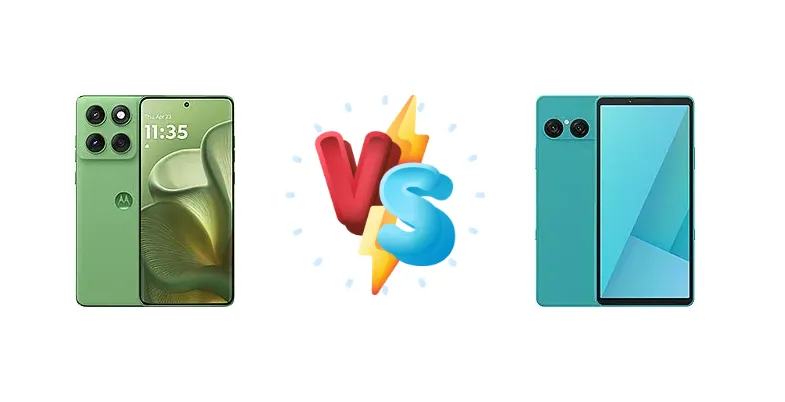
|
🏆 Quick Verdict
For users prioritizing raw performance and faster charging, the Motorola Edge 60 is the clear winner. Its Dimensity 7300 (or 7400 in India) delivers a noticeable speed advantage. However, the Sony Xperia 10 VII excels in battery endurance and offers a higher cycle count, making it ideal for users who value long-term reliability.
| PHONES | ||
|---|---|---|
| Phone Names | Motorola Edge 60 | Sony Xperia 10 VII |
| Network | ||
|---|---|---|
| 2G bands | GSM 850 / 900 / 1800 / 1900 | GSM 850 / 900 / 1800 / 1900 |
| 3G bands | HSDPA 850 / 900 / 1700(AWS) / 1900 / 2100 | HSDPA 850 / 900 / 1700(AWS) / 2100 |
| 4G bands | 1, 2, 3, 4, 5, 7, 8, 12, 13, 17, 18, 19, 20, 25, 26, 28, 32, 34, 38, 39, 40, 41, 42, 43, 48, 66 | 1, 3, 4, 5, 7, 8, 20, 28, 38, 39, 40, 41 |
| 5G bands | 1, 2, 3, 5, 7, 8, 20, 26, 28, 38, 40, 41, 66, 75, 77, 78 SA/NSA/Sub6 | 1, 3, 5, 7, 8, 20, 28, 38, 40, 41, 77, 78, 79 SA/NSA/Sub6 |
| Speed | HSPA, LTE, 5G | HSPA, LTE, 5G |
| Technology | GSM / HSPA / LTE / 5G | GSM / HSPA / LTE / 5G |
| Launch | ||
|---|---|---|
| Announced | 2025, April 24 | 2025, September 12 |
| Status | Available. Released 2025, April 25 | Available. Released 2025, September 19 |
| Body | ||
|---|---|---|
| Build | Glass front (Gorilla Glass 7i), plastic frame, plastic back | Glass front (Gorilla Glass Victus 2), plastic frame, plastic back |
| Dimensions | 161.2 x 73.1 x 7.9 mm or 8.2 mm | 153 x 72 x 8.3 mm (6.02 x 2.83 x 0.33 in) |
| SIM | · Nano-SIM· Nano-SIM + eSIM· Nano-SIM + Nano-SIM | · Nano-SIM + eSIM· Nano-SIM + Nano-SIM |
| Weight | 179 g or 181 g (6.31 oz) | 168 g (5.93 oz) |
| Display | ||
|---|---|---|
| Protection | Corning Gorilla Glass 7i, Mohs level 4 | Corning Gorilla Glass Victus 2, Mohs level 5 |
| Resolution | 1220 x 2712 pixels, 20:9 ratio (~446 ppi density) | 1080 x 2340 pixels, 19.5:9 ratio (~422 ppi density) |
| Size | 6.67 inches, 107.4 cm2 (~91.1% screen-to-body ratio) | 6.1 inches, 91.3 cm2 (~82.9% screen-to-body ratio) |
| Type | P-OLED, 1B colors, 120Hz, 720Hz PWM, HDR10+, 4500 nits peak | OLED, 1B colors, 120Hz, HDR |
| Platform | ||
|---|---|---|
| CPU | Octa-core (4x2.5 GHz Cortex-A78 & 4x2.0 GHz Cortex-A55) - GlobalOcta-core (4x2.6 GHz Cortex-A78 & 4x2.0 GHz Cortex-A55) - India | Octa-core (4x2.4 GHz Cortex-A78 & 4x1.8 GHz Cortex-A55) |
| Chipset | Mediatek Dimensity 7300 (4 nm) - GlobalMediatek Dimensity 7400 (4 nm) - India | Qualcomm SM6475-AB Snapdragon 6 Gen 3 (4 nm) |
| GPU | Mali-G615 MC2 | Adreno 710 |
| OS | Android 15, up to 3 major Android upgrades | Android 15, upgradable to Android 16, up to 4 major Android upgrades |
| Memory | ||
|---|---|---|
| Card slot | microSDXC | microSDXC (uses shared SIM slot) |
| Internal | 256GB 8GB RAM, 256GB 12GB RAM, 512GB 8GB RAM, 512GB 12GB RAM | 128GB 8GB RAM |
| Main Camera | ||
|---|---|---|
| Dual | - | 50 MP, f/1.9, 24mm (wide), 1/1.56", PDAF, OIS 13 MP, f/2.4, 16mm, 123˚ (ultrawide), 1/3.0" |
| Features | LED flash, HDR, panorama | LED flash, HDR, panorama |
| Triple | 50 MP, f/1.8, 24mm (wide), 1/1.56", 1.0µm, multi-directional PDAF, OIS 10 MP, f2.0, 73mm (telephoto), 1/3.94", 1.0µm, PDAF, 3x optical zoom, OIS 50 MP, f/2.0, 12mm, 122˚ (ultrawide), 1/2.76", 0.64µm, PDAF | - |
| Video | 4K@30fps, 1080p@30/60/120/240fps, gyro-EIS | 4K@30fps, 1080p@30/60/120fps, gyro-EIS, OIS |
| Selfie camera | ||
|---|---|---|
| Features | HDR | HDR |
| Single | 50 MP, f/2.0, (wide), 0.64µm | 8 MP, f/2.0, 26mm (wide), 1/4.0", 1.12µm |
| Video | 4K@30fps, 1080p@30/120fps | 1080p@30fps |
| Sound | ||
|---|---|---|
| 35mm jack | No | Yes |
| Loudspeaker | Yes, with stereo speakers (with Dolby Atmos) | Yes, with stereo speakers |
| Comms | ||
|---|---|---|
| Bluetooth | Yes | 5.4, A2DP, LE |
| NFC | Yes | Yes |
| Positioning | GPS, GLONASS, GALILEO | GPS, GLONASS, GALILEO, BDS, QZSS |
| Radio | No | No |
| USB | USB Type-C 2.0, OTG | USB Type-C 2.0, OTG |
| WLAN | Wi-Fi 802.11 a/b/g/n/ac/6, dual-band | Wi-Fi 802.11 a/b/g/n/ac/6e, tri-band |
| Features | ||
|---|---|---|
| Sensors | Fingerprint (under display, optical), accelerometer, gyro, proximity, compass | Fingerprint (side-mounted), accelerometer, gyro, proximity, compass |
| Battery | ||
|---|---|---|
| Charging | 68W wired | Wired, PD, QC |
| Type | Market-dependent versions:· 5200 mAh (Global)· 5500 mAh (China, India) | 5000 mAh |
| Misc | ||
|---|---|---|
| Colors | Pantone: Gibraltar sea, Shamrock, Plum perfect | White, Turquoise, Charcoal |
| Models | XT2505-1, XT2505-4 | XQ-FE54, XQZ-CBFE, xqfe54eukcl.gc, xqfe54eukcw.gc, xqfe54eukcb.gc |
| Price | £ 299.99 / € 299.00 | $ 459.99 / £ 329.00 / € 379.00 |
| SAR EU | 0.95 W/kg (head) 1.22 W/kg (body) | - |
| EU LABEL | ||
|---|---|---|
| Battery | 58:54h endurance, 1000 cycles | 48:10h endurance, 1400 cycles |
| Energy | Class A | Class B |
| Free fall | Class B (180 falls) | Class C (90 falls) |
| Repairability | Class B | Class D |
Motorola Edge 60
- Faster processor for smoother performance
- Significantly brighter display for outdoor visibility
- 68W fast charging for quick top-ups
- Lower battery cycle count (1000)
- Shorter overall battery endurance compared to Xperia 10 VII
Sony Xperia 10 VII
- Exceptional battery endurance (48:10h)
- Industry-leading 1400 battery charge cycles
- Potentially more refined software experience (typical of Sony)
- Less powerful processor for demanding tasks
- Dimmer display compared to Motorola Edge 60
Display Comparison
The Motorola Edge 60 boasts a significantly brighter display, reaching a measured 1401 nits compared to the Xperia 10 VII’s 1064 nits. This translates to superior visibility outdoors under direct sunlight. While both utilize 4nm chipsets, the display brightness difference is a key advantage for the Edge 60. We lack panel technology details (OLED vs LCD, refresh rate) but the brightness gap is a clear win for Motorola. Bezels appear comparable based on available imagery, and color accuracy data is absent, making it difficult to assess which offers a more color-accurate experience.
Camera Comparison
Detailed camera specs are limited. However, the focus should be on the main sensors. Without knowing sensor sizes or apertures, it’s difficult to definitively declare a winner. Sony’s image processing is typically known for its natural color reproduction, while Motorola often leans towards more vibrant, saturated images. The absence of information regarding OIS (Optical Image Stabilization) is a significant omission; its presence would be a major advantage for video recording and low-light photography. We'll assume both phones have competent main cameras, but lack the high-end features found in flagship devices.
Performance
The Motorola Edge 60, equipped with the Mediatek Dimensity 7300 (Global) or 7400 (India), offers a performance edge over the Sony Xperia 10 VII’s Qualcomm Snapdragon 6 Gen 3. The Dimensity chips feature a faster core clock speed (up to 2.6 GHz in India) compared to the Snapdragon’s 2.4 GHz. Both are built on a 4nm process, ensuring good efficiency, but the architectural differences favor the Dimensity in CPU-intensive tasks. The Edge 60’s potential for smoother multitasking and gaming is higher. RAM specifications are missing, but LPDDR5X would be expected in this class, and any difference here would further widen the performance gap.
Battery Life
The Sony Xperia 10 VII distinguishes itself with a remarkable 48:10h endurance rating and an impressive 1400 charge cycles, significantly exceeding the Motorola Edge 60’s 58:54h endurance and 1000 cycles. While the Edge 60 offers faster 68W wired charging, the Xperia 10 VII’s longevity is a compelling advantage for long-term users. The Edge 60’s active use score of 13:32h is slightly better than the Xperia 10 VII’s 12:57h, but the difference is less significant than the cycle count disparity. The Xperia 10 VII’s charging standard (PD, QC) is less specific than the Edge 60’s 68W, but its overall battery health is superior.
Buying Guide
Buy the Motorola Edge 60 if you need a phone for demanding tasks like gaming or video editing, and appreciate the convenience of 68W fast charging. Buy the Sony Xperia 10 VII if you prioritize exceptional battery life, long-term durability with its 1400 charge cycles, and a more streamlined, less software-heavy Android experience.