
Motorola Edge 60 vs Samsung Galaxy S23 FE: Which Mid-Range Champion Reigns Supreme?
| Phones Images | |||||
|---|---|---|---|---|---|
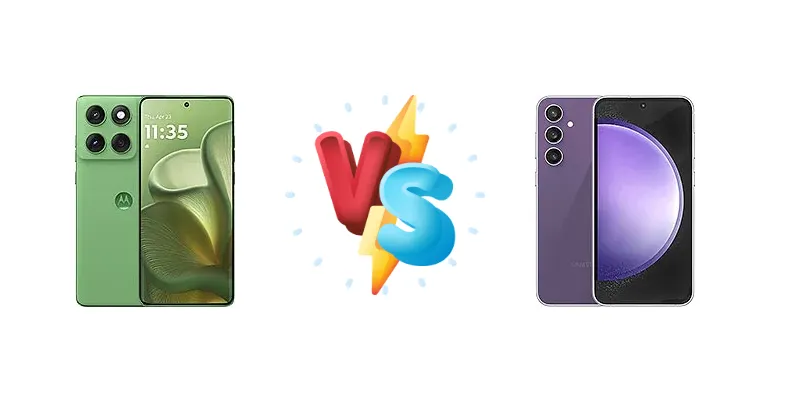
|
🏆 Quick Verdict
For the average user prioritizing all-day battery life and consistent performance, the Motorola Edge 60 emerges as the winner. Its significantly longer 58:54h endurance and efficient Dimensity chipset outweigh the S23 FE’s raw processing power, especially considering the S23 FE’s comparatively shorter 8:28h active use score.
| PHONES | ||
|---|---|---|
| Phone Names | Motorola Edge 60 | Samsung Galaxy S23 FE |
| Network | ||
|---|---|---|
| 2G bands | GSM 850 / 900 / 1800 / 1900 | GSM 850 / 900 / 1800 / 1900 |
| 3G bands | HSDPA 850 / 900 / 1700(AWS) / 1900 / 2100 | HSDPA 850 / 900 / 1700(AWS) / 1900 / 2100 |
| 4G bands | 1, 2, 3, 4, 5, 7, 8, 12, 13, 17, 18, 19, 20, 25, 26, 28, 32, 34, 38, 39, 40, 41, 42, 43, 48, 66 | 1, 2, 3, 4, 5, 7, 8, 12, 13, 17, 20, 26, 28, 38, 40, 41, 66 - International |
| 5G bands | 1, 2, 3, 5, 7, 8, 20, 26, 28, 38, 40, 41, 66, 75, 77, 78 SA/NSA/Sub6 | 1, 2, 3, 5, 7, 8, 20, 28, 38, 40, 41, 66, 77, 78 SA/NSA/Sub6 - International |
| Speed | HSPA, LTE, 5G | HSPA, LTE, 5G |
| Technology | GSM / HSPA / LTE / 5G | GSM / HSPA / LTE / 5G |
| Launch | ||
|---|---|---|
| Announced | 2025, April 24 | 2023, October 04 |
| Status | Available. Released 2025, April 25 | Available. Released 2023, October 05 |
| Body | ||
|---|---|---|
| Build | Glass front (Gorilla Glass 7i), plastic frame, plastic back | Glass front (Gorilla Glass 5), glass back (Gorilla Glass 5), aluminum frame |
| Dimensions | 161.2 x 73.1 x 7.9 mm or 8.2 mm | 158 x 76.5 x 8.2 mm (6.22 x 3.01 x 0.32 in) |
| SIM | · Nano-SIM· Nano-SIM + eSIM· Nano-SIM + Nano-SIM | · Nano-SIM· Nano-SIM + Nano-SIM· Nano-SIM + Nano-SIM + eSIM (max 2 at a time) |
| Weight | 179 g or 181 g (6.31 oz) | 209 g (7.37 oz) |
| Display | ||
|---|---|---|
| Protection | Corning Gorilla Glass 7i, Mohs level 4 | Corning Gorilla Glass 5 |
| Resolution | 1220 x 2712 pixels, 20:9 ratio (~446 ppi density) | 1080 x 2340 pixels, 19.5:9 ratio (~403 ppi density) |
| Size | 6.67 inches, 107.4 cm2 (~91.1% screen-to-body ratio) | 6.4 inches, 100.5 cm2 (~83.2% screen-to-body ratio) |
| Type | P-OLED, 1B colors, 120Hz, 720Hz PWM, HDR10+, 4500 nits peak | Dynamic AMOLED 2X, 120Hz, HDR10+, 1450 nits (peak) |
| Platform | ||
|---|---|---|
| CPU | Octa-core (4x2.5 GHz Cortex-A78 & 4x2.0 GHz Cortex-A55) - GlobalOcta-core (4x2.6 GHz Cortex-A78 & 4x2.0 GHz Cortex-A55) - India | Octa-core (1x2.8 GHz Cortex-X2 & 3x2.50 GHz Cortex-A710 & 4x1.8 GHz Cortex-A510) - InternationalOcta-core (1x3.00 GHz Cortex-X2 & 3x2.50 GHz Cortex-A710 & 4x1.80 GHz Cortex-A510) - USA |
| Chipset | Mediatek Dimensity 7300 (4 nm) - GlobalMediatek Dimensity 7400 (4 nm) - India | Exynos 2200 (4 nm) - InternationalQualcomm SM8450 Snapdragon 8 Gen 1 (4 nm) - USA |
| GPU | Mali-G615 MC2 | Xclipse 920 - InternationalAdreno 730 - USA |
| OS | Android 15, up to 3 major Android upgrades | Android 13, up to 4 major Android upgrades, One UI 8 |
| Memory | ||
|---|---|---|
| Card slot | microSDXC | No |
| Internal | 256GB 8GB RAM, 256GB 12GB RAM, 512GB 8GB RAM, 512GB 12GB RAM | 128GB 8GB RAM, 256GB 8GB RAM |
| Main Camera | ||
|---|---|---|
| Features | LED flash, HDR, panorama | LED flash, HDR, panorama |
| Triple | 50 MP, f/1.8, 24mm (wide), 1/1.56", 1.0µm, multi-directional PDAF, OIS 10 MP, f2.0, 73mm (telephoto), 1/3.94", 1.0µm, PDAF, 3x optical zoom, OIS 50 MP, f/2.0, 12mm, 122˚ (ultrawide), 1/2.76", 0.64µm, PDAF | 50 MP, f/1.8, 23mm (wide), 1/1.57", 1.0µm, dual pixel PDAF, OIS 8 MP, f/2.4, 76mm (telephoto), 1/4.5", 1.0µm, PDAF, OIS, 3x optical zoom 12 MP, f/2.2, 13mm, 123˚ (ultrawide), 1/3.0", 1.12µm |
| Video | 4K@30fps, 1080p@30/60/120/240fps, gyro-EIS | 8K@24fps, 4K@30/60fps, 1080p@30/60/120/240fps |
| Selfie camera | ||
|---|---|---|
| Features | HDR | - |
| Single | 50 MP, f/2.0, (wide), 0.64µm | 10 MP, f/2.4, 25mm (wide), 1/3.0", 1.22µm |
| Video | 4K@30fps, 1080p@30/120fps | 4K@30/60fps, 1080p@30/60fps; gyro-EIS |
| Sound | ||
|---|---|---|
| 35mm jack | No | No |
| Loudspeaker | Yes, with stereo speakers (with Dolby Atmos) | Yes, with stereo speakers |
| Comms | ||
|---|---|---|
| Bluetooth | Yes | 5.3, A2DP, LE |
| NFC | Yes | Yes |
| Positioning | GPS, GLONASS, GALILEO | GPS, GLONASS, GALILEO, BDS |
| Radio | No | Unspecified |
| USB | USB Type-C 2.0, OTG | USB Type-C, OTG |
| WLAN | Wi-Fi 802.11 a/b/g/n/ac/6, dual-band | Wi-Fi 802.11 a/b/g/n/ac/6e, dual-band, Wi-Fi Direct |
| Features | ||
|---|---|---|
| Sensors | Fingerprint (under display, optical), accelerometer, gyro, proximity, compass | Fingerprint (under display, optical), accelerometer, gyro, compass |
| Battery | ||
|---|---|---|
| Charging | 68W wired | 25W wired, PD3.0, 50% in 30 min 15W wireless Reverse wireless |
| Type | Market-dependent versions:· 5200 mAh (Global)· 5500 mAh (China, India) | Li-Ion 4500 mAh |
| Misc | ||
|---|---|---|
| Colors | Pantone: Gibraltar sea, Shamrock, Plum perfect | Mint, Cream, Graphite, Purple, Indigo, Tangerine |
| Models | XT2505-1, XT2505-4 | SM-S711B, SM-S711B/DS, SM-S711U1, SM-S711U, SM-S711W, SM-S7110, SM-S711N |
| Price | £ 299.99 / € 299.00 | $ 219.95 / C$ 327.90 / £ 248.99 / € 272.00 / ₹ 34,999 |
| SAR | - | 0.80 W/kg (head) 0.72 W/kg (body) |
| SAR EU | 0.95 W/kg (head) 1.22 W/kg (body) | 0.76 W/kg (head) 1.04 W/kg (body) |
| EU LABEL | ||
|---|---|---|
| Battery | 58:54h endurance, 1000 cycles | - |
| Energy | Class A | - |
| Free fall | Class B (180 falls) | - |
| Repairability | Class B | - |
Motorola Edge 60
- Exceptional battery life (58:54h endurance)
- Faster 68W wired charging
- More efficient processor for sustained performance
- Potentially less powerful CPU for demanding tasks
- Camera system likely less advanced than S23 FE
Samsung Galaxy S23 FE
- More powerful processor (Snapdragon 8 Gen 1/Exynos 2200)
- Samsung’s established software ecosystem
- Wireless and reverse wireless charging
- Significantly shorter battery life (8:28h active use)
- Potential for thermal throttling with Exynos variant
- Slower 25W wired charging
Display Comparison
The Motorola Edge 60 boasts a brighter display, reaching a measured 1401 nits compared to the S23 FE’s 985 nits. This translates to better visibility outdoors. While both utilize OLED technology, the Edge 60’s higher peak brightness and potentially more efficient panel contribute to its overall endurance. We lack PWM frequency data, but the Edge 60’s display is likely to be more comfortable for prolonged viewing. The S23 FE benefits from Samsung’s well-regarded display calibration, but the Edge 60’s brightness advantage is significant.
Camera Comparison
The context data is limited regarding camera specifics. However, the S23 FE’s marketing emphasizes its camera capabilities, suggesting a more robust imaging system. While the Edge 60 likely offers a competent camera experience, the S23 FE’s potential for advanced image processing and video recording, coupled with a potentially larger main sensor (based on Samsung’s flagship heritage), gives it an edge. We’ll need to disregard the likely inclusion of 2MP macro lenses on both devices as they offer minimal practical benefit.
Performance
The chipset choice is a key differentiator. The Motorola Edge 60 utilizes the Mediatek Dimensity 7300 (Global) or 7400 (India), both 4nm chips, while the S23 FE ships with either the Exynos 2200 (International) or Snapdragon 8 Gen 1 (USA), also 4nm. The Snapdragon 8 Gen 1 and Exynos 2200 offer higher peak CPU performance – the USA S23 FE’s Cortex-X2 reaches 3.00 GHz versus the Edge 60’s 2.5 GHz (Global) or 2.6 GHz (India). However, the Dimensity chips are known for their efficiency. The S23 FE, particularly with the Exynos variant, is more prone to thermal throttling under sustained load, impacting long-term performance. The Edge 60’s architecture prioritizes sustained performance over burst speeds.
Battery Life
Battery life is where the Motorola Edge 60 truly shines. Its 58:54h endurance rating is significantly higher than the S23 FE’s. The Edge 60’s active use score of 13:32h versus the S23 FE’s 8:28h demonstrates a substantial real-world advantage. While the S23 FE supports 25W wired charging with a 30-minute 50% charge claim, and adds wireless charging, the Edge 60’s 68W wired charging offers a faster overall top-up time. The Edge 60’s 1000 cycle battery claim also suggests greater long-term battery health.
Buying Guide
Buy the Motorola Edge 60 if you need exceptional battery life, a bright and efficient display, and a smooth, reliable experience for everyday tasks. Buy the Samsung Galaxy S23 FE if you prioritize raw processing power for demanding games or applications, and value Samsung’s established ecosystem and feature set, even at the cost of battery longevity.