
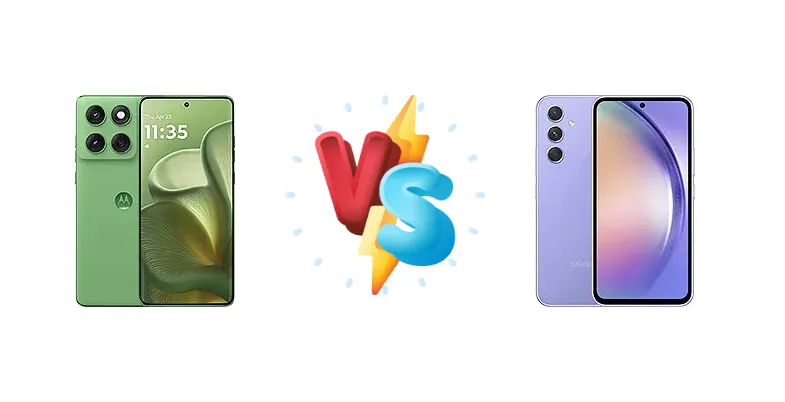
Motorola Edge 60 vs Samsung Galaxy A54: Which Mid-Range Phone Reigns Supreme?
| Phones Images | |||||
|---|---|---|---|---|---|
|
🏆 Quick Verdict
For users prioritizing raw performance and faster charging, the Motorola Edge 60 is the clear winner. Its Dimensity 7300/7400 chipset and 68W charging significantly outperform the Galaxy A54’s Exynos 1380 and 25W charging. However, Samsung’s software and established brand reputation may appeal to a broader audience.
| PHONES | ||
|---|---|---|
| Phone Names | Motorola Edge 60 | Samsung Galaxy A54 |
| Network | ||
|---|---|---|
| 2G bands | GSM 850 / 900 / 1800 / 1900 | GSM 850 / 900 / 1800 / 1900 |
| 3G bands | HSDPA 850 / 900 / 1700(AWS) / 1900 / 2100 | HSDPA 850 / 900 / 1700(AWS) / 1900 / 2100 |
| 4G bands | 1, 2, 3, 4, 5, 7, 8, 12, 13, 17, 18, 19, 20, 25, 26, 28, 32, 34, 38, 39, 40, 41, 42, 43, 48, 66 | 1, 2, 3, 4, 5, 7, 8, 12, 17, 20, 26, 28, 32, 38, 40, 41, 66 - International |
| 5G bands | 1, 2, 3, 5, 7, 8, 20, 26, 28, 38, 40, 41, 66, 75, 77, 78 SA/NSA/Sub6 | 1, 3, 7, 8, 20, 28, 38, 40, 41, 77, 78 SA/NSA/Sub6 - International |
| Speed | HSPA, LTE, 5G | HSPA, LTE, 5G |
| Technology | GSM / HSPA / LTE / 5G | GSM / HSPA / LTE / 5G |
| - | 25, 41, 66, 71 SA/NSA/Sub6/mmWave - USA | |
| Launch | ||
|---|---|---|
| Announced | 2025, April 24 | 2023, March 15 |
| Status | Available. Released 2025, April 25 | Available. Released 2023, March 24 |
| Body | ||
|---|---|---|
| Build | Glass front (Gorilla Glass 7i), plastic frame, plastic back | Glass front (Gorilla Glass 5), glass back (Gorilla Glass 5), plastic frame |
| Dimensions | 161.2 x 73.1 x 7.9 mm or 8.2 mm | 158.2 x 76.7 x 8.2 mm (6.23 x 3.02 x 0.32 in) |
| SIM | · Nano-SIM· Nano-SIM + eSIM· Nano-SIM + Nano-SIM | · Nano-SIM + eSIM· Nano-SIM + Nano-SIM |
| Weight | 179 g or 181 g (6.31 oz) | 202 g (7.13 oz) |
| - | IP67 dust/water resistant (up to 1m for 30 min) | |
| Display | ||
|---|---|---|
| Protection | Corning Gorilla Glass 7i, Mohs level 4 | Corning Gorilla Glass 5 |
| Resolution | 1220 x 2712 pixels, 20:9 ratio (~446 ppi density) | 1080 x 2340 pixels, 19.5:9 ratio (~403 ppi density) |
| Size | 6.67 inches, 107.4 cm2 (~91.1% screen-to-body ratio) | 6.4 inches, 100.5 cm2 (~82.9% screen-to-body ratio) |
| Type | P-OLED, 1B colors, 120Hz, 720Hz PWM, HDR10+, 4500 nits peak | Super AMOLED, 120Hz, HDR10+, 1000 nits (HBM) |
| Platform | ||
|---|---|---|
| CPU | Octa-core (4x2.5 GHz Cortex-A78 & 4x2.0 GHz Cortex-A55) - GlobalOcta-core (4x2.6 GHz Cortex-A78 & 4x2.0 GHz Cortex-A55) - India | Octa-core (4x2.4 GHz Cortex-A78 & 4x2.0 GHz Cortex-A55) |
| Chipset | Mediatek Dimensity 7300 (4 nm) - GlobalMediatek Dimensity 7400 (4 nm) - India | Exynos 1380 (5 nm) |
| GPU | Mali-G615 MC2 | Mali-G68 MP5 |
| OS | Android 15, up to 3 major Android upgrades | Android 13, up to 4 major Android upgrades, One UI 7 |
| Memory | ||
|---|---|---|
| Card slot | microSDXC | microSDXC (uses shared SIM slot) |
| Internal | 256GB 8GB RAM, 256GB 12GB RAM, 512GB 8GB RAM, 512GB 12GB RAM | 128GB 4GB RAM, 128GB 6GB RAM, 128GB 8GB RAM, 256GB 6GB RAM, 256GB 8GB RAM |
| Main Camera | ||
|---|---|---|
| Features | LED flash, HDR, panorama | LED flash, panorama, HDR |
| Single | - | 32 MP, f/2.2, 26mm (wide), 1/2.8", 0.8µm |
| Triple | 50 MP, f/1.8, 24mm (wide), 1/1.56", 1.0µm, multi-directional PDAF, OIS 10 MP, f2.0, 73mm (telephoto), 1/3.94", 1.0µm, PDAF, 3x optical zoom, OIS 50 MP, f/2.0, 12mm, 122˚ (ultrawide), 1/2.76", 0.64µm, PDAF | 50 MP, f/1.8, 23mm (wide), 1/1.56", 1.0µm, PDAF, OIS 12 MP, f/2.2, 13mm, 123˚ (ultrawide), 1/3.X", 1.12µm 5 MP (macro) |
| Video | 4K@30fps, 1080p@30/60/120/240fps, gyro-EIS | 4K@30fps, 1080p@30/60fps, 720p@480fps, gyro-EIS |
| Selfie camera | ||
|---|---|---|
| Features | HDR | - |
| Single | 50 MP, f/2.0, (wide), 0.64µm | 32 MP, f/2.2, 26mm (wide), 1/2.8", 0.8µm |
| Video | 4K@30fps, 1080p@30/120fps | 4K@30fps, 1080p@30/60fps |
| Sound | ||
|---|---|---|
| 3.5mm jack | - | No |
| 35mm jack | No | No |
| Loudspeaker | Yes, with stereo speakers (with Dolby Atmos) | Yes, with stereo speakers |
| Comms | ||
|---|---|---|
| Bluetooth | Yes | 5.3, A2DP, LE |
| NFC | Yes | Yes (market/region dependent) |
| Positioning | GPS, GLONASS, GALILEO | GPS, GLONASS, GALILEO, BDS |
| Radio | No | No |
| USB | USB Type-C 2.0, OTG | USB Type-C 2.0, OTG |
| WLAN | Wi-Fi 802.11 a/b/g/n/ac/6, dual-band | Wi-Fi 802.11 a/b/g/n/ac/6, dual-band, Wi-Fi Direct |
| Features | ||
|---|---|---|
| Sensors | Fingerprint (under display, optical), accelerometer, gyro, proximity, compass | Fingerprint (under display, optical), accelerometer, gyro, compass, barometer (USA only) |
| - | Virtual proximity sensing | |
| Battery | ||
|---|---|---|
| Charging | 68W wired | 25W wired |
| Type | Market-dependent versions:· 5200 mAh (Global)· 5500 mAh (China, India) | 5000 mAh |
| Misc | ||
|---|---|---|
| Colors | Pantone: Gibraltar sea, Shamrock, Plum perfect | Lime, Graphite, Violet, White |
| Models | XT2505-1, XT2505-4 | SM-A546V, SM-A546U, SM-A546U1, SM-A546B, SM-A546B/DS, SM-A546E, SM-A546E/DS, SM-A5460, SM-A546M, SM-A546M/DS, SM-A546W |
| Price | £ 299.99 / € 299.00 | € 210.00 / $ 119.11 / £ 169.95 / ₹ 28,999 |
| SAR | - | 0.81 W/kg (head) 0.67 W/kg (body) |
| SAR EU | 0.95 W/kg (head) 1.22 W/kg (body) | 0.69 W/kg (head) 1.34 W/kg (body) |
| Tests | ||
|---|---|---|
| Battery life | - | Endurance rating 119h |
| Camera | - | Photo / Video |
| Display | - | Contrast ratio: Infinite (nominal) |
| Loudspeaker | - | -26.6 LUFS (Good) |
| Performance | - | AnTuTu: 506678 (v9) GeekBench: 2703 (v5.1), 2797 (v6) GFXBench: 25fps (ES 3.1 onscreen) |
| EU LABEL | ||
|---|---|---|
| Battery | 58:54h endurance, 1000 cycles | - |
| Energy | Class A | - |
| Free fall | Class B (180 falls) | - |
| Repairability | Class B | - |
Motorola Edge 60
- Faster processor (Dimensity 7300/7400)
- Significantly faster charging (68W)
- Brighter display (1401 nits)
- Motorola’s software update commitment is less certain than Samsung’s
- Camera details are currently limited
Samsung Galaxy A54
- Polished and feature-rich Samsung One UI software
- Strong brand reputation and software support
- Likely excellent camera image processing
- Slower processor (Exynos 1380)
- Slower charging (25W)
- Dimmer display (980 nits)
Display Comparison
The Motorola Edge 60 boasts a significantly brighter display, reaching a measured 1401 nits compared to the Galaxy A54’s 980 nits. This translates to superior visibility outdoors under direct sunlight. While both displays feature an 'infinite' contrast ratio (typical for OLED panels), the Edge 60’s higher peak brightness is a tangible advantage. The A54’s display, while excellent, will appear comparatively dimmer in bright environments. We lack PWM frequency data for both, but the Edge 60’s higher brightness may allow for a lower PWM frequency to achieve similar perceived brightness, potentially reducing eye strain.
Camera Comparison
Both phones offer capable camera systems, but detailed sensor information beyond 'Photo/Video' is missing for the A54. The Galaxy A54 likely relies on Samsung’s established image processing algorithms, known for vibrant colors and pleasing results. The Edge 60’s camera performance will depend heavily on its sensor size and image processing pipeline, which are currently unknown. Without specific details, it’s difficult to definitively declare a winner, but Samsung’s history suggests a more refined and consistent camera experience. The A54’s inclusion of OIS (Optical Image Stabilization) is a likely advantage for video recording and low-light photography.
Performance
The Motorola Edge 60, depending on the region, utilizes either the Mediatek Dimensity 7300 (Global) or the Dimensity 7400 (India), both fabricated on a 4nm process. This contrasts with the Samsung Galaxy A54’s Exynos 1380, built on a 5nm node. Despite the smaller node size of the Exynos, the Dimensity 7300/7400’s CPU – featuring faster Cortex-A78 cores clocked at 2.5/2.6 GHz versus the A54’s 2.4 GHz – provides a noticeable performance edge. The 4nm process also contributes to better thermal efficiency, potentially leading to sustained performance during extended gaming sessions. The A54’s GPU is capable, but the Edge 60 will likely deliver higher frame rates in graphically intensive titles.
Battery Life
The Motorola Edge 60 claims an impressive 58:54h endurance rating and a 13:32h active use score, while the Galaxy A54 has an active use score of 11:15h and an endurance rating of 119h. While the endurance rating is a broad metric, the active use score provides a more realistic comparison. The Edge 60’s superior score suggests better real-world battery life despite a potentially smaller battery capacity (not specified). Crucially, the Edge 60 supports 68W wired charging, significantly faster than the A54’s 25W charging. This means the Edge 60 can replenish its battery much more quickly, mitigating any potential capacity differences.
Buying Guide
Buy the Motorola Edge 60 if you need a phone that can handle demanding tasks like gaming and video editing with ease, and if fast charging is a priority. You’ll benefit from the more powerful processor and quicker top-ups. Buy the Samsung Galaxy A54 if you prefer a polished software experience, a well-regarded camera system, and a brand with a strong track record for software updates and support. It’s the safer, more predictable choice for the average user.