
Motorola Edge 60 vs Oppo Reno10 Pro: A Detailed Comparison of Mid-Range Powerhouses
| Phones Images | |||||
|---|---|---|---|---|---|
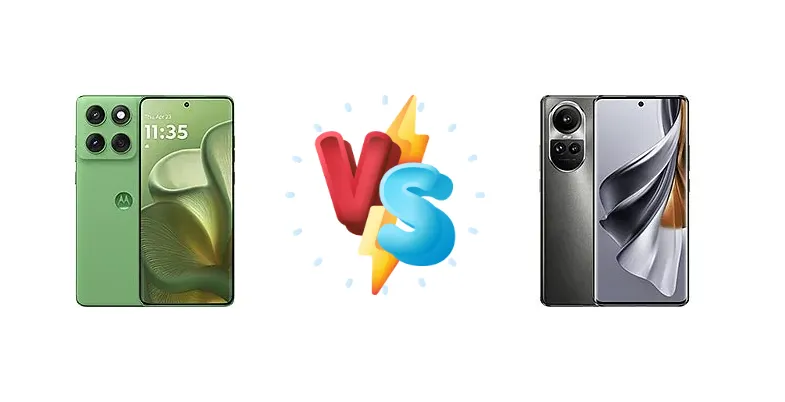
|
🏆 Quick Verdict
For most users, the Motorola Edge 60 emerges as the stronger contender. Its brighter 1401-nit display and more powerful Dimensity 7300/7400 chipset (depending on region) provide a noticeable performance edge. While the Reno10 Pro boasts faster 80W charging, the Edge 60’s endurance and processing power make it the better all-around choice.
| PHONES | ||
|---|---|---|
| Phone Names | Motorola Edge 60 | Oppo Reno10 Pro |
| Network | ||
|---|---|---|
| 2G bands | GSM 850 / 900 / 1800 / 1900 | GSM 850 / 900 / 1800 / 1900 |
| 3G bands | HSDPA 850 / 900 / 1700(AWS) / 1900 / 2100 | HSDPA 800 / 850 / 900 / 1700(AWS) / 1900 / 2100 - International |
| 4G bands | 1, 2, 3, 4, 5, 7, 8, 12, 13, 17, 18, 19, 20, 25, 26, 28, 32, 34, 38, 39, 40, 41, 42, 43, 48, 66 | 1, 2, 3, 4, 5, 7, 8, 12, 17, 18, 19, 20, 26, 28, 38, 39, 40, 41, 66 - International |
| 5G bands | 1, 2, 3, 5, 7, 8, 20, 26, 28, 38, 40, 41, 66, 75, 77, 78 SA/NSA/Sub6 | 1, 2, 3, 5, 7, 8, 12, 20, 28, 38, 40, 41, 77, 78 SA/NSA - International |
| Speed | HSPA, LTE, 5G | HSPA, LTE, 5G |
| Technology | GSM / HSPA / LTE / 5G | GSM / HSPA / LTE / 5G |
| Launch | ||
|---|---|---|
| Announced | 2025, April 24 | 2023, July 08 |
| Status | Available. Released 2025, April 25 | Available. Released 2023, July 13 |
| Body | ||
|---|---|---|
| Build | Glass front (Gorilla Glass 7i), plastic frame, plastic back | Glass front, plastic frame, glass back |
| Dimensions | 161.2 x 73.1 x 7.9 mm or 8.2 mm | 162.3 x 74.2 x 7.9 mm (6.39 x 2.92 x 0.31 in) |
| SIM | · Nano-SIM· Nano-SIM + eSIM· Nano-SIM + Nano-SIM | Nano-SIM + Nano-SIM |
| Weight | 179 g or 181 g (6.31 oz) | 185 g (6.53 oz) |
| Display | ||
|---|---|---|
| Protection | Corning Gorilla Glass 7i, Mohs level 4 | Asahi Glass AGC DT-Star2 |
| Resolution | 1220 x 2712 pixels, 20:9 ratio (~446 ppi density) | 1080 x 2412 pixels, 20:9 ratio (~394 ppi density) |
| Size | 6.67 inches, 107.4 cm2 (~91.1% screen-to-body ratio) | 6.7 inches, 108.0 cm2 (~89.7% screen-to-body ratio) |
| Type | P-OLED, 1B colors, 120Hz, 720Hz PWM, HDR10+, 4500 nits peak | AMOLED, 1B colors, 120Hz, HDR10+, 500 nits (typ), 800 nits (HBM), 950 nits (peak) |
| Platform | ||
|---|---|---|
| CPU | Octa-core (4x2.5 GHz Cortex-A78 & 4x2.0 GHz Cortex-A55) - GlobalOcta-core (4x2.6 GHz Cortex-A78 & 4x2.0 GHz Cortex-A55) - India | Octa-core (1x2.4 GHz Cortex-A78 & 3x2.2 GHz Cortex-A78 & 4x1.9 GHz Cortex-A55) |
| Chipset | Mediatek Dimensity 7300 (4 nm) - GlobalMediatek Dimensity 7400 (4 nm) - India | Qualcomm SM7325 Snapdragon 778G 5G (6 nm) |
| GPU | Mali-G615 MC2 | Adreno 642L |
| OS | Android 15, up to 3 major Android upgrades | Android 13, upgradable to Android 15, ColorOS 15 |
| Memory | ||
|---|---|---|
| Card slot | microSDXC | No |
| Internal | 256GB 8GB RAM, 256GB 12GB RAM, 512GB 8GB RAM, 512GB 12GB RAM | 256GB 8GB RAM, 256GB 12GB RAM |
| Main Camera | ||
|---|---|---|
| Features | LED flash, HDR, panorama | LED flash, HDR, panorama |
| Triple | 50 MP, f/1.8, 24mm (wide), 1/1.56", 1.0µm, multi-directional PDAF, OIS 10 MP, f2.0, 73mm (telephoto), 1/3.94", 1.0µm, PDAF, 3x optical zoom, OIS 50 MP, f/2.0, 12mm, 122˚ (ultrawide), 1/2.76", 0.64µm, PDAF | 50 MP, f/1.8, 24mm (wide), 1/1.56", 1.0µm, multi-directional PDAF, OIS 32 MP, f/2.0, 47mm (telephoto), 1/2.74", 0.8µm, PDAF, 2x optical zoom 8 MP, f/2.2, 112˚ (ultrawide), 1/4.0", 1.12µm |
| Video | 4K@30fps, 1080p@30/60/120/240fps, gyro-EIS | 4K@30fps, 1080p@30/60/120/480fps, gyro-EIS, HDR, OIS |
| Selfie camera | ||
|---|---|---|
| Features | HDR | Panorama, HDR |
| Single | 50 MP, f/2.0, (wide), 0.64µm | 32 MP, f/2.4, 22mm (wide), 1/2.74", 0.8µm, AF |
| Video | 4K@30fps, 1080p@30/120fps | 1080p@30fps, gyro-EIS |
| Sound | ||
|---|---|---|
| 35mm jack | No | No |
| Loudspeaker | Yes, with stereo speakers (with Dolby Atmos) | Yes |
| Comms | ||
|---|---|---|
| Bluetooth | Yes | 5.2, A2DP, LE, aptX HD |
| Infrared port | - | Yes |
| NFC | Yes | Yes |
| Positioning | GPS, GLONASS, GALILEO | GPS, GLONASS, GALILEO, BDS, QZSS |
| Radio | No | No |
| USB | USB Type-C 2.0, OTG | USB Type-C 2.0, OTG |
| WLAN | Wi-Fi 802.11 a/b/g/n/ac/6, dual-band | Wi-Fi 802.11 a/b/g/n/ac/6, dual-band, Wi-Fi Direct |
| Features | ||
|---|---|---|
| Sensors | Fingerprint (under display, optical), accelerometer, gyro, proximity, compass | Fingerprint (under display, optical), accelerometer, gyro, proximity, compass |
| Battery | ||
|---|---|---|
| Charging | 68W wired | 80W wired, PD3.0, QC3 Reverse wired |
| Type | Market-dependent versions:· 5200 mAh (Global)· 5500 mAh (China, India) | Li-Po 4600 mAh |
| Misc | ||
|---|---|---|
| Colors | Pantone: Gibraltar sea, Shamrock, Plum perfect | Silvery Grey, Glossy Purple |
| Models | XT2505-1, XT2505-4 | CPH2525 |
| Price | £ 299.99 / € 299.00 | € 229.99 / ₹ 31,999 |
| SAR EU | 0.95 W/kg (head) 1.22 W/kg (body) | - |
| EU LABEL | ||
|---|---|---|
| Battery | 58:54h endurance, 1000 cycles | - |
| Energy | Class A | - |
| Free fall | Class B (180 falls) | - |
| Repairability | Class B | - |
Motorola Edge 60
- Brighter display for outdoor use
- More powerful processor for gaming and multitasking
- Longer battery endurance
- Charging speed slightly slower than Oppo
- Camera performance unknown based on provided data
Oppo Reno10 Pro
- Faster 80W charging with multiple protocols
- Potentially refined camera experience (based on brand reputation)
- More power-efficient chipset for light tasks
- Dimmer display
- Older and less powerful processor
- Shorter battery life
Display Comparison
The Motorola Edge 60’s display significantly outshines the Oppo Reno10 Pro in terms of peak brightness, reaching a measured 1401 nits compared to the Reno10 Pro’s 793 nits. This makes the Edge 60 far more usable in direct sunlight. While both likely employ OLED panels, the lack of information regarding refresh rates or PWM dimming frequencies prevents a complete assessment. The higher brightness of the Edge 60 is a clear advantage for outdoor visibility and HDR content consumption.
Camera Comparison
The provided data offers limited insight into the camera capabilities of either device, with the Reno10 Pro simply stating 'Photo / Video'. Without sensor size, aperture details, or image processing specifics, a direct comparison is difficult. However, Oppo generally focuses on camera performance, suggesting the Reno10 Pro may offer a more polished camera experience. The Edge 60’s camera performance remains an unknown quantity based on this data. We can assume both phones will have a standard array of lenses, but the quality will depend on the underlying hardware and software optimization.
Performance
The Motorola Edge 60, particularly the Indian variant, boasts a more potent processor. The Dimensity 7400 (India) and 7300 (Global) are built on a 4nm process, offering improved efficiency and performance compared to the Oppo Reno10 Pro’s 6nm Snapdragon 778G 5G. The Dimensity chipsets feature a more modern CPU architecture with faster Cortex-A78 cores (2.6 GHz vs 2.4 GHz), translating to quicker app loading times and smoother multitasking. The Snapdragon 778G, while capable, is a generation older and will likely show its age in demanding scenarios. The Edge 60’s chipset advantage is particularly relevant for gamers and power users.
Battery Life
The Motorola Edge 60 demonstrates superior battery endurance with a reported 58:54h endurance rating and 13:32h of active use, compared to the Reno10 Pro’s 11:05h of active use and older 104h endurance rating. While the Reno10 Pro compensates with 80W wired charging (including PD3.0 and QC3, plus reverse wired charging), the Edge 60’s 68W charging is still respectable. The Edge 60’s longer endurance suggests it can comfortably last a full day of moderate to heavy use, while the Reno10 Pro may require more frequent top-ups despite its faster charging.
Buying Guide
Buy the Motorola Edge 60 if you prioritize display brightness, gaming performance, and future-proofing with a newer chipset. It’s ideal for users who consume a lot of media outdoors or enjoy demanding mobile games. Buy the Oppo Reno10 Pro if you value fast charging, a potentially more refined camera experience (though details are limited in the provided data), and a slightly more power-efficient chipset for everyday tasks.