
Motorola Edge 60 vs. Nothing Phone (2): A Deep Dive Comparison
| Phones Images | |||||
|---|---|---|---|---|---|
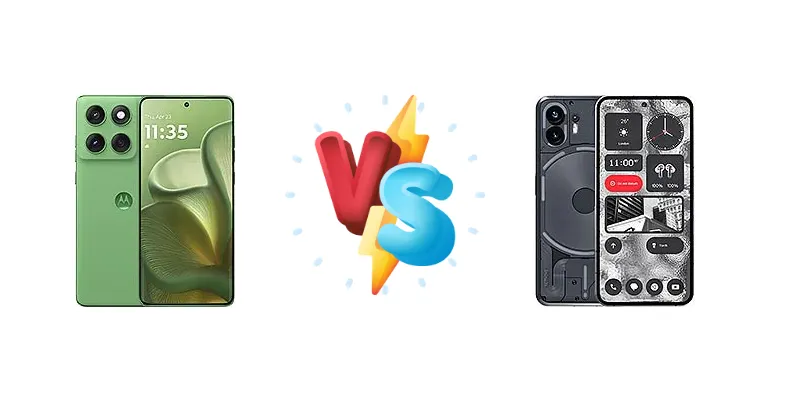
|
🏆 Quick Verdict
For most users, the Nothing Phone (2) is the stronger choice. Its Snapdragon 8+ Gen 1 chipset delivers noticeably superior performance, and its active use battery score of 14:21h is slightly better than the Edge 60’s 13:32h. While the Edge 60 offers faster wired charging, the overall package of the Nothing Phone (2) provides a more premium experience.
| PHONES | ||
|---|---|---|
| Phone Names | Motorola Edge 60 | Nothing Phone (2) |
| Network | ||
|---|---|---|
| 2G bands | GSM 850 / 900 / 1800 / 1900 | GSM 850 / 900 / 1800 / 1900 |
| 3G bands | HSDPA 850 / 900 / 1700(AWS) / 1900 / 2100 | HSDPA 800 / 850 / 900 / 1700(AWS) / 1900 / 2100 |
| 4G bands | 1, 2, 3, 4, 5, 7, 8, 12, 13, 17, 18, 19, 20, 25, 26, 28, 32, 34, 38, 39, 40, 41, 42, 43, 48, 66 | 1, 2, 3, 4, 5, 7, 8, 12, 17, 18, 19, 20, 25, 26, 28, 30, 32, 34, 38, 39, 40, 41, 42, 48, 66, 71 |
| 5G bands | 1, 2, 3, 5, 7, 8, 20, 26, 28, 38, 40, 41, 66, 75, 77, 78 SA/NSA/Sub6 | 1, 2, 3, 5, 7, 8, 12, 20, 25, 28, 30, 38, 40, 41, 66, 71, 75, 77, 78 SA/NSA |
| Speed | HSPA, LTE, 5G | HSPA, LTE, 5G |
| Technology | GSM / HSPA / LTE / 5G | GSM / HSPA / LTE / 5G |
| Launch | ||
|---|---|---|
| Announced | 2025, April 24 | 2023, July 11 |
| Status | Available. Released 2025, April 25 | Available. Released 2023, July 17 |
| Body | ||
|---|---|---|
| Build | Glass front (Gorilla Glass 7i), plastic frame, plastic back | Glass front (Gorilla Glass 5), glass back (Gorilla Glass 5), aluminum frame |
| Dimensions | 161.2 x 73.1 x 7.9 mm or 8.2 mm | 162.1 x 76.4 x 8.6 mm (6.38 x 3.01 x 0.34 in) |
| SIM | · Nano-SIM· Nano-SIM + eSIM· Nano-SIM + Nano-SIM | Nano-SIM + Nano-SIM |
| Weight | 179 g or 181 g (6.31 oz) | 201.2 g (7.09 oz) |
| Display | ||
|---|---|---|
| Protection | Corning Gorilla Glass 7i, Mohs level 4 | Corning Gorilla Glass 5 |
| Resolution | 1220 x 2712 pixels, 20:9 ratio (~446 ppi density) | 1080 x 2412 pixels, 20:9 ratio (~394 ppi density) |
| Size | 6.67 inches, 107.4 cm2 (~91.1% screen-to-body ratio) | 6.7 inches, 108.0 cm2 (~87.2% screen-to-body ratio) |
| Type | P-OLED, 1B colors, 120Hz, 720Hz PWM, HDR10+, 4500 nits peak | LTPO OLED, 1B colors, 120Hz, 1920Hz PWM, HDR10+, 1600 nits (HBM), 1600 nits (peak) |
| Platform | ||
|---|---|---|
| CPU | Octa-core (4x2.5 GHz Cortex-A78 & 4x2.0 GHz Cortex-A55) - GlobalOcta-core (4x2.6 GHz Cortex-A78 & 4x2.0 GHz Cortex-A55) - India | Octa-core (1x3.0 GHz Cortex-X2 & 3x2.5 GHz Cortex-A710 & 4x1.80 GHz Cortex-A510) |
| Chipset | Mediatek Dimensity 7300 (4 nm) - GlobalMediatek Dimensity 7400 (4 nm) - India | Qualcomm SM8475 Snapdragon 8+ Gen 1 (4 nm) |
| GPU | Mali-G615 MC2 | Adreno 730 |
| OS | Android 15, up to 3 major Android upgrades | Android 13, upgradable to Android 15, up to 3 major Android upgrades, Nothing OS 3.0 |
| Memory | ||
|---|---|---|
| Card slot | microSDXC | No |
| Internal | 256GB 8GB RAM, 256GB 12GB RAM, 512GB 8GB RAM, 512GB 12GB RAM | 128GB 8GB RAM, 256GB 12GB RAM, 512GB 12GB RAM |
| Main Camera | ||
|---|---|---|
| Dual | - | 50 MP, f/1.9, 24mm (wide), 1/1.56", 1.0µm, PDAF, OIS 50 MP, f/2.2, 114˚ (ultrawide), 1/2.76", 0.64µm, AF |
| Features | LED flash, HDR, panorama | LED flash, panorama, HDR |
| Triple | 50 MP, f/1.8, 24mm (wide), 1/1.56", 1.0µm, multi-directional PDAF, OIS 10 MP, f2.0, 73mm (telephoto), 1/3.94", 1.0µm, PDAF, 3x optical zoom, OIS 50 MP, f/2.0, 12mm, 122˚ (ultrawide), 1/2.76", 0.64µm, PDAF | - |
| Video | 4K@30fps, 1080p@30/60/120/240fps, gyro-EIS | 4K@30/60fps, 1080p@30/60fps, gyro-EIS, live HDR, OIS |
| Selfie camera | ||
|---|---|---|
| Features | HDR | HDR |
| Single | 50 MP, f/2.0, (wide), 0.64µm | 32 MP, f/2.5, (wide), 1/2.74", 0.8µm |
| Video | 4K@30fps, 1080p@30/120fps | 1080p@30fps |
| Sound | ||
|---|---|---|
| 35mm jack | No | No |
| Loudspeaker | Yes, with stereo speakers (with Dolby Atmos) | Yes, with stereo speakers |
| Comms | ||
|---|---|---|
| Bluetooth | Yes | 5.3, A2DP, LE, aptX HD, aptX Adaptive |
| NFC | Yes | Yes |
| Positioning | GPS, GLONASS, GALILEO | GPS (L1+L5), GLONASS (L1), BDS (B1I+B1c), GALILEO (E1), QZSS (L1), NavIC |
| Radio | No | No |
| USB | USB Type-C 2.0, OTG | USB Type-C 2.0, OTG |
| WLAN | Wi-Fi 802.11 a/b/g/n/ac/6, dual-band | Wi-Fi 802.11 a/b/g/n/ac/6, dual-band, Wi-Fi Direct |
| Features | ||
|---|---|---|
| Sensors | Fingerprint (under display, optical), accelerometer, gyro, proximity, compass | Fingerprint (under display, optical), accelerometer, proximity, gyro, compass |
| Battery | ||
|---|---|---|
| Charging | 68W wired | 45W wired, PD3.0, PPS, QC4, 100% in 55 min 15W wireless, 100% in 130 min 5W reverse wireless |
| Type | Market-dependent versions:· 5200 mAh (Global)· 5500 mAh (China, India) | Li-Ion 4700 mAh |
| Misc | ||
|---|---|---|
| Colors | Pantone: Gibraltar sea, Shamrock, Plum perfect | White, Dark Gray |
| Models | XT2505-1, XT2505-4 | A065 |
| Price | £ 299.99 / € 299.00 | $ 379.99 / £ 370.00 |
| SAR EU | 0.95 W/kg (head) 1.22 W/kg (body) | - |
| EU LABEL | ||
|---|---|---|
| Battery | 58:54h endurance, 1000 cycles | - |
| Energy | Class A | - |
| Free fall | Class B (180 falls) | - |
| Repairability | Class B | - |
Motorola Edge 60
- Faster 68W wired charging
- Potentially lower price
- Higher peak display brightness
- Less powerful chipset
- Lower battery endurance rating
Nothing Phone (2)
- More powerful Snapdragon 8+ Gen 1 chipset
- Better battery life (active use)
- Wireless and reverse wireless charging
- Slower wired charging (45W)
- Lower peak display brightness
Display Comparison
Both phones feature excellent displays, but the Motorola Edge 60 boasts a higher peak brightness of 1401 nits compared to the Nothing Phone (2)’s 998 nits. This translates to better visibility in direct sunlight for the Edge 60. However, the Nothing Phone (2) likely employs a more sophisticated color calibration profile, a common strength of the brand, though this isn't specified in the data. The absence of LTPO technology in either device suggests both will rely on adaptive refresh rates to conserve battery, but lack the granular control of LTPO panels.
Camera Comparison
The provided data is limited regarding camera specifics. The Nothing Phone (2) explicitly mentions 'Photo / Video' capabilities, suggesting a focus on overall camera quality. While sensor sizes and apertures aren't provided, the Snapdragon 8+ Gen 1’s image signal processor (ISP) is known for its excellent image processing capabilities. The Motorola Edge 60’s camera performance is less clear without further details. We can assume both phones will offer competent camera systems, but the Nothing Phone (2) likely holds an edge due to its more powerful chipset and ISP.
Performance
The performance gap is significant. The Nothing Phone (2) is powered by the Qualcomm Snapdragon 8+ Gen 1 (4nm), featuring a Cortex-X2 prime core clocked at 3.0 GHz, while the Motorola Edge 60 utilizes the MediaTek Dimensity 7300 (4nm) – or the 7400 in India, with a slightly higher 2.6 GHz clock speed on its Cortex-A78 cores. The Snapdragon 8+ Gen 1’s architecture is demonstrably more powerful, offering a substantial advantage in demanding tasks like gaming and video editing. The 4nm fabrication process on both chips ensures reasonable thermal efficiency, but the Snapdragon’s superior architecture will likely result in sustained performance under load.
Battery Life
The Nothing Phone (2) boasts an endurance rating of 103 hours, while the Motorola Edge 60 achieves 58:54h. However, endurance ratings are often based on standardized tests and don't always reflect real-world usage. The active use score paints a clearer picture: 14:21h for the Nothing Phone (2) versus 13:32h for the Edge 60. The Edge 60 compensates with significantly faster 68W wired charging, while the Nothing Phone (2) offers 45W wired (with PD3.0, PPS, QC4) taking 55 minutes for a full charge, 15W wireless, and 5W reverse wireless charging. The Edge 60’s faster charging is a key advantage for users who prioritize quick top-ups.
Buying Guide
Buy the Motorola Edge 60 if you prioritize fast charging (68W) and a potentially lower price point, and are comfortable with a slightly less powerful chipset. Buy the Nothing Phone (2) if you value raw performance, a distinctive design, and a more refined software experience, and are willing to trade some charging speed for wireless charging capabilities and a more powerful processor.