
Motorola Edge 60 vs Google Pixel 7a: A Detailed Comparison of Mid-Range Champions
| Phones Images | |||||
|---|---|---|---|---|---|
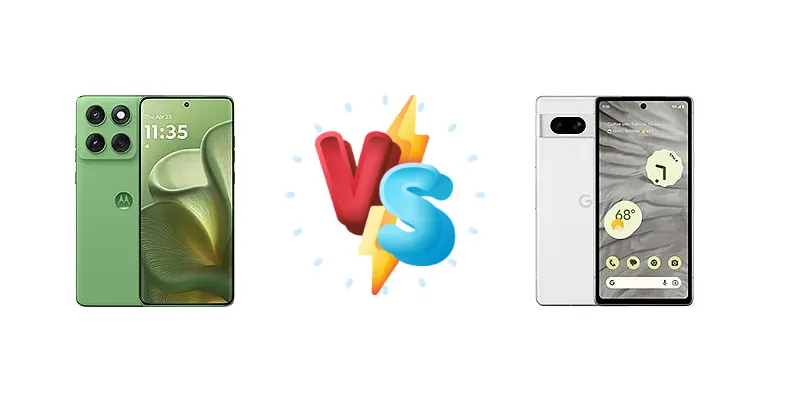
|
🏆 Quick Verdict
For most users, the Google Pixel 7a is the better choice, primarily due to its superior camera capabilities and Google’s software support. However, the Motorola Edge 60 appeals to those prioritizing faster charging speeds and potentially higher CPU performance (especially the India variant with the Dimensity 7400).
| PHONES | ||
|---|---|---|
| Phone Names | Motorola Edge 60 | Google Pixel 7a |
| Network | ||
|---|---|---|
| 2G bands | GSM 850 / 900 / 1800 / 1900 | GSM 850 / 900 / 1800 / 1900 |
| 3G bands | HSDPA 850 / 900 / 1700(AWS) / 1900 / 2100 | HSDPA 800 / 850 / 900 / 1700(AWS) / 1900 / 2100 |
| 4G bands | 1, 2, 3, 4, 5, 7, 8, 12, 13, 17, 18, 19, 20, 25, 26, 28, 32, 34, 38, 39, 40, 41, 42, 43, 48, 66 | 1, 2, 3, 4, 5, 7, 8, 12, 13, 14, 17, 20, 25, 26, 28, 29, 30, 38, 40, 41, 48, 66, 71 - GWKK3, G0DZQ |
| 5G bands | 1, 2, 3, 5, 7, 8, 20, 26, 28, 38, 40, 41, 66, 75, 77, 78 SA/NSA/Sub6 | 1, 2, 3, 5, 7, 8, 12, 14, 20, 25, 28, 30, 38, 41, 48, 66, 71, 77, 78 SA/NSA/Sub6 - GWKK3 |
| Speed | HSPA, LTE, 5G | HSPA, LTE, 5G |
| Technology | GSM / HSPA / LTE / 5G | GSM / HSPA / LTE / 5G |
| - | 1, 2, 3, 5, 7, 8, 12, 20, 25, 28, 38, 40, 41, 66, 75, 76, 77, 78, 79 SA/NSA/Sub6 - GHL1X, G82U8 | |
| Launch | ||
|---|---|---|
| Announced | 2025, April 24 | 2023, May 10 |
| Status | Available. Released 2025, April 25 | Available. Released 2023, May 10 |
| Body | ||
|---|---|---|
| Build | Glass front (Gorilla Glass 7i), plastic frame, plastic back | Glass front (Gorilla Glass 3), aluminum frame, plastic back |
| Dimensions | 161.2 x 73.1 x 7.9 mm or 8.2 mm | 152 x 72.9 x 9 mm (5.98 x 2.87 x 0.35 in) |
| SIM | · Nano-SIM· Nano-SIM + eSIM· Nano-SIM + Nano-SIM | Nano-SIM + eSIM |
| Weight | 179 g or 181 g (6.31 oz) | 193.5 g (6.84 oz) |
| - | IP67 dust/water resistant (up to 1m for 30 min) | |
| Display | ||
|---|---|---|
| Protection | Corning Gorilla Glass 7i, Mohs level 4 | Corning Gorilla Glass 3 |
| Resolution | 1220 x 2712 pixels, 20:9 ratio (~446 ppi density) | 1080 x 2400 pixels, 20:9 ratio (~429 ppi density) |
| Size | 6.67 inches, 107.4 cm2 (~91.1% screen-to-body ratio) | 6.1 inches, 90.7 cm2 (~81.8% screen-to-body ratio) |
| Type | P-OLED, 1B colors, 120Hz, 720Hz PWM, HDR10+, 4500 nits peak | OLED, HDR, 90Hz |
| - | Always-on display | |
| Platform | ||
|---|---|---|
| CPU | Octa-core (4x2.5 GHz Cortex-A78 & 4x2.0 GHz Cortex-A55) - GlobalOcta-core (4x2.6 GHz Cortex-A78 & 4x2.0 GHz Cortex-A55) - India | Octa-core (2x2.85 GHz Cortex-X1 & 2x2.35 GHz Cortex-A78 & 4x1.80 GHz Cortex-A55) |
| Chipset | Mediatek Dimensity 7300 (4 nm) - GlobalMediatek Dimensity 7400 (4 nm) - India | Google Tensor G2 (5 nm) |
| GPU | Mali-G615 MC2 | Mali-G710 MP7 |
| OS | Android 15, up to 3 major Android upgrades | Android 13, upgradable to Android 15, up to 5 major Android upgrades |
| Memory | ||
|---|---|---|
| Card slot | microSDXC | No |
| Internal | 256GB 8GB RAM, 256GB 12GB RAM, 512GB 8GB RAM, 512GB 12GB RAM | 128GB 8GB RAM |
| - | UFS 3.1 | |
| Main Camera | ||
|---|---|---|
| Dual | - | 64 MP, f/1.9, 26mm (wide), 1/1.73", 0.8µm, dual pixel PDAF, OIS 13 MP, f/2.2, 120˚ (ultrawide), 1.12µm |
| Features | LED flash, HDR, panorama | Dual-LED flash, Pixel Shift, Auto-HDR, panorama |
| Triple | 50 MP, f/1.8, 24mm (wide), 1/1.56", 1.0µm, multi-directional PDAF, OIS 10 MP, f2.0, 73mm (telephoto), 1/3.94", 1.0µm, PDAF, 3x optical zoom, OIS 50 MP, f/2.0, 12mm, 122˚ (ultrawide), 1/2.76", 0.64µm, PDAF | - |
| Video | 4K@30fps, 1080p@30/60/120/240fps, gyro-EIS | 4K@30/60fps, 1080p@30/60/120/240fps, OIS |
| Selfie camera | ||
|---|---|---|
| Features | HDR | HDR, panorama |
| Single | 50 MP, f/2.0, (wide), 0.64µm | 13 MP, f/2.2, 20mm (ultrawide), 1.12µm |
| Video | 4K@30fps, 1080p@30/120fps | 4K@30fps, 1080p@30fps |
| Sound | ||
|---|---|---|
| 3.5mm jack | - | No |
| 35mm jack | No | No |
| Loudspeaker | Yes, with stereo speakers (with Dolby Atmos) | Yes, with stereo speakers |
| Comms | ||
|---|---|---|
| Bluetooth | Yes | 5.3, A2DP, LE |
| NFC | Yes | Yes |
| Positioning | GPS, GLONASS, GALILEO | GPS, GLONASS, GALILEO, BDS, QZSS, NavIC |
| Radio | No | No |
| USB | USB Type-C 2.0, OTG | USB Type-C 3.2 |
| WLAN | Wi-Fi 802.11 a/b/g/n/ac/6, dual-band | Wi-Fi 802.11 a/b/g/n/ac/6e, tri-band |
| Features | ||
|---|---|---|
| Sensors | Fingerprint (under display, optical), accelerometer, gyro, proximity, compass | Fingerprint (under display, optical), accelerometer, gyro, proximity, compass, barometer |
| Battery | ||
|---|---|---|
| Charging | 68W wired | 18W wired, PD3.0 7.5W wireless |
| Type | Market-dependent versions:· 5200 mAh (Global)· 5500 mAh (China, India) | Li-Po 4385 mAh |
| Misc | ||
|---|---|---|
| Colors | Pantone: Gibraltar sea, Shamrock, Plum perfect | Charcoal, Snow, Sea, Coral |
| Models | XT2505-1, XT2505-4 | GWKK3, GHL1X, G0DZQ, G82U8 |
| Price | £ 299.99 / € 299.00 | € 179.90 / $ 150.00 / £ 170.00 / ₹ 25,980 |
| SAR EU | 0.95 W/kg (head) 1.22 W/kg (body) | - |
| EU LABEL | ||
|---|---|---|
| Battery | 58:54h endurance, 1000 cycles | - |
| Energy | Class A | - |
| Free fall | Class B (180 falls) | - |
| Repairability | Class B | - |
Motorola Edge 60
- Significantly faster 68W charging
- Potentially higher CPU performance (especially Dimensity 7400)
- Brighter display for outdoor visibility
- Likely inferior camera performance
- Less consistent software updates compared to Pixel
Google Pixel 7a
- Superior camera quality and image processing
- Google’s AI features and software support
- Wireless charging support
- Slow 18W wired charging
- Less powerful chipset for demanding tasks
Display Comparison
The Motorola Edge 60 boasts a significantly brighter display, reaching a measured 1401 nits compared to the Pixel 7a’s 1070 nits. This translates to better visibility outdoors under direct sunlight. While both utilize OLED panels, the Edge 60’s higher peak brightness is a clear advantage. We lack PWM frequency data for both, but the brightness difference is the key differentiator. Bezels appear comparable in initial impressions, and color accuracy is likely excellent on both, given their OLED nature.
Camera Comparison
Google’s Pixel 7a is the clear winner in the camera department. While specific sensor details are missing, the Pixel’s reputation for computational photography and image processing is unmatched in this price bracket. The Pixel 7a’s camera excels in dynamic range, low-light performance, and overall image quality. The Motorola Edge 60’s camera is likely competent, but it won’t match the Pixel’s consistently excellent results. We’re ignoring the likely presence of a low-resolution macro lens on both devices, as their utility is limited.
Performance
The chipset choice is the core performance battle. The Pixel 7a’s Google Tensor G2 (5nm) features a unique CPU configuration with 2x Cortex-X1 cores for peak performance, but the Motorola Edge 60 (Global: Dimensity 7300 4nm, India: Dimensity 7400 4nm) offers a more traditional octa-core setup. The Dimensity 7400 in India boasts slightly higher clock speeds (2.6 GHz vs 2.5 GHz on the 7300) on its Cortex-A78 cores. The 4nm process node on the Dimensity chips provides better power efficiency than the 5nm Tensor G2, potentially leading to improved sustained performance and thermal management. The Pixel 7a’s Tensor G2 excels in AI tasks, however, offering features like Magic Eraser and improved voice recognition.
Battery Life
The Motorola Edge 60’s 68W wired charging is a massive advantage over the Pixel 7a’s 18W charging. This allows for significantly faster top-ups, potentially adding hours of usage in just minutes. The Edge 60’s endurance is rated at 58:54h, while the Pixel 7a’s older rating is 76h. However, endurance ratings are often optimistic. The Edge 60’s active use score of 13:32h provides a more realistic expectation. The Pixel 7a also offers 7.5W wireless charging, a feature absent on the Edge 60.
Buying Guide
Buy the Motorola Edge 60 if you need a phone that charges incredibly quickly (68W) and you frequently engage in demanding tasks like gaming, particularly if you're in India where it ships with the slightly faster Dimensity 7400. Buy the Google Pixel 7a if you prioritize camera quality, seamless software updates, and Google’s AI-powered features, even if it means sacrificing charging speed and raw CPU power.