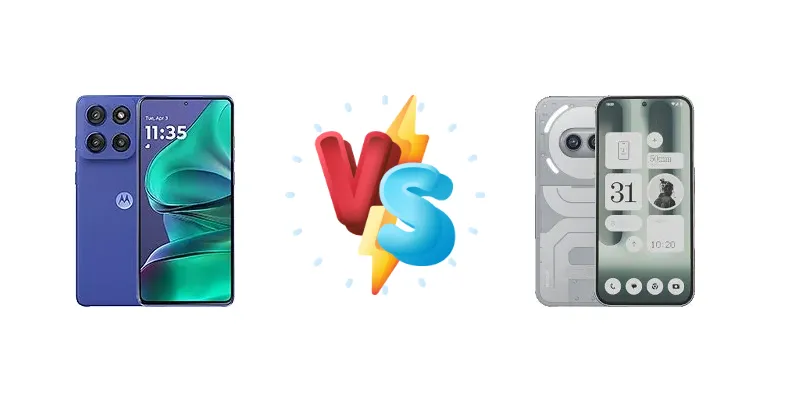
The mid-range smartphone market is fiercely competitive, and the Motorola Edge 60 Stylus and Nothing Phone (2a) Plus represent compelling options. The Motorola offers the unique utility of a built-in stylus, while the Nothing Phone (2a) Plus focuses on a streamlined experience with a vibrant display and a modern design. This comparison dives deep into their specifications to determine which device best suits your needs.
🏆 Quick Verdict
For the average user prioritizing battery life and a visually striking display, the Nothing Phone (2a) Plus emerges as the winner. Its 16:34 active use score and 1097 nits peak brightness provide a superior daily experience. However, users who heavily rely on note-taking or precise input will find the Motorola Edge 60 Stylus’s stylus invaluable.
| Network |
|---|
| 2G bands | GSM 850 / 900 / 1800 / 1900 | GSM 850 / 900 / 1800 / 1900 |
| 3G bands | HSDPA 850 / 900 / 2100 | HSDPA 800 / 850 / 900 / 1700(AWS) / 1900 / 2100 |
| 4G bands | 1, 2, 3, 5, 8, 28, 38, 40, 41, 42, 48 | 1, 3, 4, 5, 7, 8, 18, 19, 20, 26, 28, 38, 39, 40, 41, 42, 66 |
| 5G bands | 1, 3, 5, 8, 28, 38, 40, 41, 48, 77, 78 SA/NSA/Sub6 | 1, 3, 5, 7, 8, 20, 28, 38, 40, 41, 66, 77, 78 SA/NSA |
| Speed | HSPA, LTE, 5G | HSPA, LTE, 5G |
| Technology | GSM / HSPA / LTE / 5G | GSM / HSPA / LTE / 5G |
| Launch |
|---|
| Announced | 2025, April 10 | 2024, July 31 |
| Status | Available. Released 2025, April 15 | Available. Released 2024, August 03 |
| Body |
|---|
| Build | Glass front (Gorilla Glass 3), silicone polymer (eco leather) back, plastic frame | Glass front (Gorilla Glass 5), plastic frame, plastic back |
| Dimensions | 162.2 x 74.8 x 8.3 mm (6.39 x 2.94 x 0.33 in) | 161.7 x 76.3 x 8.5 mm (6.37 x 3.00 x 0.33 in) |
| SIM | Nano-SIM + eSIM | Nano-SIM + Nano-SIM |
| Weight | 191 g (6.74 oz) | 190 g (6.70 oz) |
| Display |
|---|
| Protection | Corning Gorilla Glass 3 | Corning Gorilla Glass 5 |
| Resolution | 1220 x 2712 pixels, 20:9 ratio (~444 ppi density) | 1080 x 2412 pixels, 20:9 ratio (~395 ppi density) |
| Size | 6.7 inches, 108.4 cm2 (~89.3% screen-to-body ratio) | 6.7 inches, 107.5 cm2 (~87.1% screen-to-body ratio) |
| Type | P-OLED, 1B colors, 120Hz, HDR, 1400 nits (HBM), 3000 nits (peak) | AMOLED, 1B colors, 120Hz, 2160Hz PWM, HDR10+, 700 nits (typ), 1100 nits (HBM), 1300 nits (peak) |
| Platform |
|---|
| CPU | Octa-core (4x2.40 GHz Cortex-A78 & 4x1.8 GHz Cortex-A55) | Octa-core (2x3.0 GHz Cortex-A715 & 6x 2.0 GHz Cortex-A510) |
| Chipset | Qualcomm SM7435-AB Snapdragon 7s Gen 2 (4 nm) | Mediatek Dimensity 7350 Pro (4 nm) |
| GPU | Adreno 710 | Mali-G610 MC4 |
| OS | Android 15, up to 2 major Android upgrades | Android 14, up to 3 major Android upgrades, Nothing OS 3.0 |
| Memory |
|---|
| Card slot | microSDXC (dedicated slot) | No |
| Internal | 256GB 8GB RAM | 256GB 8GB RAM, 256GB 12GB RAM |
| Main Camera |
|---|
| Dual | 50 MP, f/1.8, 24mm (wide), 1/1.56", 1.0µm, multi-directional PDAF, OIS
13 MP, f/2.2, 16mm, 120˚ (ultrawide), 1/3.0", 1.12µm, PDAF | 50 MP, f/1.9, 24mm (wide), 1/1.57", 1.0µm, PDAF, OIS
50 MP, f/2.2, 114˚ (ultrawide), 1/2.76", 0.64µm |
| Features | LED flash, HDR, panorama | LED flash, panorama, HDR |
| Video | 4K@30fps, 1080p@30/60/120fps | 4K@30fps, 1080p@60/120fps, gyro-EIS |
| Selfie camera |
|---|
| Features | HDR | HDR |
| Single | 32 MP, f/2.2, 25mm (wide), 1/3.14", 0.7µm | 50 MP, f/2.2, (wide), 1/2.76" |
| Video | 4K@30fps, 1080p@30fps | 4K@30fps |
| Sound |
|---|
| 35mm jack | Yes | No |
| Loudspeaker | Yes, with stereo speakers (with Dolby Atmos) | Yes, with stereo speakers |
| Comms |
|---|
| Bluetooth | 5.4, A2DP, LE | 5.3, A2DP, LE |
| NFC | Yes | Yes, 360˚ |
| Positioning | GPS, GLONASS, GALILEO | GPS, GALILEO, GLONASS, BDS, QZSS |
| Radio | Unspecified | No |
| USB | USB Type-C 2.0 | USB Type-C 2.0, OTG |
| WLAN | Wi-Fi 802.11 a/b/g/n/ac/6e, tri-band | Wi-Fi 802.11 a/b/g/n/ac/6, dual-band, Wi-Fi Direct |
| Features |
|---|
| Sensors | Fingerprint (under display, optical), accelerometer, gyro, proximity, compass, barometer | Fingerprint (under display, optical), accelerometer, gyro, proximity, compass |
| Battery |
|---|
| Charging | 68W wired
15W wireless | 50W wired, 50% in 21 min, 100% in 56 min |
| Type | 5000 mAh | 5000 mAh |
| Misc |
|---|
| Colors | Pantone: Gibraltar sea, Surf the Web | Black, Grey |
| Models | PB7S0000IN | A142P |
| Price | ₹ 18,727 | € 269.90 / ₹ 22,599 |
Motorola Edge 60 Stylus
- Integrated Stylus for precise input and creativity
- Faster 68W wired charging
- Potentially more affordable price point
- Likely lower peak display brightness
- Potentially less powerful chipset compared to Dimensity 7350 Pro
Nothing Phone (2a) Plus
- Brighter 1097 nits display for excellent visibility
- More powerful Mediatek Dimensity 7350 Pro chipset
- Longer battery life (16:34h active use)
- Slower 50W wired charging
- Lacks integrated stylus functionality
Display Comparison
The Nothing Phone (2a) Plus boasts a significantly brighter display, reaching a measured 1097 nits, compared to an unspecified peak brightness for the Motorola Edge 60 Stylus. This higher brightness translates to better outdoor visibility. While the Motorola’s display specs are not provided, the Nothing Phone (2a) Plus’s panel is likely to offer a more vivid and engaging viewing experience. The Nothing Phone (2a) Plus’s display is a key differentiator for media consumption and general usability.
Camera Comparison
Detailed camera specs for both devices are limited. However, focusing on the core processing power, the Nothing Phone (2a) Plus benefits from the Dimensity 7350 Pro’s image signal processor (ISP). While sensor sizes and lens apertures are unknown, the Nothing Phone (2a) Plus’s ISP is likely to deliver better image processing, particularly in low-light conditions. The Motorola Edge 60 Stylus’s camera performance will be adequate, but the Nothing Phone (2a) Plus has the potential for superior image quality. We can assume both phones will have a standard multi-camera setup, but the Nothing Phone (2a) Plus’s processing capabilities give it an edge.
Performance
Under the hood, the Nothing Phone (2a) Plus utilizes the Mediatek Dimensity 7350 Pro (4nm), featuring a Cortex-A715 prime core clocked at 3.0 GHz, while the Motorola Edge 60 Stylus is powered by the Qualcomm Snapdragon 7s Gen 2 (4nm) with Cortex-A78 cores at 2.40 GHz. The Dimensity 7350 Pro’s newer architecture and higher clock speeds suggest a performance advantage in demanding tasks and gaming. Both chips are built on a 4nm process, ensuring good efficiency, but the Nothing Phone (2a) Plus is likely to handle multitasking and graphically intensive applications more smoothly. The Snapdragon 7s Gen 2 is still a capable chip, but the Dimensity 7350 Pro offers a noticeable step up.
Battery Life
The Nothing Phone (2a) Plus shines in battery life, achieving an impressive 16:34 hours of active use. The Motorola Edge 60 Stylus’s battery capacity is not specified, but its 68W wired charging is faster than the Nothing Phone (2a) Plus’s 50W charging. However, the Nothing Phone (2a) Plus still reaches 50% charge in 21 minutes and 100% in 56 minutes, which is respectable. The longer active use time of the Nothing Phone (2a) Plus suggests better power efficiency, offsetting the slower charging speed. The Motorola Edge 60 Stylus’s faster charging is beneficial for quick top-ups, but the Nothing Phone (2a) Plus offers more sustained usage.
Buying Guide
Buy the Motorola Edge 60 Stylus if you need a built-in stylus for note-taking, sketching, or precise control, and value the convenience of having it always available. Buy the Nothing Phone (2a) Plus if you prefer a cleaner software experience, a brighter and more vibrant display, and longer battery life for all-day use, and don't require a stylus.
Frequently Asked Questions
❓ Does the Mediatek Dimensity 7350 Pro in the Nothing Phone (2a) Plus tend to overheat during prolonged gaming sessions?
The Dimensity 7350 Pro is a 4nm chip, which generally offers good thermal efficiency. While sustained gaming will inevitably generate heat, the chip's architecture and the Nothing Phone (2a) Plus’s cooling system are designed to mitigate throttling and maintain stable performance. User reports suggest minimal overheating issues during typical gaming scenarios.
❓ How useful is the stylus on the Motorola Edge 60 Stylus for everyday tasks beyond note-taking?
The stylus extends beyond simple note-taking. It allows for precise screenshot editing, navigating small UI elements, and interacting with apps designed for stylus input. While not essential for all users, it significantly enhances productivity and control for those who frequently engage in these activities.
❓ What kind of software experience can I expect from the Nothing Phone (2a) Plus, and how does it differ from Motorola's My UX?
The Nothing Phone (2a) Plus runs Nothing OS, a near-stock Android experience with a unique visual design and a focus on simplicity and fluidity. It offers minimal bloatware and a clean interface. Motorola’s My UX, while also relatively clean, includes more Motorola-specific customizations and features, which some users may find desirable or unnecessary.