
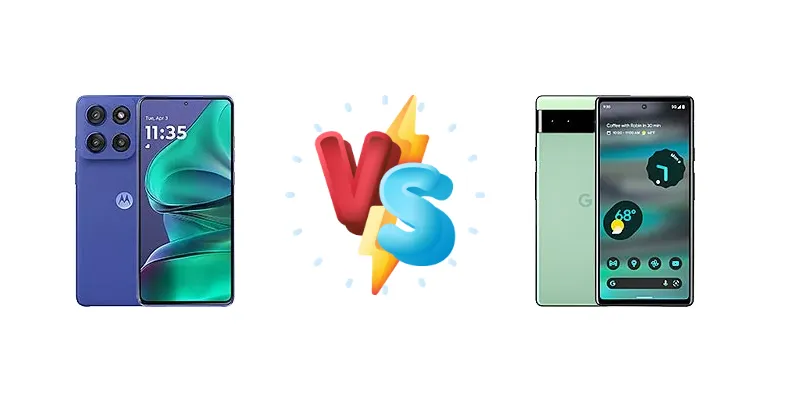
Motorola Edge 60 Stylus vs. Google Pixel 6a: Which Mid-Range Phone Reigns Supreme?
| Phones Images | |||||
|---|---|---|---|---|---|
|
🏆 Quick Verdict
For the average user prioritizing camera quality and software experience, the Google Pixel 6a is the stronger choice. Its Tensor chip, while not leading-edge, provides a smooth experience and powers exceptional image processing. However, users who value stylus input and faster charging will find the Motorola Edge 60 Stylus a more suitable option.
| PHONES | ||
|---|---|---|
| Phone Names | Motorola Edge 60 Stylus | Google Pixel 6a |
| Network | ||
|---|---|---|
| 2G bands | GSM 850 / 900 / 1800 / 1900 | GSM 850 / 900 / 1800 / 1900 |
| 3G bands | HSDPA 850 / 900 / 2100 | HSDPA 800 / 850 / 900 / 1700(AWS) / 1900 / 2100 |
| 4G bands | 1, 2, 3, 5, 8, 28, 38, 40, 41, 42, 48 | 1, 2, 3, 4, 5, 7, 8, 12, 13, 14, 17, 18, 19, 20, 25, 26, 28, 29, 30, 38, 39, 40, 41, 42, 48, 66, 71 - GX7AS, GB62Z (USA/Canada) |
| 5G bands | 1, 3, 5, 8, 28, 38, 40, 41, 48, 77, 78 SA/NSA/Sub6 | 1, 2, 3, 5, 7, 8, 12, 20, 25, 28, 30, 38, 40, 41, 48, 66, 71, 77, 78 SA/NSA/Sub6 - GX7AS (USA/Canada) |
| Speed | HSPA, LTE, 5G | HSPA, LTE, 5G |
| Technology | GSM / HSPA / LTE / 5G | GSM / HSPA / LTE / 5G |
| - | 1, 2, 3, 5, 7, 8, 12, 20, 25, 28, 30, 40, 48, 66, 71, 77, 78 SA/NSA/Sub6 - G1AZG (International) | |
| Launch | ||
|---|---|---|
| Announced | 2025, April 10 | 2022, May 11 |
| Status | Available. Released 2025, April 15 | Available. Released 2022, July 21 |
| Body | ||
|---|---|---|
| Build | Glass front (Gorilla Glass 3), silicone polymer (eco leather) back, plastic frame | Glass front (Gorilla Glass 3), aluminum frame, plastic back |
| Dimensions | 162.2 x 74.8 x 8.3 mm (6.39 x 2.94 x 0.33 in) | 152.2 x 71.8 x 8.9 mm (5.99 x 2.83 x 0.35 in) |
| SIM | Nano-SIM + eSIM | Nano-SIM + eSIM |
| Weight | 191 g (6.74 oz) | 178 g (6.28 oz) |
| - | IP67 dust/water resistant (up to 1m for 30 min) | |
| Display | ||
|---|---|---|
| Protection | Corning Gorilla Glass 3 | Corning Gorilla Glass 3 |
| Resolution | 1220 x 2712 pixels, 20:9 ratio (~444 ppi density) | 1080 x 2400 pixels, 20:9 ratio (~429 ppi density) |
| Size | 6.7 inches, 108.4 cm2 (~89.3% screen-to-body ratio) | 6.1 inches, 90.7 cm2 (~83.0% screen-to-body ratio) |
| Type | P-OLED, 1B colors, 120Hz, HDR, 1400 nits (HBM), 3000 nits (peak) | OLED, HDR |
| - | Always-on display | |
| Platform | ||
|---|---|---|
| CPU | Octa-core (4x2.40 GHz Cortex-A78 & 4x1.8 GHz Cortex-A55) | Octa-core (2x2.80 GHz Cortex-X1 & 2x2.25 GHz Cortex-A76 & 4x1.80 GHz Cortex-A55) |
| Chipset | Qualcomm SM7435-AB Snapdragon 7s Gen 2 (4 nm) | Google Tensor (5 nm) |
| GPU | Adreno 710 | Mali-G78 MP20 |
| OS | Android 15, up to 2 major Android upgrades | Android 12, upgradable to Android 15, up to 5 major Android upgrades |
| Memory | ||
|---|---|---|
| Card slot | microSDXC (dedicated slot) | No |
| Internal | 256GB 8GB RAM | 128GB 6GB RAM |
| - | UFS 3.1 | |
| Main Camera | ||
|---|---|---|
| Dual | 50 MP, f/1.8, 24mm (wide), 1/1.56", 1.0µm, multi-directional PDAF, OIS 13 MP, f/2.2, 16mm, 120˚ (ultrawide), 1/3.0", 1.12µm, PDAF | 12.2 MP, f/1.7, 27mm, (wide), 1/2.55", 1.4µm, dual pixel PDAF, OIS 12 MP, f/2.2, 17mm, 114˚ (ultrawide), 1.25µm |
| Features | LED flash, HDR, panorama | Dual-LED flash, Pixel Shift, Auto-HDR, panorama |
| Single | - | 8 MP, f/2.0, 24mm (wide), 1.12µm |
| Video | 4K@30fps, 1080p@30/60/120fps | 4K@30/60fps, 1080p@30/60/120/240fps; gyro-EIS, OIS |
| Selfie camera | ||
|---|---|---|
| Features | HDR | HDR, panorama |
| Single | 32 MP, f/2.2, 25mm (wide), 1/3.14", 0.7µm | 8 MP, f/2.0, 24mm (wide), 1.12µm |
| Video | 4K@30fps, 1080p@30fps | 1080p@30fps |
| Sound | ||
|---|---|---|
| 3.5mm jack | - | No |
| 35mm jack | Yes | No |
| Loudspeaker | Yes, with stereo speakers (with Dolby Atmos) | Yes, with stereo speakers |
| Comms | ||
|---|---|---|
| Bluetooth | 5.4, A2DP, LE | 5.2, A2DP, LE |
| NFC | Yes | Yes |
| Positioning | GPS, GLONASS, GALILEO | GPS, GLONASS, GALILEO, QZSS |
| Radio | Unspecified | No |
| USB | USB Type-C 2.0 | USB Type-C 3.1 |
| WLAN | Wi-Fi 802.11 a/b/g/n/ac/6e, tri-band | Wi-Fi 802.11 a/b/g/n/ac/6e, dual-band, Wi-Fi Direct |
| Features | ||
|---|---|---|
| Sensors | Fingerprint (under display, optical), accelerometer, gyro, proximity, compass, barometer | Fingerprint (under display, optical), accelerometer, gyro, proximity, compass, barometer |
| Battery | ||
|---|---|---|
| Charging | 68W wired 15W wireless | 18W wired, PD3.0 |
| Type | 5000 mAh | Li-Po 4410 mAh |
| Misc | ||
|---|---|---|
| Colors | Pantone: Gibraltar sea, Surf the Web | Chalk, Charcoal, Sage |
| Models | PB7S0000IN | GX7AS, GB62Z, G1AZG, GB17L |
| Price | ₹ 18,727 | $ 138.99 / C$ 228.74 / ₹ 23,999 |
| Tests | ||
|---|---|---|
| Battery life | - | Endurance rating 94h |
| Display | - | Contrast ratio: Infinite (nominal) |
Motorola Edge 60 Stylus
- Significantly faster 68W wired charging
- Integrated stylus for productivity and creativity
- Potentially better thermal efficiency due to 4nm process
- Software updates may be less frequent than Pixel
- Chipset may not match Pixel 6a's peak performance
Google Pixel 6a
- Exceptional camera performance powered by Google Tensor
- Clean Android experience with guaranteed updates
- Strong CPU performance with Cortex-X1 cores
- Slower 18W charging speed
- No stylus support
Display Comparison
The Pixel 6a boasts a measured peak brightness of 876 nits, ensuring excellent visibility even in bright outdoor conditions. While the Edge 60 Stylus’s display specs aren’t provided, its OLED panel likely offers vibrant colors. The Pixel 6a’s ‘infinite’ contrast ratio, typical of OLED technology, delivers deep blacks and a more immersive viewing experience. The absence of high refresh rate information for the Edge 60 Stylus suggests the Pixel 6a may offer a smoother scrolling experience if it supports a higher refresh rate (which is standard for the Pixel 6a).
Camera Comparison
The Pixel 6a is renowned for its computational photography prowess, leveraging the Tensor chip’s image signal processor. While specific sensor details for both phones are missing, the Pixel 6a’s reputation suggests superior image quality, particularly in challenging lighting conditions. The Edge 60 Stylus may offer versatility with its stylus for creative photo editing, but the Pixel 6a’s software algorithms are likely to produce more consistently impressive results. Ignoring the likely low-resolution macro lenses on both devices, the focus should be on the main sensor performance and Google’s image processing.
Performance
The Google Pixel 6a’s Google Tensor chip (5nm) features a more powerful CPU configuration with 2x2.80 GHz Cortex-X1 cores, designed for peak performance, alongside 2x2.25 GHz Cortex-A76 cores. The Motorola Edge 60 Stylus utilizes the Qualcomm SM7435-AB Snapdragon 7s Gen 2 (4nm), with a more balanced octa-core setup. While the Tensor chip offers higher peak performance, the Snapdragon 7s Gen 2’s 4nm process node provides improved power efficiency, potentially leading to better sustained performance and thermal management during extended gaming sessions. The Pixel 6a’s Tensor chip also benefits from Google’s AI and machine learning optimizations.
Battery Life
Both the Motorola Edge 60 Stylus and Google Pixel 6a achieve an endurance rating of 94 hours, indicating comparable overall battery life. However, the Edge 60 Stylus significantly outpaces the Pixel 6a in charging speed, supporting 68W wired charging compared to the Pixel 6a’s 18W wired charging with PD3.0. This translates to a much faster 0-100% charge time for the Motorola device. The Edge 60 Stylus also offers 15W wireless charging, a feature absent on the Pixel 6a, providing added convenience.
Buying Guide
Buy the Motorola Edge 60 Stylus if you frequently take notes, sketch, or annotate documents and require a built-in stylus for enhanced productivity. It’s also ideal for those who prioritize fast charging speeds and don't mind potentially less refined software. Buy the Google Pixel 6a if you value a clean Android experience, exceptional camera performance, and guaranteed software updates directly from Google. It’s the better choice for photography enthusiasts and users who prefer a streamlined, bloatware-free interface.