
Motorola Edge 60 Pro vs vivo X80 Pro: A Deep Dive into Flagship Performance and Value
| Phones Images | |||||
|---|---|---|---|---|---|
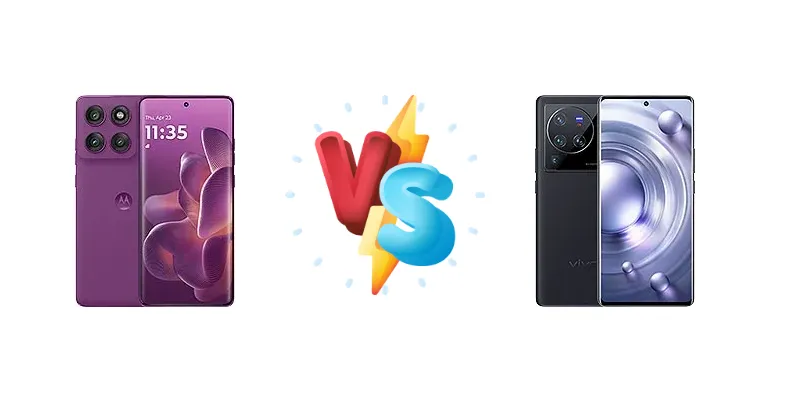
|
🏆 Quick Verdict
For most users, the Motorola Edge 60 Pro emerges as the stronger choice. Its significantly faster 90W charging, coupled with a brighter display reaching 1595 nits, and the efficient Dimensity 8350 Extreme chipset, provide a more modern and user-friendly experience. While the X80 Pro boasts a longer endurance rating, the Edge 60 Pro’s quicker top-ups and superior display make it the more practical daily driver.
| PHONES | ||
|---|---|---|
| Phone Names | Motorola Edge 60 Pro | vivo X80 Pro |
| Network | ||
|---|---|---|
| 2G bands | GSM 850 / 900 / 1800 / 1900 | GSM 850 / 900 / 1800 / 1900 |
| 3G bands | HSDPA 850 / 900 / 1700(AWS) / 1900 / 2100 | HSDPA 800 / 850 / 900 / 1700(AWS) / 1900 / 2100 |
| 4G bands | 1, 2, 3, 4, 5, 7, 8, 11, 12, 13, 17, 18, 19, 20, 25, 26, 28, 32, 34, 38, 39, 40, 41, 42, 43, 66, 71 | 1, 2, 3, 4, 5, 7, 8, 12, 13, 17, 18, 19, 20, 26, 28, 32, 38, 39, 40, 41, 42, 66 - International |
| 5G bands | 1, 2, 3, 5, 7, 8, 20, 26, 28, 38, 40, 41, 66, 71, 75, 77, 78 SA/NSA/Sub6 | 1, 2, 3, 5, 7, 8, 20, 28, 38, 40, 41, 66, 77, 78 SA/NSA - International |
| Speed | HSPA, LTE, 5G | HSPA, LTE, 5G |
| Technology | GSM / HSPA / LTE / 5G | GSM / CDMA / HSPA / EVDO / LTE / 5G |
| - | 1, 3, 5, 7, 8, 12, 20, 28, 66, 38, 40, 41, 77, 78, 79 SA/NSA - China | |
| Launch | ||
|---|---|---|
| Announced | 2025, April 24 | 2022, April 25 |
| Status | Available. Released 2025, April 30 | Available. Released 2022, April 29 |
| Body | ||
|---|---|---|
| Build | Glass front (Gorilla Glass 7i), plastic frame, silicone polymer (eco leather) back | Glass front (Schott Xensation Up), glass back or ceramic back or eco leather back, aluminum frame |
| Dimensions | 160.7 x 73.1 x 8.2 mm (6.33 x 2.88 x 0.32 in) | 164.6 x 75.3 x 9.1 mm (6.48 x 2.96 x 0.36 in) |
| SIM | · Nano-SIM· Nano-SIM + eSIM· Nano-SIM + Nano-SIM | Nano-SIM + Nano-SIM |
| Weight | 186 g (6.56 oz) | 215 g / 219 g (7.58 oz) |
| - | IP68 dust/water resistant (up to 1.5m for 30 min) | |
| Display | ||
|---|---|---|
| Protection | Corning Gorilla Glass 7i, Mohs level 4 | Schott Xensation Up |
| Resolution | 1220 x 2712 pixels, 20:9 ratio (~444 ppi density) | 1440 x 3200 pixels, 20:9 ratio (~517 ppi density) |
| Size | 6.7 inches, 108.4 cm2 (~92.2% screen-to-body ratio) | 6.78 inches, 111.4 cm2 (~89.9% screen-to-body ratio) |
| Type | P-OLED, 1B colors, 120Hz, 720Hz PWM, HDR10+, 4500 nits peak | LTPO3 AMOLED, 1B colors, 120Hz, HDR10+, 1500 nits (peak) |
| Platform | ||
|---|---|---|
| CPU | Octa-core (1x3.35 GHz Cortex-A715 & 3x3.20 GHz Cortex-A715 & 4x2.20 GHz Cortex-A510) | Octa-core (1x3.00 GHz Cortex-X2 & 3x2.50 GHz Cortex-A710 & 4x1.80 GHz Cortex-A510)Octa-core (1x3.05 GHz Cortex-X2 & 3x2.85 GHz Cortex-A710 & 4x1.80 GHz Cortex-A510) |
| Chipset | Mediatek Dimensity 8350 Extreme (4 nm) | Qualcomm SM8450 Snapdragon 8 Gen 1 (4 nm)Mediatek Dimensity 9000 (4 nm) |
| GPU | Mali G615-MC6 | Adreno 730Mali-G710 MC10 |
| OS | Android 15, up to 3 major Android upgrades | Android 12, upgradable to Android 14, Funtouch 14 (Global), OriginOS Ocean (China) |
| Memory | ||
|---|---|---|
| Card slot | No | No |
| Internal | 256GB 8GB RAM, 256GB 12GB RAM, 512GB 12GB RAM, 512GB 16GB RAM | 256GB 8GB RAM, 256GB 12GB RAM, 512GB 12GB RAM |
| - | UFS 3.1 | |
| Main Camera | ||
|---|---|---|
| Features | Color spectrum sensor, LED flash, HDR, panorama, Pantone Validated Colour and Skin Tones | Laser AF, color spectrum sensor, Zeiss optics, Zeiss T* lens coating, Pixel Shift, dual-LED dual-tone flash, HDR, panorama |
| Quad | - | 50 MP, f/1.6, (wide), 1/1.3", PDAF, OIS 8 MP, f/3.4, (periscope telephoto), 1/4.4", 1.0µm, PDAF, OIS, 5x optical zoom 12 MP, f/1.9, 50mm (telephoto), 1/2.93", 1.22µm, dual pixel PDAF, 2x optical zoom, gimbal OIS 48 MP, f/2.2, 114˚ (ultrawide), 1/2.0", AF |
| Single | - | 32 MP, f/2.5, 24mm (wide), 1/2.8", 0.8µm |
| Triple | 50 MP, f/1.8, 24mm (wide), 1/1.56", 1.0µm, multi-directional PDAF, OIS 10 MP, f2.0, 73mm (telephoto), 1/3.94", 1.0µm, PDAF, 3x optical zoom, OIS 50 MP, f/2.0, 120˚ (ultrawide), 1/2.76", 0.64µm, PDAF | - |
| Video | 4K@30fps, 1080p@30/60/120/240fps, gyro-EIS, HDR10+ | 8K@30fps, 4K@30/60fps, 1080p@30/60fps, gyro-EIS |
| Selfie camera | ||
|---|---|---|
| Features | HDR | HDR |
| Single | 50 MP, f/2.0, (wide), 1/2.76", 0.64µm | 32 MP, f/2.5, 24mm (wide), 1/2.8", 0.8µm |
| Video | 4K@30fps, 1080p@30/120fps | 1080p@30fps |
| Sound | ||
|---|---|---|
| 3.5mm jack | - | No |
| 35mm jack | No | No |
| Loudspeaker | Yes, with stereo speakers (with Dolby Atmos) | Yes, with stereo speakers |
| - | 32-bit/192kHz audio | |
| Comms | ||
|---|---|---|
| Bluetooth | Yes | 5.2 (Snapdragon)/ 5.3 (Dimensity), A2DP, LE, aptX HD, aptX Adaptive, aptX Lossless |
| Infrared port | - | Yes |
| NFC | Yes | Yes |
| Positioning | GPS, GLONASS, GALILEO, BDS, NavIC | GPS (L1+L5), GLONASS, BDS, GALILEO, QZSS, NavIC |
| Radio | No | No |
| USB | USB Type-C, OTG | USB Type-C 3.1 (Global)/ 3.2 (China), OTG |
| WLAN | Wi-Fi 802.11 a/b/g/n/ac/6e, tri-band | Wi-Fi 802.11 a/b/g/n/ac/6, dual-band, Wi-Fi Direct |
| Features | ||
|---|---|---|
| Sensors | Fingerprint (under display, optical), accelerometer, gyro, proximity, compass | Fingerprint (under display, ultrasonic), accelerometer, gyro, proximity, compass |
| Battery | ||
|---|---|---|
| Charging | 90W wired, PD3.0 15W wireless 5W reverse wired | 80W wired, 100% in 38 min 50W wireless, 100% in 50 min Reverse wired |
| Type | Si/C Li-Ion 6000 mAh | 4700 mAh |
| Misc | ||
|---|---|---|
| Colors | Pantone: Shadow, Dazzling Blue , Sparkling Grape | Cosmic Black, Blue, Orange |
| Models | XT2507-1 | V2185A, V2145 |
| Price | € 399.00 / $ 515.00 / £ 445.00 / ₹ 27,599 | About 850 EUR |
| SAR EU | 0.90 W/kg (head) 1.39 W/kg (body) | - |
| Tests | ||
|---|---|---|
| Battery life | - | Endurance rating 79h |
| Camera | - | Photo / Video |
| Display | - | Contrast ratio: Infinite (nominal) |
| Loudspeaker | - | -25.1 LUFS (Very good) |
| EU LABEL | ||
|---|---|---|
| Battery | 67:47h endurance, 1000 cycles | - |
| Energy | Class A | - |
| Free fall | Class A (270 falls) | - |
| Repairability | Class B | - |
Motorola Edge 60 Pro
- Significantly faster 90W wired charging
- Brighter display (1595 nits) for outdoor visibility
- More efficient Dimensity 8350 Extreme chipset
- Shorter battery endurance rating
- Less detailed camera specifications available
vivo X80 Pro
- Longer battery endurance rating (79 hours)
- Faster 50W wireless charging
- Established camera brand reputation
- Snapdragon 8 Gen 1 prone to thermal throttling
- Dimmer display (1014 nits)
Display Comparison
The Motorola Edge 60 Pro boasts a substantial advantage in display brightness, achieving a measured peak of 1595 nits compared to the vivo X80 Pro’s 1014 nits. This translates to significantly better visibility under direct sunlight. While both displays feature an infinite (nominal) contrast ratio, the higher brightness of the Edge 60 Pro is a tangible benefit for outdoor use. Details regarding refresh rate and panel technology (LTPO) are missing for both, but the Edge 60 Pro’s brightness alone makes it the clear winner for users who frequently consume content outdoors.
Camera Comparison
Both devices are marketed with strong camera capabilities, but specific details are limited. The context data only indicates 'Photo / Video' for both. Without sensor size, aperture, or image processing details, a direct comparison is difficult. However, vivo has a strong reputation for camera tuning and image processing, potentially giving the X80 Pro an edge in image quality, particularly in challenging lighting conditions. The absence of details on the Edge 60 Pro’s camera system makes it harder to assess its capabilities beyond marketing claims. We can assume both phones will offer a versatile camera experience, but the X80 Pro’s brand history suggests a more refined output.
Performance
The chipset battle pits Mediatek’s Dimensity 8350 Extreme (4nm) in the Edge 60 Pro against Qualcomm’s Snapdragon 8 Gen 1 (4nm) and Mediatek’s Dimensity 9000 (4nm) in the X80 Pro. The Dimensity 8350 Extreme utilizes a tri-cluster configuration with Cortex-A715 cores, while the Snapdragon 8 Gen 1 employs the more powerful Cortex-X2 core. However, the Snapdragon 8 Gen 1 is known for thermal throttling under sustained load, a potential issue the Dimensity 8350 Extreme may mitigate due to its more efficient architecture. The Edge 60 Pro’s CPU configuration (1x3.35 GHz Cortex-A715, 3x3.20 GHz Cortex-A715, 4x2.20 GHz Cortex-A510) is optimized for a balance of performance and power efficiency, potentially offering a smoother long-term experience than the X80 Pro’s Snapdragon variant.
Battery Life
The vivo X80 Pro claims an endurance rating of 79 hours, while the Motorola Edge 60 Pro achieves 67:47 hours. However, endurance ratings are based on a mixed usage profile and don’t tell the whole story. The Edge 60 Pro compensates for its slightly smaller battery with significantly faster charging: 90W wired, 15W wireless, and 5W reverse wired, compared to the X80 Pro’s 80W wired, 50W wireless, and reverse wired. The Edge 60 Pro can fully charge in a much shorter timeframe, mitigating the impact of its lower endurance rating. The X80 Pro’s 50W wireless charging is also notably faster than the Edge 60 Pro’s 15W offering.
Buying Guide
Buy the Motorola Edge 60 Pro if you prioritize fast charging, a vibrant and bright display, and a modern chipset optimized for efficiency. Buy the vivo X80 Pro if you value a potentially longer overall battery life (though charging is slower) and are seeking a device with a well-established camera system, potentially benefitting from vivo’s image processing expertise. Consider the X80 Pro if you find a significantly discounted price.