
Motorola Edge 60 Pro vs. Samsung Galaxy S23 FE: A Detailed Comparison
| Phones Images | |||||
|---|---|---|---|---|---|
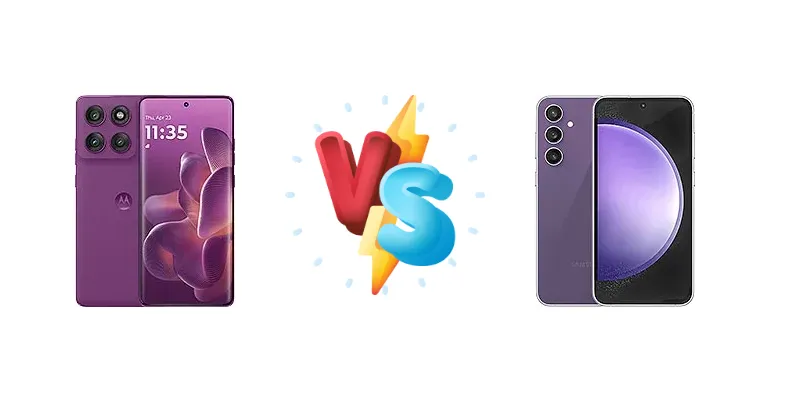
|
🏆 Quick Verdict
For the average user prioritizing battery life and charging speed, the Motorola Edge 60 Pro emerges as the stronger choice. Its significantly longer 67:47h endurance and 90W charging capability outweigh the S23 FE’s brand recognition and potentially more refined software experience. However, the S23 FE’s camera system offers a more versatile experience.
| PHONES | ||
|---|---|---|
| Phone Names | Motorola Edge 60 Pro | Samsung Galaxy S23 FE |
| Network | ||
|---|---|---|
| 2G bands | GSM 850 / 900 / 1800 / 1900 | GSM 850 / 900 / 1800 / 1900 |
| 3G bands | HSDPA 850 / 900 / 1700(AWS) / 1900 / 2100 | HSDPA 850 / 900 / 1700(AWS) / 1900 / 2100 |
| 4G bands | 1, 2, 3, 4, 5, 7, 8, 11, 12, 13, 17, 18, 19, 20, 25, 26, 28, 32, 34, 38, 39, 40, 41, 42, 43, 66, 71 | 1, 2, 3, 4, 5, 7, 8, 12, 13, 17, 20, 26, 28, 38, 40, 41, 66 - International |
| 5G bands | 1, 2, 3, 5, 7, 8, 20, 26, 28, 38, 40, 41, 66, 71, 75, 77, 78 SA/NSA/Sub6 | 1, 2, 3, 5, 7, 8, 20, 28, 38, 40, 41, 66, 77, 78 SA/NSA/Sub6 - International |
| Speed | HSPA, LTE, 5G | HSPA, LTE, 5G |
| Technology | GSM / HSPA / LTE / 5G | GSM / HSPA / LTE / 5G |
| Launch | ||
|---|---|---|
| Announced | 2025, April 24 | 2023, October 04 |
| Status | Available. Released 2025, April 30 | Available. Released 2023, October 05 |
| Body | ||
|---|---|---|
| Build | Glass front (Gorilla Glass 7i), plastic frame, silicone polymer (eco leather) back | Glass front (Gorilla Glass 5), glass back (Gorilla Glass 5), aluminum frame |
| Dimensions | 160.7 x 73.1 x 8.2 mm (6.33 x 2.88 x 0.32 in) | 158 x 76.5 x 8.2 mm (6.22 x 3.01 x 0.32 in) |
| SIM | · Nano-SIM· Nano-SIM + eSIM· Nano-SIM + Nano-SIM | · Nano-SIM· Nano-SIM + Nano-SIM· Nano-SIM + Nano-SIM + eSIM (max 2 at a time) |
| Weight | 186 g (6.56 oz) | 209 g (7.37 oz) |
| Display | ||
|---|---|---|
| Protection | Corning Gorilla Glass 7i, Mohs level 4 | Corning Gorilla Glass 5 |
| Resolution | 1220 x 2712 pixels, 20:9 ratio (~444 ppi density) | 1080 x 2340 pixels, 19.5:9 ratio (~403 ppi density) |
| Size | 6.7 inches, 108.4 cm2 (~92.2% screen-to-body ratio) | 6.4 inches, 100.5 cm2 (~83.2% screen-to-body ratio) |
| Type | P-OLED, 1B colors, 120Hz, 720Hz PWM, HDR10+, 4500 nits peak | Dynamic AMOLED 2X, 120Hz, HDR10+, 1450 nits (peak) |
| Platform | ||
|---|---|---|
| CPU | Octa-core (1x3.35 GHz Cortex-A715 & 3x3.20 GHz Cortex-A715 & 4x2.20 GHz Cortex-A510) | Octa-core (1x2.8 GHz Cortex-X2 & 3x2.50 GHz Cortex-A710 & 4x1.8 GHz Cortex-A510) - InternationalOcta-core (1x3.00 GHz Cortex-X2 & 3x2.50 GHz Cortex-A710 & 4x1.80 GHz Cortex-A510) - USA |
| Chipset | Mediatek Dimensity 8350 Extreme (4 nm) | Exynos 2200 (4 nm) - InternationalQualcomm SM8450 Snapdragon 8 Gen 1 (4 nm) - USA |
| GPU | Mali G615-MC6 | Xclipse 920 - InternationalAdreno 730 - USA |
| OS | Android 15, up to 3 major Android upgrades | Android 13, up to 4 major Android upgrades, One UI 8 |
| Memory | ||
|---|---|---|
| Card slot | No | No |
| Internal | 256GB 8GB RAM, 256GB 12GB RAM, 512GB 12GB RAM, 512GB 16GB RAM | 128GB 8GB RAM, 256GB 8GB RAM |
| Main Camera | ||
|---|---|---|
| Features | Color spectrum sensor, LED flash, HDR, panorama, Pantone Validated Colour and Skin Tones | LED flash, HDR, panorama |
| Triple | 50 MP, f/1.8, 24mm (wide), 1/1.56", 1.0µm, multi-directional PDAF, OIS 10 MP, f2.0, 73mm (telephoto), 1/3.94", 1.0µm, PDAF, 3x optical zoom, OIS 50 MP, f/2.0, 120˚ (ultrawide), 1/2.76", 0.64µm, PDAF | 50 MP, f/1.8, 23mm (wide), 1/1.57", 1.0µm, dual pixel PDAF, OIS 8 MP, f/2.4, 76mm (telephoto), 1/4.5", 1.0µm, PDAF, OIS, 3x optical zoom 12 MP, f/2.2, 13mm, 123˚ (ultrawide), 1/3.0", 1.12µm |
| Video | 4K@30fps, 1080p@30/60/120/240fps, gyro-EIS, HDR10+ | 8K@24fps, 4K@30/60fps, 1080p@30/60/120/240fps |
| Selfie camera | ||
|---|---|---|
| Features | HDR | - |
| Single | 50 MP, f/2.0, (wide), 1/2.76", 0.64µm | 10 MP, f/2.4, 25mm (wide), 1/3.0", 1.22µm |
| Video | 4K@30fps, 1080p@30/120fps | 4K@30/60fps, 1080p@30/60fps; gyro-EIS |
| Sound | ||
|---|---|---|
| 35mm jack | No | No |
| Loudspeaker | Yes, with stereo speakers (with Dolby Atmos) | Yes, with stereo speakers |
| Comms | ||
|---|---|---|
| Bluetooth | Yes | 5.3, A2DP, LE |
| NFC | Yes | Yes |
| Positioning | GPS, GLONASS, GALILEO, BDS, NavIC | GPS, GLONASS, GALILEO, BDS |
| Radio | No | Unspecified |
| USB | USB Type-C, OTG | USB Type-C, OTG |
| WLAN | Wi-Fi 802.11 a/b/g/n/ac/6e, tri-band | Wi-Fi 802.11 a/b/g/n/ac/6e, dual-band, Wi-Fi Direct |
| Features | ||
|---|---|---|
| Sensors | Fingerprint (under display, optical), accelerometer, gyro, proximity, compass | Fingerprint (under display, optical), accelerometer, gyro, compass |
| Battery | ||
|---|---|---|
| Charging | 90W wired, PD3.0 15W wireless 5W reverse wired | 25W wired, PD3.0, 50% in 30 min 15W wireless Reverse wireless |
| Type | Si/C Li-Ion 6000 mAh | Li-Ion 4500 mAh |
| Misc | ||
|---|---|---|
| Colors | Pantone: Shadow, Dazzling Blue , Sparkling Grape | Mint, Cream, Graphite, Purple, Indigo, Tangerine |
| Models | XT2507-1 | SM-S711B, SM-S711B/DS, SM-S711U1, SM-S711U, SM-S711W, SM-S7110, SM-S711N |
| Price | € 399.00 / $ 515.00 / £ 445.00 / ₹ 27,599 | $ 219.95 / C$ 327.90 / £ 248.99 / € 272.00 / ₹ 34,999 |
| SAR | - | 0.80 W/kg (head) 0.72 W/kg (body) |
| SAR EU | 0.90 W/kg (head) 1.39 W/kg (body) | 0.76 W/kg (head) 1.04 W/kg (body) |
| EU LABEL | ||
|---|---|---|
| Battery | 67:47h endurance, 1000 cycles | - |
| Energy | Class A | - |
| Free fall | Class A (270 falls) | - |
| Repairability | Class B | - |
Motorola Edge 60 Pro
- Exceptional battery life (67:47h endurance)
- Ultra-fast 90W wired charging
- Potentially better thermal management with Dimensity 8350 Extreme
- Camera specifications are unknown
- Motorola’s software update track record is less consistent than Samsung’s
Samsung Galaxy S23 FE
- Well-established Samsung ecosystem
- Versatile camera system (likely)
- Refined software experience
- Significantly shorter battery life (8:28h active use)
- Slower 25W charging
- Exynos 2200 variant may suffer from thermal throttling
Display Comparison
The Motorola Edge 60 Pro boasts a brighter display, reaching a measured peak brightness of 1595 nits, compared to the Samsung Galaxy S23 FE’s 985 nits. This translates to superior visibility in direct sunlight. While both utilize 4nm chipsets, the display brightness difference is significant. Neither specification details refresh rate or panel type, but the higher brightness of the Edge 60 Pro is a clear advantage for outdoor use. The S23 FE benefits from Samsung’s established display calibration expertise, potentially offering more accurate colors out of the box, but the Edge 60 Pro’s peak brightness is a substantial benefit.
Camera Comparison
Samsung emphasizes the camera capabilities of the S23 FE, but the provided data is limited to a general 'Photo / Video' designation. The Motorola Edge 60 Pro’s camera specifications are absent, making a direct comparison difficult. However, given the S23 FE’s positioning, it likely features a more versatile camera system with multiple lenses and advanced image processing algorithms. The S23 FE’s strength likely lies in its video recording capabilities and Samsung’s well-regarded image processing. Without detailed specs for the Edge 60 Pro, it’s difficult to assess its camera performance beyond speculation. We can assume the S23 FE will have a more refined camera experience.
Performance
The chipset choice is a key differentiator. The Motorola Edge 60 Pro features the Mediatek Dimensity 8350 Extreme, while the Samsung Galaxy S23 FE comes in two variants: an Exynos 2200 (International) and a Qualcomm Snapdragon 8 Gen 1 (USA). The Dimensity 8350 Extreme, built on a 4nm process, utilizes a unique CPU core configuration (1x3.35 GHz Cortex-A715, 3x3.20 GHz Cortex-A715, 4x2.20 GHz Cortex-A510) designed for sustained performance. The Snapdragon 8 Gen 1 and Exynos 2200, also 4nm, employ a more traditional Cortex-X2 based setup. While the Snapdragon 8 Gen 1 (USA variant) offers comparable peak performance, the Dimensity 8350 Extreme is often lauded for its thermal efficiency, potentially leading to less throttling during extended gaming sessions. The Exynos 2200 has a history of thermal concerns, which could impact sustained performance. Both devices likely utilize LPDDR5x RAM, but specific speeds aren't provided.
Battery Life
Battery life is where the Motorola Edge 60 Pro truly shines. It achieves an impressive 67:47h endurance score and a 16:14h active use score, significantly outperforming the Samsung Galaxy S23 FE’s 8:28h active use score. This difference is substantial and indicates the Edge 60 Pro can comfortably last a full day, even with heavy usage. Furthermore, the Edge 60 Pro supports 90W wired charging with PD3.0, allowing for incredibly fast top-ups, alongside 15W wireless and 5W reverse wired charging. The S23 FE offers 25W wired charging (50% in 30 minutes) and 15W wireless, which is considerably slower. The Edge 60 Pro also claims 1000 battery cycles, suggesting greater long-term battery health.
Buying Guide
Buy the Motorola Edge 60 Pro if you need exceptional battery life, incredibly fast charging, and raw processing power for demanding tasks. It’s ideal for users who frequently travel or rely heavily on their phone throughout the day. Buy the Samsung Galaxy S23 FE if you prioritize a well-established ecosystem, a more polished software experience, and a versatile camera system with strong video capabilities, and are willing to compromise on battery endurance and charging speed.