
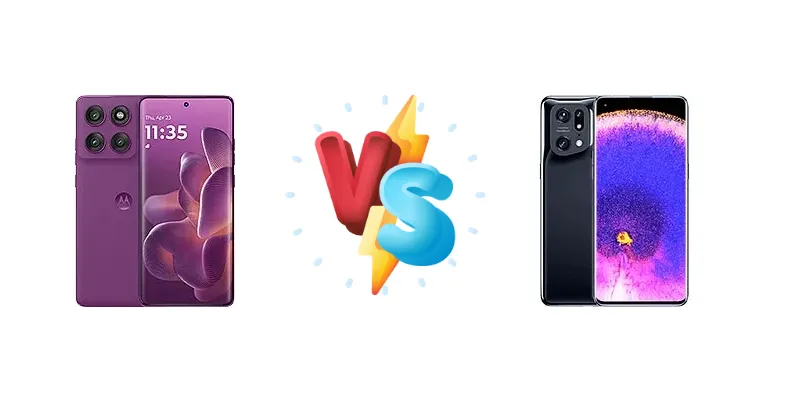
Motorola Edge 60 Pro vs Oppo Find X5 Pro: A Deep Dive into Flagship Performance and Value
| Phones Images | |||||
|---|---|---|---|---|---|
|
🏆 Quick Verdict
For most users, the Motorola Edge 60 Pro emerges as the stronger contender. Its significantly faster 90W charging, coupled with a brighter display and competitive performance from the Dimensity 8350 Extreme, offers a more compelling package, especially considering its likely lower price point compared to the older Find X5 Pro.
| PHONES | ||
|---|---|---|
| Phone Names | Motorola Edge 60 Pro | Oppo Find X5 Pro |
| Network | ||
|---|---|---|
| 2G bands | GSM 850 / 900 / 1800 / 1900 | GSM 850 / 900 / 1800 / 1900 |
| 3G bands | HSDPA 850 / 900 / 1700(AWS) / 1900 / 2100 | HSDPA 800 / 850 / 900 / 1700(AWS) / 1900 / 2100 |
| 4G bands | 1, 2, 3, 4, 5, 7, 8, 11, 12, 13, 17, 18, 19, 20, 25, 26, 28, 32, 34, 38, 39, 40, 41, 42, 43, 66, 71 | 1, 2, 3, 4, 5, 7, 8, 12, 13, 17, 18, 19, 20, 25, 26, 28, 32, 34, 38, 39, 40, 41, 42, 66 - Global |
| 5G bands | 1, 2, 3, 5, 7, 8, 20, 26, 28, 38, 40, 41, 66, 71, 75, 77, 78 SA/NSA/Sub6 | 1, 2, 3, 5, 7, 8, 12, 13, 18, 20, 25, 26, 28, 38, 40, 41, 66, 77, 78, 79 SA/NSA - Global |
| Speed | HSPA, LTE, 5G | HSPA, LTE, 5G |
| Technology | GSM / HSPA / LTE / 5G | GSM / CDMA / HSPA / CDMA2000 / LTE / 5G |
| - | 1, 2, 3, 5, 8, 20, 28, 38, 41, 66, 77, 78, 79 SA/NSA - China | |
| Launch | ||
|---|---|---|
| Announced | 2025, April 24 | 2022, February 24 |
| Status | Available. Released 2025, April 30 | Available. Released 2022, March 14 |
| Body | ||
|---|---|---|
| Build | Glass front (Gorilla Glass 7i), plastic frame, silicone polymer (eco leather) back | Glass front (Gorilla Glass Victus), ceramic back or eco leather back, aluminum frame |
| Dimensions | 160.7 x 73.1 x 8.2 mm (6.33 x 2.88 x 0.32 in) | 163.7 x 73.9 x 8.5 or 8.8 mm |
| SIM | · Nano-SIM· Nano-SIM + eSIM· Nano-SIM + Nano-SIM | Nano-SIM + eSIM |
| Weight | 186 g (6.56 oz) | 218 g or 195 g (6.88 oz) |
| - | IP68 dust/water resistant (up to 1.5m for 30 min) | |
| Display | ||
|---|---|---|
| Protection | Corning Gorilla Glass 7i, Mohs level 4 | Corning Gorilla Glass Victus |
| Resolution | 1220 x 2712 pixels, 20:9 ratio (~444 ppi density) | 1440 x 3216 pixels, 20:9 ratio (~525 ppi density) |
| Size | 6.7 inches, 108.4 cm2 (~92.2% screen-to-body ratio) | 6.7 inches, 108.4 cm2 (~89.6% screen-to-body ratio) |
| Type | P-OLED, 1B colors, 120Hz, 720Hz PWM, HDR10+, 4500 nits peak | LTPO2 AMOLED, 1B colors, 120Hz, HDR10+, BT.2020, 500 nits (typ), 800 nits (HBM), 1300 nits (peak) |
| Platform | ||
|---|---|---|
| CPU | Octa-core (1x3.35 GHz Cortex-A715 & 3x3.20 GHz Cortex-A715 & 4x2.20 GHz Cortex-A510) | Octa-core (1x3.00 GHz Cortex-X2 & 3x2.50 GHz Cortex-A710 & 4x1.80 GHz Cortex-A510) - GlobalOcta-core (1x3.05 GHz Cortex-X2 & 3x2.85 GHz Cortex-A710 & 4x1.80 GHz Cortex-A510) - China |
| Chipset | Mediatek Dimensity 8350 Extreme (4 nm) | Qualcomm SM8450 Snapdragon 8 Gen 1 (4 nm) - GlobalMediatek Dimensity 9000 (4 nm) - China |
| GPU | Mali G615-MC6 | Adreno 730 - GlobalMali-G710 MC10 - China |
| OS | Android 15, up to 3 major Android upgrades | Android 12, upgradable to Android 14, ColorOS 14 |
| Memory | ||
|---|---|---|
| Card slot | No | No |
| Internal | 256GB 8GB RAM, 256GB 12GB RAM, 512GB 12GB RAM, 512GB 16GB RAM | 256GB 8GB RAM, 256GB 12GB RAM, 512GB 12GB RAM |
| - | UFS 3.1 | |
| Main Camera | ||
|---|---|---|
| Features | Color spectrum sensor, LED flash, HDR, panorama, Pantone Validated Colour and Skin Tones | Hasselblad Color Calibration, color spectrum sensor, LED flash, HDR, panorama |
| Single | - | 32 MP, f/2.4, 21mm (wide), 1/2.74", 0.8µm |
| Triple | 50 MP, f/1.8, 24mm (wide), 1/1.56", 1.0µm, multi-directional PDAF, OIS 10 MP, f2.0, 73mm (telephoto), 1/3.94", 1.0µm, PDAF, 3x optical zoom, OIS 50 MP, f/2.0, 120˚ (ultrawide), 1/2.76", 0.64µm, PDAF | 50 MP, f/1.7, 25mm (wide), 1/1.56", 1.0µm, multi-directional PDAF, OIS (3-axis sensor-shift, 2-axis lens-shift) 13 MP, f/2.4, 52mm (telephoto), 1/3.4", 2x optical zoom, PDAF 50 MP, f/2.2, 15mm, 110˚ (ultrawide), 1/1.56", 1.0µm, multi-directional PDAF |
| Video | 4K@30fps, 1080p@30/60/120/240fps, gyro-EIS, HDR10+ | 4K@30/60fps, 1080p@30/60/240fps; gyro-EIS; HDR, 10‑bit video |
| Selfie camera | ||
|---|---|---|
| Features | HDR | Panorama |
| Single | 50 MP, f/2.0, (wide), 1/2.76", 0.64µm | 32 MP, f/2.4, 21mm (wide), 1/2.74", 0.8µm |
| Video | 4K@30fps, 1080p@30/120fps | 1080p@30fps, gyro-EIS |
| Sound | ||
|---|---|---|
| 3.5mm jack | - | No |
| 35mm jack | No | No |
| Loudspeaker | Yes, with stereo speakers (with Dolby Atmos) | Yes, with stereo speakers |
| Comms | ||
|---|---|---|
| Bluetooth | Yes | 5.2, A2DP, LE, aptX HD |
| NFC | Yes | Yes |
| Positioning | GPS, GLONASS, GALILEO, BDS, NavIC | GPS (L1), GLONASS (L1), BDS (B1I+B1c), GALILEO (E1+E5a), QZSS (L1) |
| Radio | No | No |
| USB | USB Type-C, OTG | USB Type-C 3.1, OTG |
| WLAN | Wi-Fi 802.11 a/b/g/n/ac/6e, tri-band | Wi-Fi 802.11 a/b/g/n/ac/6e, dual-band, Wi-Fi Direct |
| Features | ||
|---|---|---|
| Sensors | Fingerprint (under display, optical), accelerometer, gyro, proximity, compass | Fingerprint (under display, optical), accelerometer, gyro, proximity, compass |
| - | Oppo Find X5 Pro Dimensity model has no MariSilicon X image chip, 5-axis OIS and Hasselblad’s color calibration | |
| Battery | ||
|---|---|---|
| Charging | 90W wired, PD3.0 15W wireless 5W reverse wired | 80W wired, PD, 50% in 12 min 50W wireless, 100% in 47 min 10W reverse wireless |
| Type | Si/C Li-Ion 6000 mAh | Li-Po 5000 mAh |
| Misc | ||
|---|---|---|
| Colors | Pantone: Shadow, Dazzling Blue , Sparkling Grape | Ceramic Black, Ceramic White, Blue (eco leather) |
| Models | XT2507-1 | PFEM10, CPH2305, PFFM20 |
| Price | € 399.00 / $ 515.00 / £ 445.00 / ₹ 27,599 | € 449.00 / $ 430.24 / £ 1,049.00 |
| SAR EU | 0.90 W/kg (head) 1.39 W/kg (body) | - |
| Tests | ||
|---|---|---|
| Battery life | - | Endurance rating 101h |
| Camera | - | Photo / Video |
| Display | - | Contrast ratio: Infinite (nominal) |
| Loudspeaker | - | -24.7 LUFS (Very good) |
| Performance | - | AnTuTu: 1012896 (v9) GeekBench: 3433 (v5.1) GFXBench: 44fps (ES 3.1 onscreen) |
| EU LABEL | ||
|---|---|---|
| Battery | 67:47h endurance, 1000 cycles | - |
| Energy | Class A | - |
| Free fall | Class A (270 falls) | - |
| Repairability | Class B | - |
Motorola Edge 60 Pro
- Significantly faster 90W wired charging
- Brighter display for better outdoor visibility
- Potentially more efficient Dimensity 8350 Extreme chipset
- Slightly lower initial endurance rating (based on older testing)
- Camera details are currently unknown
Oppo Find X5 Pro
- Potentially refined camera image processing (Oppo's strength)
- 50W wireless charging is faster than Edge 60 Pro's
- Established brand reputation in photography
- Slower 80W wired charging
- Dimmer display compared to the Edge 60 Pro
- Snapdragon 8 Gen 1 may throttle under sustained load
Display Comparison
The Motorola Edge 60 Pro boasts a substantial advantage in display brightness, reaching a measured 1595 nits compared to the Oppo Find X5 Pro’s 762 nits. This translates to significantly better visibility under direct sunlight. While the Oppo Find X5 Pro claims an 'Infinite' contrast ratio, this is a standard marketing term and doesn’t necessarily indicate superior image quality. The lack of refresh rate information for both devices makes a direct comparison difficult, but both are likely to offer smooth scrolling experiences. The Edge 60 Pro’s higher peak brightness is a clear win for outdoor usability.
Camera Comparison
Both devices are listed as having capable photo and video capabilities, but the provided data lacks specifics. Without sensor size, aperture information, or details on image processing algorithms, a definitive comparison is impossible. The Oppo Find X5 Pro’s camera system likely benefits from Oppo’s established image processing expertise, but the Edge 60 Pro’s newer hardware could offer improvements in low-light performance. The absence of detail prevents a meaningful assessment beyond acknowledging both are marketed as strong camera phones.
Performance
The Motorola Edge 60 Pro’s MediaTek Dimensity 8350 Extreme (4nm) and the Oppo Find X5 Pro’s Snapdragon 8 Gen 1 (4nm) are both high-end chipsets, but differ in architecture. The Snapdragon 8 Gen 1 utilizes a Cortex-X2 prime core, while the Dimensity 8350 Extreme employs a cluster of Cortex-A715 cores. The Dimensity 8350 Extreme’s architecture is generally considered more efficient, potentially leading to better sustained performance and thermal management. The Find X5 Pro’s China variant with the Dimensity 9000 offers a slight CPU clock speed advantage, but real-world gains are likely minimal. Both devices utilize 4nm fabrication, but the Dimensity 8350 Extreme’s newer design may offer a slight edge in power efficiency.
Battery Life
The Oppo Find X5 Pro initially boasts a 101-hour endurance rating, but this is based on older testing methodologies. The Motorola Edge 60 Pro delivers 67.47 hours of endurance, but crucially, it features significantly faster charging at 90W wired, capable of a full charge much quicker than the Find X5 Pro’s 80W. The Edge 60 Pro also offers 15W wireless and 5W reverse wired charging, while the Find X5 Pro provides 50W wireless and 10W reverse wireless. The Edge 60 Pro’s faster charging and comparable endurance make it more convenient for users who frequently need to top up their battery.
Buying Guide
Buy the Motorola Edge 60 Pro if you prioritize rapid charging, a vibrant and bright display for outdoor use, and a modern chipset optimized for efficiency. Buy the Oppo Find X5 Pro if you value a potentially more refined camera experience (though specifics are lacking in the provided data) and are willing to accept slower charging speeds and a slightly dimmer screen. The Find X5 Pro may appeal to those already invested in the Oppo ecosystem.