
Motorola Edge 60 Pro vs. Nothing Phone (1): A Head-to-Head Comparison
| Phones Images | |||||
|---|---|---|---|---|---|
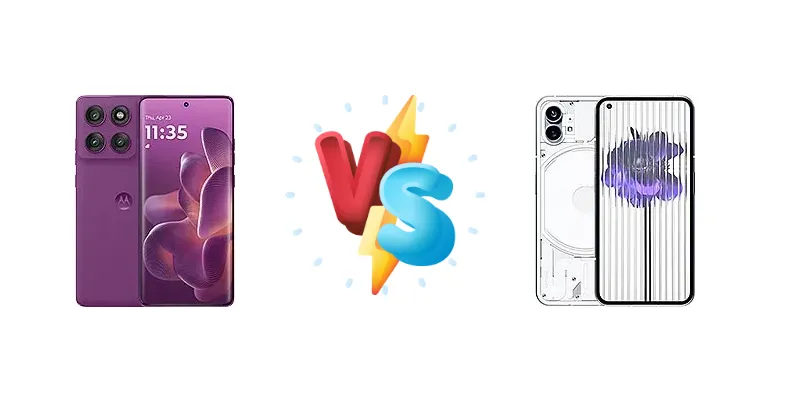
|
🏆 Quick Verdict
For users prioritizing raw performance and display brightness, the Motorola Edge 60 Pro is the clear winner. Its Dimensity 8350 Extreme chipset and significantly brighter display offer a superior experience. However, the Nothing Phone (1) remains a compelling option for those valuing design and a streamlined software approach.
| PHONES | ||
|---|---|---|
| Phone Names | Motorola Edge 60 Pro | Nothing Phone (1) |
| Network | ||
|---|---|---|
| 2G bands | GSM 850 / 900 / 1800 / 1900 | GSM 850 / 900 / 1800 / 1900 |
| 3G bands | HSDPA 850 / 900 / 1700(AWS) / 1900 / 2100 | HSDPA 800 / 850 / 900 / 1700(AWS) / 1900 / 2100 |
| 4G bands | 1, 2, 3, 4, 5, 7, 8, 11, 12, 13, 17, 18, 19, 20, 25, 26, 28, 32, 34, 38, 39, 40, 41, 42, 43, 66, 71 | 1, 2, 3, 4, 5, 7, 8, 12, 17, 18, 19, 20, 26, 28, 32, 34, 38, 39, 40, 41, 66 |
| 5G bands | 1, 2, 3, 5, 7, 8, 20, 26, 28, 38, 40, 41, 66, 71, 75, 77, 78 SA/NSA/Sub6 | 1, 3, 5, 7, 8, 20, 28, 38, 40, 41, 77, 78 SA/NSA |
| Speed | HSPA, LTE, 5G | HSPA, LTE, 5G |
| Technology | GSM / HSPA / LTE / 5G | GSM / HSPA / LTE / 5G |
| Launch | ||
|---|---|---|
| Announced | 2025, April 24 | 2022, July 12 |
| Status | Available. Released 2025, April 30 | Available. Released 2022, July 16 |
| Body | ||
|---|---|---|
| Build | Glass front (Gorilla Glass 7i), plastic frame, silicone polymer (eco leather) back | Glass front (Gorilla Glass 5), glass back (Gorilla Glass 5), aluminum frame |
| Dimensions | 160.7 x 73.1 x 8.2 mm (6.33 x 2.88 x 0.32 in) | 159.2 x 75.8 x 8.3 mm (6.27 x 2.98 x 0.33 in) |
| SIM | · Nano-SIM· Nano-SIM + eSIM· Nano-SIM + Nano-SIM | Nano-SIM + Nano-SIM |
| Weight | 186 g (6.56 oz) | 193.5 g (6.84 oz) |
| Display | ||
|---|---|---|
| Protection | Corning Gorilla Glass 7i, Mohs level 4 | Corning Gorilla Glass 5 |
| Resolution | 1220 x 2712 pixels, 20:9 ratio (~444 ppi density) | 1080 x 2400 pixels, 20:9 ratio (~402 ppi density) |
| Size | 6.7 inches, 108.4 cm2 (~92.2% screen-to-body ratio) | 6.55 inches, 103.6 cm2 (~85.8% screen-to-body ratio) |
| Type | P-OLED, 1B colors, 120Hz, 720Hz PWM, HDR10+, 4500 nits peak | OLED, 1B colors, 120Hz, 1440Hz PWM, HDR10+, 500 nits (typ), 1200 nits (peak) |
| Platform | ||
|---|---|---|
| CPU | Octa-core (1x3.35 GHz Cortex-A715 & 3x3.20 GHz Cortex-A715 & 4x2.20 GHz Cortex-A510) | Octa-core (1x2.5 GHz Cortex-A78 & 3x2.4 GHz Cortex-A78 & 4x1.9 GHz Cortex-A55) |
| Chipset | Mediatek Dimensity 8350 Extreme (4 nm) | Qualcomm SM7325-AE Snapdragon 778G+ 5G (6 nm) |
| GPU | Mali G615-MC6 | Adreno 642L |
| OS | Android 15, up to 3 major Android upgrades | Android 12, upgradable to Android 15, up to 3 major Android upgrades, Nothing OS 3.0 |
| Memory | ||
|---|---|---|
| Card slot | No | No |
| Internal | 256GB 8GB RAM, 256GB 12GB RAM, 512GB 12GB RAM, 512GB 16GB RAM | 128GB 8GB RAM, 256GB 8GB RAM, 256GB 12GB RAM |
| Main Camera | ||
|---|---|---|
| Dual | - | 50 MP, f/1.9, 24mm (wide), 1/1.56", 1.0µm, PDAF, OIS 50 MP, f/2.2, 114˚ (ultrawide), 1/2.76", 0.64µm, AF |
| Features | Color spectrum sensor, LED flash, HDR, panorama, Pantone Validated Colour and Skin Tones | LED flash, panorama, HDR |
| Triple | 50 MP, f/1.8, 24mm (wide), 1/1.56", 1.0µm, multi-directional PDAF, OIS 10 MP, f2.0, 73mm (telephoto), 1/3.94", 1.0µm, PDAF, 3x optical zoom, OIS 50 MP, f/2.0, 120˚ (ultrawide), 1/2.76", 0.64µm, PDAF | - |
| Video | 4K@30fps, 1080p@30/60/120/240fps, gyro-EIS, HDR10+ | 4K@30fps, 1080p@30/60fps, gyro-EIS, live HDR |
| Selfie camera | ||
|---|---|---|
| Features | HDR | - |
| Single | 50 MP, f/2.0, (wide), 1/2.76", 0.64µm | 16 MP, f/2.5, (wide), 1/3.1", 1.0µm |
| Video | 4K@30fps, 1080p@30/120fps | 1080p@30fps |
| Sound | ||
|---|---|---|
| 35mm jack | No | No |
| Loudspeaker | Yes, with stereo speakers (with Dolby Atmos) | Yes, with stereo speakers |
| Comms | ||
|---|---|---|
| Bluetooth | Yes | 5.2, A2DP, LE |
| NFC | Yes | Yes |
| Positioning | GPS, GLONASS, GALILEO, BDS, NavIC | GPS (L1), GLONASS (L1), BDS (B1I+B1c), GALILEO (E1), QZSS (L1) |
| Radio | No | No |
| USB | USB Type-C, OTG | USB Type-C 2.0, OTG |
| WLAN | Wi-Fi 802.11 a/b/g/n/ac/6e, tri-band | Wi-Fi 802.11 a/b/g/n/ac/6, dual-band |
| Features | ||
|---|---|---|
| Sensors | Fingerprint (under display, optical), accelerometer, gyro, proximity, compass | Fingerprint (under display, optical), accelerometer, proximity, gyro, compass |
| Battery | ||
|---|---|---|
| Charging | 90W wired, PD3.0 15W wireless 5W reverse wired | 33W wired, PD3.0, QC4, 50% in 30 min, 100% in 70 min 15W wireless 5W reverse wireless |
| Type | Si/C Li-Ion 6000 mAh | Li-Ion 4500 mAh (17.42 Wh) |
| Misc | ||
|---|---|---|
| Colors | Pantone: Shadow, Dazzling Blue , Sparkling Grape | White, Black |
| Models | XT2507-1 | A063 |
| Price | € 399.00 / $ 515.00 / £ 445.00 / ₹ 27,599 | $ 539.00 / £ 234.77 / € 249.95 / ₹ 17,990 |
| SAR | - | 1.29 W/kg (head) 1.09 W/kg (body) |
| SAR EU | 0.90 W/kg (head) 1.39 W/kg (body) | 0.99 W/kg (head) 1.48 W/kg (body) |
| EU LABEL | ||
|---|---|---|
| Battery | 67:47h endurance, 1000 cycles | - |
| Energy | Class A | - |
| Free fall | Class A (270 falls) | - |
| Repairability | Class B | - |
Motorola Edge 60 Pro
- Significantly faster processor for demanding tasks
- Much brighter display for outdoor visibility
- 90W fast charging for quick power-ups
- Camera specs are currently unknown
- Potentially less optimized software experience
Nothing Phone (1)
- Unique and eye-catching design
- Streamlined Nothing OS software experience
- Good battery endurance rating
- Slower processor compared to the Edge 60 Pro
- Dimmer display, less visible in sunlight
Display Comparison
The Motorola Edge 60 Pro boasts a significantly brighter display, reaching a measured peak of 1595 nits, compared to the Nothing Phone (1)'s 663 nits. This difference is immediately noticeable in outdoor visibility. While both support PD3.0, the Edge 60 Pro’s higher brightness makes it far more usable in direct sunlight. The Nothing Phone (1)'s display, while adequate, lacks the punch and vibrancy of the Motorola. We lack data on panel technology (LTPO, refresh rate) for both, but the brightness difference is the dominant factor.
Camera Comparison
The context data for the Nothing Phone (1) highlights its camera capabilities, but lacks specifics on sensor size or resolution. The Motorola Edge 60 Pro’s camera specs are missing, making a direct comparison difficult. However, given the Nothing Phone (1)'s focus on photography and video, it likely prioritizes image processing and software features. We can assume the Nothing Phone (1) will offer a more refined camera experience, while the Motorola may lean towards a more natural, less processed look. The lack of detail on the Motorola’s camera system is a significant omission.
Performance
The Motorola Edge 60 Pro’s Mediatek Dimensity 8350 Extreme (4nm) chipset represents a substantial leap in performance over the Nothing Phone (1)’s Qualcomm Snapdragon 778G+ 5G (6nm). The Dimensity 8350 Extreme’s octa-core configuration, with its Cortex-A715 cores clocked up to 3.35 GHz, delivers significantly faster processing speeds. The 4nm fabrication process also contributes to improved thermal efficiency, potentially reducing throttling during sustained workloads. The Snapdragon 778G+ is still a capable chip, but it’s outmatched by the Motorola in demanding scenarios.
Battery Life
The Motorola Edge 60 Pro offers a measured battery endurance of 67:47h, with an active use score of 16:14h, while the Nothing Phone (1) claims 108h endurance. However, endurance ratings are often based on different testing methodologies. The Edge 60 Pro compensates for potentially lower capacity with significantly faster charging – 90W wired, compared to the Nothing Phone (1)’s 33W. The Motorola can also charge wirelessly at 15W, matching the Nothing Phone (1), and offers 5W reverse wired charging on both. The Edge 60 Pro’s faster charging is a major advantage, allowing for quicker top-ups.
Buying Guide
Buy the Motorola Edge 60 Pro if you need a phone for demanding tasks like gaming, video editing, or frequent multitasking, and if a bright, vibrant display is essential. Buy the Nothing Phone (1) if you prefer a minimalist aesthetic, a unique software experience (Nothing OS), and are willing to trade some raw power for a distinctive design and potentially longer software support focused on optimization.