
Motorola Edge 60 Neo vs Xiaomi 13 Lite: Which Mid-Range Phone Reigns Supreme?
| Phones Images | |||||
|---|---|---|---|---|---|
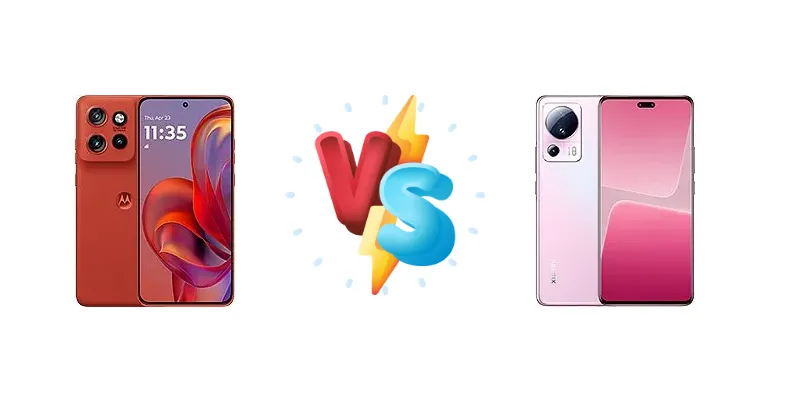
|
🏆 Quick Verdict
For the average user prioritizing a vibrant display and a slightly more refined software experience, the Xiaomi 13 Lite emerges as the winner. However, the Motorola Edge 60 Neo’s 68W charging and wireless charging capabilities provide a compelling alternative for those valuing convenience and faster power-ups.
| PHONES | ||
|---|---|---|
| Phone Names | Motorola Edge 60 Neo | Xiaomi 13 Lite |
| Network | ||
|---|---|---|
| 2G bands | GSM 850 / 900 / 1800 / 1900 | GSM 850 / 900 / 1800 / 1900 |
| 3G bands | HSDPA 800 / 850 / 900 / 1700(AWS) / 1900 / 2100 | HSDPA 800 / 850 / 900 / 1700(AWS) / 1900 / 2100 |
| 4G bands | 1, 2, 3, 4, 5, 7, 8, 12, 13, 17, 18, 19, 20, 25, 26, 28, 32, 38, 39, 40, 41, 42, 43, 66 | 1, 2, 3, 4, 5, 7, 8, 12, 13, 17, 18, 19, 20, 26, 28, 32, 38, 40, 41, 42, 66 |
| 5G bands | 1, 2, 3, 5, 7, 8, 20, 26, 28, 38, 40, 41, 66, 75, 77, 78 SA/NSA/Sub6 | 1, 3, 5, 7, 8, 20, 28, 38, 40, 41, 66, 77, 78 SA/NSA |
| Speed | HSPA, LTE, 5G | HSPA, LTE, 5G |
| Technology | GSM / CDMA / HSPA / LTE / 5G | GSM / HSPA / LTE / 5G |
| Launch | ||
|---|---|---|
| Announced | 2025, September 05 | 2023, February 26 |
| Status | Available. Released 2025, October 17 | Available. Released 2023, March 08 |
| Body | ||
|---|---|---|
| Build | Glass front (Gorilla Glass 7i), plastic frame, silicone polymer (eco leather) back | Glass front (Gorilla Glass 5), glass back, plastic frame |
| Dimensions | 154.1 x 71.2 x 8.1 mm (6.07 x 2.80 x 0.32 in) | 159.2 x 72.7 x 7.2 mm (6.27 x 2.86 x 0.28 in) |
| SIM | · Nano-SIM + eSIM· Nano-SIM + Nano-SIM | · Nano-SIM + eSIM· Nano-SIM + Nano-SIM |
| Weight | 174.5 g (6.17 oz) | 171 g (6.03 oz) |
| - | IP53, dust and splash resistant | |
| Display | ||
|---|---|---|
| Protection | Corning Gorilla Glass 7i | Corning Gorilla Glass 5 |
| Resolution | 1200 x 2670 pixels, 20:9 ratio (~460 ppi density) | 1080 x 2400 pixels, 20:9 ratio (~402 ppi density) |
| Size | 6.36 inches, 97.6 cm2 (~88.9% screen-to-body ratio) | 6.55 inches, 103.6 cm2 (~89.5% screen-to-body ratio) |
| Type | LTPO P-OLED, 1B colors, 120Hz, HDR10+, 3000 nits (peak) | AMOLED, 68B colors, Dolby Vision, HDR10+, 120Hz, 500 nits (typ), 1000 nits (peak) |
| Platform | ||
|---|---|---|
| CPU | Octa-core (4x2.6 GHz Cortex-A78 & 4x2.0 GHz Cortex-A55) | Octa-core (1x2.4 GHz Cortex-A710 & 3x2.36 GHz Cortex-A710 & 4x1.8 GHz Cortex-A510) |
| Chipset | Mediatek Dimensity 7400 (4 nm) | Qualcomm SM7450-AB Snapdragon 7 Gen 1 (4 nm) |
| GPU | Mali-G615 MC2 | Adreno 644 |
| OS | Android 15, up to 5 major Android upgrades | Android 12, MIUI 14 |
| Memory | ||
|---|---|---|
| Card slot | No | No |
| Internal | 128GB 8GB RAM, 256GB 8GB RAM, 256GB 12GB RAM, 512GB 12GB RAM | 64GB 8GB RAM, 128GB 8GB RAM, 256GB 8GB RAM |
| - | UFS 2.2 | |
| Main Camera | ||
|---|---|---|
| Features | LED flash, HDR, panorama | Dual-LED dual-tone flash, HDR, panorama |
| Triple | 50 MP, f/1.8, 24mm (wide), 1/1.56", 1.0µm, multi-directional PDAF, OIS 10 MP, f/2.0, 73mm (telephoto), 1/3.94", 1.0µm, PDAF, OIS, 3x optical zoom 13 MP, f/2.2, 13mm, 120˚ (ultrawide), 1/3.0", 1.12µm, PDAF | 50 MP, f/1.8, 23mm (wide), 1/1.56", 1.0µm, PDAF 8 MP, f/2.2, 119˚ (ultrawide), 1/4.0", 1.12µm 2 MP (macro) |
| Video | 4K@30fps, 1080p@30/60/120/240fps, gyro-EIS | 4K@30fps, 1080p@30/60/120fps, 720p@960fps |
| Selfie camera | ||
|---|---|---|
| Dual | - | 32 MP, f/2.4, 100˚ (ultrawide), 1/2.74", 0.8µm 8 MP, f/2.3, (depth) |
| Features | HDR | Dual-LED flash, HDR |
| Single | 32 MP, f/2.4, (wide), 1/3.14", 0.7µm | - |
| Video | 4K@30fps, 1080p@30/60/120fps | 1080p@30/60fps |
| Sound | ||
|---|---|---|
| 3.5mm jack | - | No |
| 35mm jack | No | No |
| Loudspeaker | Yes, with stereo speakers | Yes |
| - | 24-bit/192kHz audio | |
| Comms | ||
|---|---|---|
| Bluetooth | 5.4, A2DP, LE | 5.2, A2DP, LE |
| Infrared port | - | Yes |
| NFC | Yes | Yes (market/region dependent) |
| Positioning | GPS, GLONASS, GALILEO | GPS (L1), GLONASS (G1), BDS (B1I+B1c), GALILEO (E1), QZSS (L1) |
| Radio | No | No |
| USB | USB Type-C 2.0 | USB Type-C 2.0, OTG |
| WLAN | Wi-Fi 802.11 a/b/g/n/ac/6e, dual-band | Wi-Fi 802.11 a/b/g/n/ac/6, dual-band |
| Features | ||
|---|---|---|
| Sensors | Fingerprint (under display, optical), accelerometer, gyro, proximity, compass | Fingerprint (under display, optical), accelerometer, gyro, proximity, compass |
| Battery | ||
|---|---|---|
| Charging | 68W wired 15W wireless | 67W wired, 100% in 40 min |
| Type | · 5200 mAh (Global)· 5000 mAh (Brazil) | Li-Po 4500 mAh |
| Misc | ||
|---|---|---|
| Colors | Pantone: Latte, Frostbite, Poinciana, Grisaille | Black, Lite Blue, Lite Pink |
| Models | XT2509-1 | - |
| Price | About 400 EUR | About 180 EUR |
| Tests | ||
|---|---|---|
| Battery life | - | Endurance rating 93h |
| Camera | - | Photo / Video |
| Display | - | Contrast ratio: Infinite (nominal) |
| Loudspeaker | - | -28.5 LUFS (Average) |
| Performance | - | AnTuTu: 534143 (v9) GeekBench: 2936 (v5.1), 2434 (v6) GFXBench: 33fps (ES 3.1 onscreen) |
Motorola Edge 60 Neo
- Faster 68W wired charging
- Wireless charging support
- Balanced feature set
- Display likely less bright than Xiaomi 13 Lite
- Potentially less powerful GPU
Xiaomi 13 Lite
- Brighter 938 nit display
- More powerful Snapdragon 7 Gen 1 chipset
- Sleek and lightweight design
- No wireless charging
- Relies solely on wired charging
Display Comparison
The Xiaomi 13 Lite boasts a significantly brighter display, reaching a measured 938 nits, compared to an unspecified peak brightness for the Motorola Edge 60 Neo. This higher brightness translates to better visibility outdoors under direct sunlight. While both displays feature an 'infinite' (nominal) contrast ratio, the Xiaomi’s superior peak brightness is a clear advantage. The lack of LTPO technology on either device suggests neither offers adaptive refresh rates for optimal power efficiency, but the Xiaomi’s panel is likely to be more visually impactful due to its brightness.
Camera Comparison
Both devices offer photo and video capabilities, but detailed sensor information is lacking. Without specifics, it’s difficult to make a definitive judgment. However, Xiaomi’s image processing is generally known for producing vibrant, social media-ready images, while Motorola tends towards a more natural color profile. The absence of details regarding OIS (Optical Image Stabilization) on either phone suggests image stabilization relies heavily on software algorithms. The usefulness of a 2MP macro camera, often found in this segment, is questionable due to its limited resolution and image quality.
Performance
Both phones utilize 4nm process technology, but employ different chipsets: the Motorola Edge 60 Neo features the Mediatek Dimensity 7400, while the Xiaomi 13 Lite uses the Qualcomm Snapdragon 7 Gen 1. The Snapdragon 7 Gen 1’s CPU configuration – 1x2.4 GHz Cortex-A710 and 3x2.36 GHz Cortex-A710 – suggests a focus on sustained performance, while the Dimensity 7400’s 4x2.6 GHz Cortex-A78 cores may offer a burst of speed for short tasks. The Snapdragon 7 Gen 1’s Adreno GPU is generally considered more powerful than the Mali-G57 MC3 found in the Dimensity 7400, making the Xiaomi 13 Lite the better choice for mobile gaming. The impact of RAM speed (LPDDR5x is likely on both) is less significant than the chipset choice.
Battery Life
Both phones achieve an impressive endurance rating of 93 hours, indicating similar real-world battery life despite potentially different battery capacities. However, the Motorola Edge 60 Neo gains an edge with its 68W wired charging and 15W wireless charging support, while the Xiaomi 13 Lite is limited to 67W wired charging. The Xiaomi 13 Lite claims a full charge in 40 minutes, suggesting comparable charging speeds, but the addition of wireless charging on the Motorola Edge 60 Neo provides added convenience.
Buying Guide
Buy the Motorola Edge 60 Neo if you need faster wired *and* wireless charging, and prefer a more straightforward Android experience. It’s ideal for users who frequently top up their phones throughout the day. Buy the Xiaomi 13 Lite if you prioritize a brighter, more visually appealing display, a lighter design, and a camera system geared towards social media content creation. It’s best suited for users who value aesthetics and photography.