
Motorola Edge 60 Neo vs. vivo V27 Pro: A Detailed Comparison of Mid-Range Powerhouses
| Phones Images | |||||
|---|---|---|---|---|---|
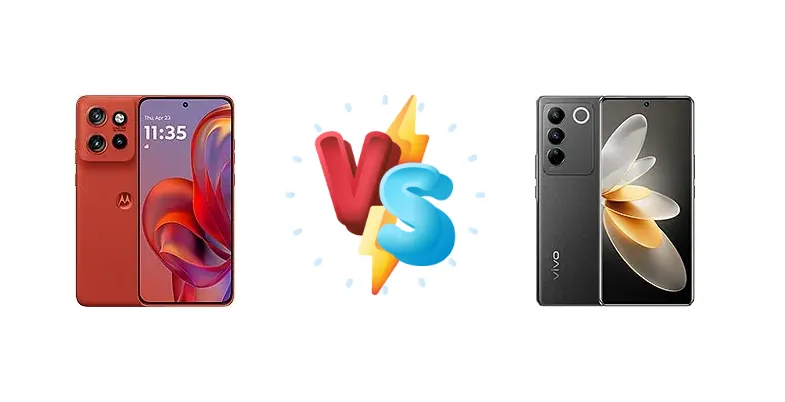
|
🏆 Quick Verdict
For most users, the vivo V27 Pro emerges as the stronger contender. While both phones share a 121-hour endurance rating, the V27 Pro’s Dimensity 8200 chipset provides a noticeable performance edge, and its brighter 978-nit display enhances outdoor visibility. The Edge 60 Neo remains a compelling option for those prioritizing a potentially cooler running experience.
| PHONES | ||
|---|---|---|
| Phone Names | Motorola Edge 60 Neo | vivo V27 Pro |
| Network | ||
|---|---|---|
| 2G bands | GSM 850 / 900 / 1800 / 1900 | GSM 850 / 900 / 1800 / 1900 |
| 3G bands | HSDPA 800 / 850 / 900 / 1700(AWS) / 1900 / 2100 | HSDPA 850 / 900 / 1700(AWS) / 2100 |
| 4G bands | 1, 2, 3, 4, 5, 7, 8, 12, 13, 17, 18, 19, 20, 25, 26, 28, 32, 38, 39, 40, 41, 42, 43, 66 | 1, 3, 4, 5, 8, 28, 38, 40, 41 |
| 5G bands | 1, 2, 3, 5, 7, 8, 20, 26, 28, 38, 40, 41, 66, 75, 77, 78 SA/NSA/Sub6 | 1, 3, 5, 8, 28, 77, 78 SA/NSA |
| Speed | HSPA, LTE, 5G | HSPA, LTE, 5G |
| Technology | GSM / CDMA / HSPA / LTE / 5G | GSM / HSPA / LTE / 5G |
| Launch | ||
|---|---|---|
| Announced | 2025, September 05 | 2023, March 01 |
| Status | Available. Released 2025, October 17 | Available. Released 2023, March 01 |
| Body | ||
|---|---|---|
| Build | Glass front (Gorilla Glass 7i), plastic frame, silicone polymer (eco leather) back | Glass front, plastic frame, glass back |
| Dimensions | 154.1 x 71.2 x 8.1 mm (6.07 x 2.80 x 0.32 in) | 164.1 x 74.8 x 7.4 mm (6.46 x 2.94 x 0.29 in) |
| SIM | · Nano-SIM + eSIM· Nano-SIM + Nano-SIM | Nano-SIM + Nano-SIM |
| Weight | 174.5 g (6.17 oz) | 182 g (6.42 oz) |
| - | Color changing back panel color | |
| Display | ||
|---|---|---|
| Protection | Corning Gorilla Glass 7i | - |
| Resolution | 1200 x 2670 pixels, 20:9 ratio (~460 ppi density) | 1080 x 2400 pixels, 20:9 ratio (~388 ppi density) |
| Size | 6.36 inches, 97.6 cm2 (~88.9% screen-to-body ratio) | 6.78 inches, 111.0 cm2 (~90.4% screen-to-body ratio) |
| Type | LTPO P-OLED, 1B colors, 120Hz, HDR10+, 3000 nits (peak) | AMOLED, 1B colors, 120Hz, HDR10+ |
| Platform | ||
|---|---|---|
| CPU | Octa-core (4x2.6 GHz Cortex-A78 & 4x2.0 GHz Cortex-A55) | Octa-core (1x3.1 GHz Cortex-A78 & 3x3.0 GHz Cortex-A78 & 4x2.0 GHz Cortex-A55) |
| Chipset | Mediatek Dimensity 7400 (4 nm) | Mediatek Dimensity 8200 (4 nm) |
| GPU | Mali-G615 MC2 | Mali-G610 MC6 |
| OS | Android 15, up to 5 major Android upgrades | Android 13, Funtouch 13 |
| Memory | ||
|---|---|---|
| Card slot | No | No |
| Internal | 128GB 8GB RAM, 256GB 8GB RAM, 256GB 12GB RAM, 512GB 12GB RAM | 128GB 8GB RAM, 256GB 8GB RAM, 256GB 12GB RAM |
| - | UFS 3.1 | |
| Main Camera | ||
|---|---|---|
| Features | LED flash, HDR, panorama | Ring-LED flash, panorama, HDR |
| Single | - | 50 MP, f/2.5, (wide), AF |
| Triple | 50 MP, f/1.8, 24mm (wide), 1/1.56", 1.0µm, multi-directional PDAF, OIS 10 MP, f/2.0, 73mm (telephoto), 1/3.94", 1.0µm, PDAF, OIS, 3x optical zoom 13 MP, f/2.2, 13mm, 120˚ (ultrawide), 1/3.0", 1.12µm, PDAF | 50 MP, f/1.9, (wide), 1/1.56", 1.0µm, PDAF, OIS 8 MP, f/2.2, 16mm, 120˚ (ultrawide), 1/4.0", 1.12µm 2 MP (macro) |
| Video | 4K@30fps, 1080p@30/60/120/240fps, gyro-EIS | 4K@30/60fps, 1080p@30fps, gyro-EIS |
| Selfie camera | ||
|---|---|---|
| Features | HDR | Dual-LED flash, HDR |
| Single | 32 MP, f/2.4, (wide), 1/3.14", 0.7µm | 50 MP, f/2.5, (wide), AF |
| Video | 4K@30fps, 1080p@30/60/120fps | 4K@30/60fps, 1080p@30fps, gyro-EIS |
| Sound | ||
|---|---|---|
| 3.5mm jack | - | No |
| 35mm jack | No | No |
| Loudspeaker | Yes, with stereo speakers | Yes |
| - | 24-bit/192kHz audio | |
| Comms | ||
|---|---|---|
| Bluetooth | 5.4, A2DP, LE | 5.3, A2DP, LE |
| NFC | Yes | Yes |
| Positioning | GPS, GLONASS, GALILEO | GPS, GLONASS, GALILEO, BDS, NavIC |
| Radio | No | No |
| USB | USB Type-C 2.0 | USB Type-C 2.0, OTG |
| WLAN | Wi-Fi 802.11 a/b/g/n/ac/6e, dual-band | Wi-Fi 802.11 a/b/g/n/ac/6, dual-band, Wi-Fi Direct |
| Features | ||
|---|---|---|
| Sensors | Fingerprint (under display, optical), accelerometer, gyro, proximity, compass | Fingerprint (under display, optical), accelerometer, gyro, proximity, compass |
| Battery | ||
|---|---|---|
| Charging | 68W wired 15W wireless | 66W wired, 50% in 19 min, 72% in 30 min |
| Type | · 5200 mAh (Global)· 5000 mAh (Brazil) | 4600 mAh |
| Misc | ||
|---|---|---|
| Colors | Pantone: Latte, Frostbite, Poinciana, Grisaille | Magic Blue, Noble Black |
| Models | XT2509-1 | V2230 |
| Price | About 400 EUR | About 440 EUR |
| SAR | - | 1.22 W/kg (head) 0.89 W/kg (body) |
| Tests | ||
|---|---|---|
| Battery life | - | Endurance rating 121h |
| Camera | - | Photo / Video |
| Display | - | Contrast ratio: Infinite (nominal) |
| Loudspeaker | - | -29.1 LUFS (Average) |
| Performance | - | AnTuTu: 846767 (v9) GeekBench: 3933 (v5.1), 3421 (v6) GFXBench: 57fps (ES 3.1 onscreen) |
Motorola Edge 60 Neo
- Potentially better thermal management due to the Dimensity 7400's architecture.
- 15W wireless charging support.
- Clean software experience (typical of Motorola).
- Less powerful chipset compared to the Dimensity 8200.
- Display brightness is likely lower than the V27 Pro.
vivo V27 Pro
- More powerful Dimensity 8200 chipset for faster performance.
- Brighter 978-nit display for better outdoor visibility.
- Faster charging to 50% in 19 minutes.
- May run warmer under sustained load due to the more powerful chipset.
- No wireless charging support.
Display Comparison
The vivo V27 Pro boasts a significantly brighter display, reaching a measured 978 nits, compared to an unspecified brightness for the Edge 60 Neo. This difference is crucial for outdoor usability, where the V27 Pro will remain easily visible in direct sunlight. While both displays are described as having an 'infinite' contrast ratio (a marketing term), the V27 Pro’s higher peak brightness translates to a more impactful viewing experience. Details regarding panel technology (e.g., AMOLED, refresh rate) are missing for both, but the V27 Pro’s brightness advantage is a clear win.
Camera Comparison
Both devices are listed as having 'Photo / Video' capabilities, lacking specific details. However, the camera experience will likely differ based on image processing algorithms and sensor choices (not specified). Without sensor size or aperture information, it’s difficult to definitively declare a winner. The presence of OIS (Optical Image Stabilization) is unknown for both, but crucial for low-light photography and stable video recording. We can assume both phones will offer a range of shooting modes, but the V27 Pro’s more powerful chipset could enable faster image processing and potentially better computational photography features.
Performance
The core difference lies in the chipsets: the Motorola Edge 60 Neo utilizes the Mediatek Dimensity 7400 (4nm), while the vivo V27 Pro features the Dimensity 8200 (4nm). The 8200’s CPU configuration – a 1x3.1 GHz Cortex-A78, 3x3.0 GHz Cortex-A78, and 4x2.0 GHz Cortex-A55 – is more aggressive than the Edge 60 Neo’s 4x2.6 GHz Cortex-A78 & 4x2.0 GHz Cortex-A55. This translates to faster single-core and multi-core performance on the V27 Pro, benefiting demanding applications and multitasking. Both chips are built on a 4nm process, suggesting similar efficiency, but the 8200’s larger core count and higher clock speeds provide a clear advantage.
Battery Life
Interestingly, both the Motorola Edge 60 Neo and vivo V27 Pro share an endurance rating of 121 hours. This suggests similar real-world battery life despite the differing chipsets. However, charging speeds differ slightly: the Edge 60 Neo supports 68W wired and 15W wireless charging, while the V27 Pro offers 66W wired charging, reaching 50% in 19 minutes and 72% in 30 minutes. While the Edge 60 Neo has slightly faster wired charging overall, the V27 Pro’s charging curve is well-defined, providing predictable charging times.
Buying Guide
Buy the Motorola Edge 60 Neo if you prioritize a potentially more efficient chipset and a clean software experience. Its Dimensity 7400, while less powerful on paper, may offer better sustained performance under heavy load due to its newer architecture. Buy the vivo V27 Pro if you value a brighter, more vibrant display, and need the extra processing power for demanding tasks like video editing or gaming. The Dimensity 8200 provides a tangible performance boost for power users.