
Google Pixel 7a vs. Motorola Edge 60 Neo: A Detailed Comparison
| Phones Images | |||||
|---|---|---|---|---|---|
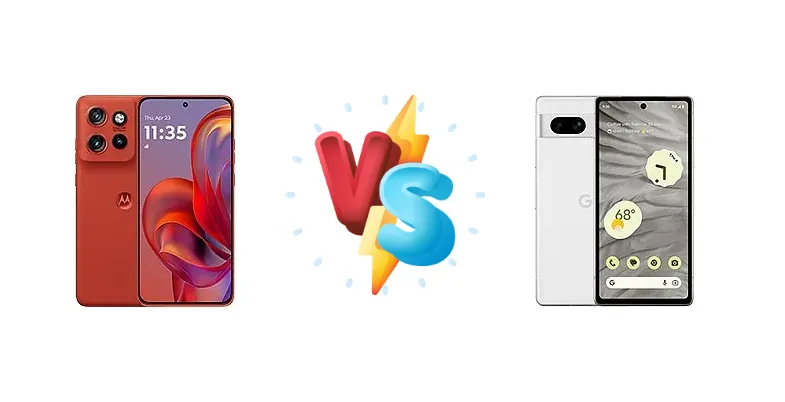
|
🏆 Quick Verdict
For most users, the Google Pixel 7a is the superior choice, primarily due to its exceptional camera capabilities and Google’s software support. However, the Motorola Edge 60 Neo is a strong contender for those prioritizing faster charging speeds and a potentially more streamlined Android experience.
| PHONES | ||
|---|---|---|
| Phone Names | Motorola Edge 60 Neo | Google Pixel 7a |
| Network | ||
|---|---|---|
| 2G bands | GSM 850 / 900 / 1800 / 1900 | GSM 850 / 900 / 1800 / 1900 |
| 3G bands | HSDPA 800 / 850 / 900 / 1700(AWS) / 1900 / 2100 | HSDPA 800 / 850 / 900 / 1700(AWS) / 1900 / 2100 |
| 4G bands | 1, 2, 3, 4, 5, 7, 8, 12, 13, 17, 18, 19, 20, 25, 26, 28, 32, 38, 39, 40, 41, 42, 43, 66 | 1, 2, 3, 4, 5, 7, 8, 12, 13, 14, 17, 20, 25, 26, 28, 29, 30, 38, 40, 41, 48, 66, 71 - GWKK3, G0DZQ |
| 5G bands | 1, 2, 3, 5, 7, 8, 20, 26, 28, 38, 40, 41, 66, 75, 77, 78 SA/NSA/Sub6 | 1, 2, 3, 5, 7, 8, 12, 14, 20, 25, 28, 30, 38, 41, 48, 66, 71, 77, 78 SA/NSA/Sub6 - GWKK3 |
| Speed | HSPA, LTE, 5G | HSPA, LTE, 5G |
| Technology | GSM / CDMA / HSPA / LTE / 5G | GSM / HSPA / LTE / 5G |
| - | 1, 2, 3, 5, 7, 8, 12, 20, 25, 28, 38, 40, 41, 66, 75, 76, 77, 78, 79 SA/NSA/Sub6 - GHL1X, G82U8 | |
| Launch | ||
|---|---|---|
| Announced | 2025, September 05 | 2023, May 10 |
| Status | Available. Released 2025, October 17 | Available. Released 2023, May 10 |
| Body | ||
|---|---|---|
| Build | Glass front (Gorilla Glass 7i), plastic frame, silicone polymer (eco leather) back | Glass front (Gorilla Glass 3), aluminum frame, plastic back |
| Dimensions | 154.1 x 71.2 x 8.1 mm (6.07 x 2.80 x 0.32 in) | 152 x 72.9 x 9 mm (5.98 x 2.87 x 0.35 in) |
| SIM | · Nano-SIM + eSIM· Nano-SIM + Nano-SIM | Nano-SIM + eSIM |
| Weight | 174.5 g (6.17 oz) | 193.5 g (6.84 oz) |
| - | IP67 dust/water resistant (up to 1m for 30 min) | |
| Display | ||
|---|---|---|
| Protection | Corning Gorilla Glass 7i | Corning Gorilla Glass 3 |
| Resolution | 1200 x 2670 pixels, 20:9 ratio (~460 ppi density) | 1080 x 2400 pixels, 20:9 ratio (~429 ppi density) |
| Size | 6.36 inches, 97.6 cm2 (~88.9% screen-to-body ratio) | 6.1 inches, 90.7 cm2 (~81.8% screen-to-body ratio) |
| Type | LTPO P-OLED, 1B colors, 120Hz, HDR10+, 3000 nits (peak) | OLED, HDR, 90Hz |
| - | Always-on display | |
| Platform | ||
|---|---|---|
| CPU | Octa-core (4x2.6 GHz Cortex-A78 & 4x2.0 GHz Cortex-A55) | Octa-core (2x2.85 GHz Cortex-X1 & 2x2.35 GHz Cortex-A78 & 4x1.80 GHz Cortex-A55) |
| Chipset | Mediatek Dimensity 7400 (4 nm) | Google Tensor G2 (5 nm) |
| GPU | Mali-G615 MC2 | Mali-G710 MP7 |
| OS | Android 15, up to 5 major Android upgrades | Android 13, upgradable to Android 15, up to 5 major Android upgrades |
| Memory | ||
|---|---|---|
| Card slot | No | No |
| Internal | 128GB 8GB RAM, 256GB 8GB RAM, 256GB 12GB RAM, 512GB 12GB RAM | 128GB 8GB RAM |
| - | UFS 3.1 | |
| Main Camera | ||
|---|---|---|
| Dual | - | 64 MP, f/1.9, 26mm (wide), 1/1.73", 0.8µm, dual pixel PDAF, OIS 13 MP, f/2.2, 120˚ (ultrawide), 1.12µm |
| Features | LED flash, HDR, panorama | Dual-LED flash, Pixel Shift, Auto-HDR, panorama |
| Triple | 50 MP, f/1.8, 24mm (wide), 1/1.56", 1.0µm, multi-directional PDAF, OIS 10 MP, f/2.0, 73mm (telephoto), 1/3.94", 1.0µm, PDAF, OIS, 3x optical zoom 13 MP, f/2.2, 13mm, 120˚ (ultrawide), 1/3.0", 1.12µm, PDAF | - |
| Video | 4K@30fps, 1080p@30/60/120/240fps, gyro-EIS | 4K@30/60fps, 1080p@30/60/120/240fps, OIS |
| Selfie camera | ||
|---|---|---|
| Features | HDR | HDR, panorama |
| Single | 32 MP, f/2.4, (wide), 1/3.14", 0.7µm | 13 MP, f/2.2, 20mm (ultrawide), 1.12µm |
| Video | 4K@30fps, 1080p@30/60/120fps | 4K@30fps, 1080p@30fps |
| Sound | ||
|---|---|---|
| 3.5mm jack | - | No |
| 35mm jack | No | No |
| Loudspeaker | Yes, with stereo speakers | Yes, with stereo speakers |
| Comms | ||
|---|---|---|
| Bluetooth | 5.4, A2DP, LE | 5.3, A2DP, LE |
| NFC | Yes | Yes |
| Positioning | GPS, GLONASS, GALILEO | GPS, GLONASS, GALILEO, BDS, QZSS, NavIC |
| Radio | No | No |
| USB | USB Type-C 2.0 | USB Type-C 3.2 |
| WLAN | Wi-Fi 802.11 a/b/g/n/ac/6e, dual-band | Wi-Fi 802.11 a/b/g/n/ac/6e, tri-band |
| Features | ||
|---|---|---|
| Sensors | Fingerprint (under display, optical), accelerometer, gyro, proximity, compass | Fingerprint (under display, optical), accelerometer, gyro, proximity, compass, barometer |
| Battery | ||
|---|---|---|
| Charging | 68W wired 15W wireless | 18W wired, PD3.0 7.5W wireless |
| Type | · 5200 mAh (Global)· 5000 mAh (Brazil) | Li-Po 4385 mAh |
| Misc | ||
|---|---|---|
| Colors | Pantone: Latte, Frostbite, Poinciana, Grisaille | Charcoal, Snow, Sea, Coral |
| Models | XT2509-1 | GWKK3, GHL1X, G0DZQ, G82U8 |
| Price | About 400 EUR | € 179.90 / $ 150.00 / £ 170.00 / ₹ 25,980 |
Motorola Edge 60 Neo
- Superior camera performance and image processing
- Powerful Google Tensor G2 chipset for AI tasks
- Guaranteed software updates and long-term support
- Slower charging speeds (18W)
- Potentially less customizable Android experience
Google Pixel 7a
- Incredibly fast 68W wired charging
- Sleek design and lightweight build
- Potentially more streamlined Android experience
- Less powerful chipset compared to Tensor G2
- Camera performance likely inferior to Pixel 7a
Display Comparison
The Pixel 7a boasts a measured peak brightness of 1070 nits, providing excellent visibility even in direct sunlight. While the Edge 60 Neo’s display specifications aren’t provided, Motorola typically utilizes OLED panels in this range. The Pixel 7a’s higher brightness is a significant advantage for outdoor use. The Pixel 7a’s display is likely to have a standard 60Hz refresh rate, while the Edge 60 Neo’s refresh rate is not specified, but is likely similar. Both devices likely employ similar color accuracy profiles, but the Pixel 7a benefits from Google’s color calibration expertise.
Camera Comparison
The Pixel 7a’s camera system is its standout feature. While specific sensor details aren’t provided, Google’s computational photography prowess, powered by the Tensor G2, elevates image quality significantly. The Pixel 7a excels in dynamic range, low-light performance, and overall image processing. The Edge 60 Neo’s camera specifications are not detailed enough to make a direct comparison, but Motorola typically focuses on providing a versatile camera experience. The Pixel 7a’s video capabilities are also superior, benefiting from Google’s advanced video stabilization and processing algorithms. The absence of detailed camera specs for the Edge 60 Neo makes a precise assessment difficult, but the Pixel 7a’s reputation for camera excellence is well-established.
Performance
The core difference lies in the chipsets: the Google Pixel 7a utilizes the Google Tensor G2 (5nm), while the Motorola Edge 60 Neo features the MediaTek Dimensity 7400 (4nm). The Tensor G2, with its Cortex-X1 prime core clocked at 2.85 GHz, offers a performance edge in CPU-intensive tasks and AI processing. The Dimensity 7400, while efficient due to its 4nm process, has a more conventional core configuration. The Tensor G2’s 5nm fabrication allows for greater transistor density and potentially better sustained performance under load. The Pixel 7a’s integrated TPU (Tensor Processing Unit) provides a significant advantage in machine learning tasks, enhancing features like voice recognition and image processing. The Edge 60 Neo’s performance will be more than adequate for everyday tasks, but the Pixel 7a will handle demanding applications and gaming more smoothly.
Battery Life
The Pixel 7a has an endurance rating of 76 hours, indicating solid battery life. The Edge 60 Neo compensates for potentially smaller battery capacity with its significantly faster 68W wired charging, allowing for a full charge in under an hour. The Pixel 7a’s 18W charging is comparatively slow. The Edge 60 Neo also supports 15W wireless charging, while the Pixel 7a offers 7.5W wireless charging. For users who prioritize quick top-ups, the Edge 60 Neo is the clear winner. However, the Pixel 7a’s overall endurance rating suggests it can comfortably last a full day for most users.
Buying Guide
Buy the Motorola Edge 60 Neo if you prioritize incredibly fast 68W charging and a lighter, more minimalist software experience. It’s ideal for users who frequently top up their phones and prefer a less intrusive Android skin. Buy the Google Pixel 7a if you value camera quality above all else, appreciate Google’s AI-powered features, and want guaranteed software updates for years to come. It’s the better choice for photography enthusiasts and those deeply integrated into the Google ecosystem.