
Motorola Edge 60 Fusion vs. Xiaomi 13 Lite: Which Mid-Range Phone Reigns Supreme?
| Phones Images | |||||
|---|---|---|---|---|---|
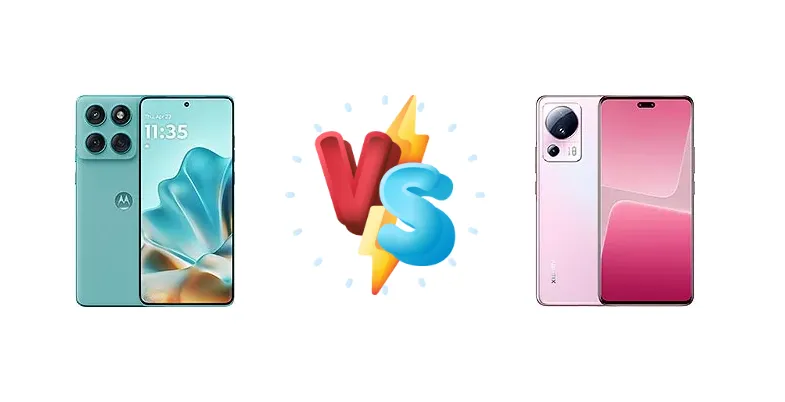
|
🏆 Quick Verdict
For most users, the Motorola Edge 60 Fusion emerges as the stronger contender. Its superior measured display brightness (1376 nits vs 938 nits) and potentially faster chipset (Dimensity 7400 in India/Indonesia) provide a more robust user experience, especially for media consumption and demanding tasks. While the Xiaomi 13 Lite boasts a sleek design, the Fusion’s performance edge is more impactful.
| PHONES | ||
|---|---|---|
| Phone Names | Motorola Edge 60 Fusion | Xiaomi 13 Lite |
| Network | ||
|---|---|---|
| 2G bands | GSM 850 / 900 / 1800 / 1900 | GSM 850 / 900 / 1800 / 1900 |
| 3G bands | HSDPA 850 / 900 / 1700(AWS) / 1900 / 2100 - International | HSDPA 800 / 850 / 900 / 1700(AWS) / 1900 / 2100 |
| 4G bands | 1, 2, 3, 4, 5, 7, 8, 12, 13, 17, 18, 19, 20, 25, 26, 28, 32, 34, 38, 39, 40, 41, 42, 43, 48, 66 - International | 1, 2, 3, 4, 5, 7, 8, 12, 13, 17, 18, 19, 20, 26, 28, 32, 38, 40, 41, 42, 66 |
| 5G bands | 1, 2, 3, 5, 7, 8, 20, 26, 28, 38, 40, 41, 66, 75, 77, 78 SA/NSA/Sub6 - International | 1, 3, 5, 7, 8, 20, 28, 38, 40, 41, 66, 77, 78 SA/NSA |
| Speed | HSPA, LTE, 5G | HSPA, LTE, 5G |
| Technology | GSM / HSPA / LTE / 5G | GSM / HSPA / LTE / 5G |
| Launch | ||
|---|---|---|
| Announced | 2025, April 02 | 2023, February 26 |
| Status | Available. Released 2025, April 09 | Available. Released 2023, March 08 |
| Body | ||
|---|---|---|
| Build | Glass front (Gorilla Glass 7i), silicone polymer back (eco leather) | Glass front (Gorilla Glass 5), glass back, plastic frame |
| Dimensions | 161 x 73 x 8.0 mm or 8.3 mm | 159.2 x 72.7 x 7.2 mm (6.27 x 2.86 x 0.28 in) |
| SIM | · Nano-SIM + eSIM· Nano-SIM + Nano-SIM | · Nano-SIM + eSIM· Nano-SIM + Nano-SIM |
| Weight | 177.5 g or 180 g (6.28 oz) | 171 g (6.03 oz) |
| - | IP53, dust and splash resistant | |
| Display | ||
|---|---|---|
| Protection | Corning Gorilla Glass 7i, Mohs level 4 | Corning Gorilla Glass 5 |
| Resolution | 1220 x 2712 pixels, 20:9 ratio (~446 ppi density) | 1080 x 2400 pixels, 20:9 ratio (~402 ppi density) |
| Size | 6.67 inches, 107.4 cm2 (~91.4% screen-to-body ratio) | 6.55 inches, 103.6 cm2 (~89.5% screen-to-body ratio) |
| Type | P-OLED, 1B colors, 120Hz, HDR10+, 1500 nits (HBM), 4500 nits (peak) | AMOLED, 68B colors, Dolby Vision, HDR10+, 120Hz, 500 nits (typ), 1000 nits (peak) |
| Platform | ||
|---|---|---|
| CPU | Octa-core (4x2.5 GHz Cortex-A78 & 4x2.0 GHz Cortex-A55) - GlobalOcta-core (4x2.6 GHz Cortex-A78 & 4x2.0 GHz Cortex-A55) - India, Indonesia | Octa-core (1x2.4 GHz Cortex-A710 & 3x2.36 GHz Cortex-A710 & 4x1.8 GHz Cortex-A510) |
| Chipset | Mediatek Dimensity 7300 (4 nm) - GlobalMediatek Dimensity 7400 (4 nm) - India, Indonesia | Qualcomm SM7450-AB Snapdragon 7 Gen 1 (4 nm) |
| GPU | Mali-G615 MC2 | Adreno 644 |
| OS | Android 15, up to 3 major Android upgrades | Android 12, MIUI 14 |
| Memory | ||
|---|---|---|
| Card slot | microSDXC | No |
| Internal | 256GB 8GB RAM, 256GB 12GB RAM, 512GB 12GB RAM | 64GB 8GB RAM, 128GB 8GB RAM, 256GB 8GB RAM |
| - | UFS 2.2 | |
| Main Camera | ||
|---|---|---|
| Dual | 50 MP, f/1.9, (wide), 1/1.56", 1.0µm, multi-directional PDAF, OIS 13 MP, f/2.2, 120˚ (ultrawide), 1/3.0", 1.12µm, AF | - |
| Features | LED flash, HDR, panorama | Dual-LED dual-tone flash, HDR, panorama |
| Triple | - | 50 MP, f/1.8, 23mm (wide), 1/1.56", 1.0µm, PDAF 8 MP, f/2.2, 119˚ (ultrawide), 1/4.0", 1.12µm 2 MP (macro) |
| Video | 4K@30fps, 1080p@30/60/120/240fps, gyro-EIS | 4K@30fps, 1080p@30/60/120fps, 720p@960fps |
| Selfie camera | ||
|---|---|---|
| Dual | - | 32 MP, f/2.4, 100˚ (ultrawide), 1/2.74", 0.8µm 8 MP, f/2.3, (depth) |
| Features | HDR | Dual-LED flash, HDR |
| Single | 32 MP, f/2.2, (wide), 1/3.14", 0.7µm | - |
| Video | 4K@30fps, 1080p@30fps, gyro-EIS | 1080p@30/60fps |
| Sound | ||
|---|---|---|
| 3.5mm jack | - | No |
| 35mm jack | No | No |
| Loudspeaker | Yes, with stereo speakers (with Dolby Atmos) | Yes |
| - | 24-bit/192kHz audio | |
| Comms | ||
|---|---|---|
| Bluetooth | 5.4, A2DP, LE | 5.2, A2DP, LE |
| Infrared port | - | Yes |
| NFC | Yes (market/region dependent) | Yes (market/region dependent) |
| Positioning | GPS, GLONASS, GALILEO | GPS (L1), GLONASS (G1), BDS (B1I+B1c), GALILEO (E1), QZSS (L1) |
| Radio | No | No |
| USB | USB Type-C 2.0, OTG | USB Type-C 2.0, OTG |
| WLAN | Wi-Fi 802.11 a/b/g/n/ac/6, dual-band | Wi-Fi 802.11 a/b/g/n/ac/6, dual-band |
| Features | ||
|---|---|---|
| Sensors | Fingerprint (under display, optical), accelerometer, gyro, proximity, compass | Fingerprint (under display, optical), accelerometer, gyro, proximity, compass |
| Battery | ||
|---|---|---|
| Charging | 68W wired | 67W wired, 100% in 40 min |
| Type | Market-dependent versions:· 5200 mAh (Global)· 5500 mAh (India only) | Li-Po 4500 mAh |
| Misc | ||
|---|---|---|
| Colors | Pantone: Slipstream, Amazonite, Zephyr, Mykonos Blue | Black, Lite Blue, Lite Pink |
| Models | XT2503-4 | - |
| Price | € 199.00 / $ 499.00 / £ 298.99 / ₹ 21,040 | About 180 EUR |
| Tests | ||
|---|---|---|
| Battery life | - | Endurance rating 93h |
| Camera | - | Photo / Video |
| Display | - | Contrast ratio: Infinite (nominal) |
| Loudspeaker | - | -28.5 LUFS (Average) |
| Performance | - | AnTuTu: 534143 (v9) GeekBench: 2936 (v5.1), 2434 (v6) GFXBench: 33fps (ES 3.1 onscreen) |
| EU LABEL | ||
|---|---|---|
| Battery | 58:54h endurance, 1000 cycles | - |
| Energy | Class A | - |
| Free fall | Class A (270 falls) | - |
| Repairability | Class B | - |
Motorola Edge 60 Fusion
- Brighter display for better outdoor visibility
- Potentially faster chipset (Dimensity 7400 in select regions)
- Longer battery life and 1000 cycle claim
- Camera details are sparse
- Design may be less visually striking than the Xiaomi 13 Lite
Xiaomi 13 Lite
- Sleek and lightweight design
- Fast 67W charging
- Likely strong selfie camera performance
- Dimmer display
- Potentially less powerful chipset
- Lower endurance rating
Display Comparison
The Motorola Edge 60 Fusion boasts a significantly brighter display, reaching a measured 1376 nits compared to the Xiaomi 13 Lite’s 938 nits. This translates to superior visibility under direct sunlight. While both feature infinite (nominal) contrast ratios, the higher peak brightness of the Fusion is a tangible advantage. The Xiaomi 13 Lite’s display, while still good, will appear washed out in bright environments. We lack PWM frequency data for both, but the difference in brightness is the more significant factor for most users.
Camera Comparison
Both phones offer photo and video capabilities, but detailed sensor information is lacking. Without specifics on sensor size, aperture, or OIS, a direct comparison is difficult. The Xiaomi 13 Lite likely emphasizes selfie performance, a common Xiaomi strength. The Motorola Edge 60 Fusion’s camera system is less clearly defined, but a larger main sensor would be a significant advantage. The presence of a 2MP macro camera on the Xiaomi 13 Lite is unlikely to be a deciding factor for most users, as image quality from such sensors is typically limited.
Performance
The chipset choice is a key differentiator. The Motorola Edge 60 Fusion utilizes the Mediatek Dimensity 7300 globally, with India and Indonesia receiving the slightly faster Dimensity 7400. This 4nm chip features an octa-core configuration with Cortex-A78 cores clocked up to 2.6 GHz in the India/Indonesia variant. The Xiaomi 13 Lite is powered by the Qualcomm SM7450-AB Snapdragon 7 Gen 1 (also 4nm). While both are 4nm chips, the Dimensity 7400’s higher clock speeds suggest a performance advantage in CPU-intensive tasks. The Snapdragon 7 Gen 1’s CPU core configuration (1x A710 + 3x A710 + 4x A510) is unusual, potentially impacting efficiency. The Fusion’s RAM configuration (not specified, but likely LPDDR5x) will also play a role in multitasking.
Battery Life
The Xiaomi 13 Lite claims an endurance rating of 93 hours, while the Motorola Edge 60 Fusion achieves a remarkable 58:54h endurance. However, endurance ratings are based on a specific usage model. The Fusion’s active use score of 14:18h provides a more realistic measure of real-world performance. Both support fast charging – 67W for the Xiaomi 13 Lite (0-100% in 40 minutes) and 68W for the Motorola Edge 60 Fusion. The Fusion’s 1000 cycle battery claim suggests greater long-term battery health, a benefit for users who keep their phones for extended periods.
Buying Guide
Buy the Motorola Edge 60 Fusion if you prioritize sustained performance for gaming or multitasking, and value a brighter, more visible display for outdoor use. The Fusion is ideal for users who frequently consume media or require a phone that can handle demanding applications. Buy the Xiaomi 13 Lite if you prefer a lighter, more aesthetically focused device with a strong emphasis on selfie capabilities and a generally polished user experience, even if it means sacrificing some raw processing power.