
Motorola Edge 60 Fusion vs. vivo V27 Pro: Which Mid-Range Champion Reigns Supreme?
| Phones Images | |||||
|---|---|---|---|---|---|
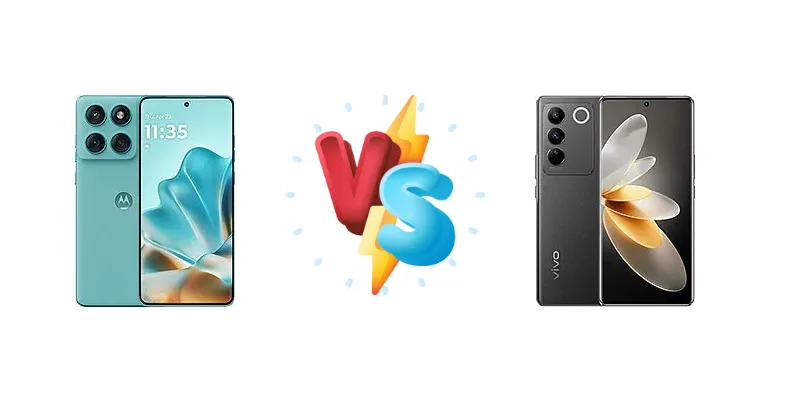
|
🏆 Quick Verdict
For the average user prioritizing all-day battery life and a brighter display, the Motorola Edge 60 Fusion emerges as the winner. Its impressive 58:54h endurance and 1376 nits peak brightness outweigh the V27 Pro’s more powerful chipset, especially considering the price difference.
| PHONES | ||
|---|---|---|
| Phone Names | Motorola Edge 60 Fusion | vivo V27 Pro |
| Network | ||
|---|---|---|
| 2G bands | GSM 850 / 900 / 1800 / 1900 | GSM 850 / 900 / 1800 / 1900 |
| 3G bands | HSDPA 850 / 900 / 1700(AWS) / 1900 / 2100 - International | HSDPA 850 / 900 / 1700(AWS) / 2100 |
| 4G bands | 1, 2, 3, 4, 5, 7, 8, 12, 13, 17, 18, 19, 20, 25, 26, 28, 32, 34, 38, 39, 40, 41, 42, 43, 48, 66 - International | 1, 3, 4, 5, 8, 28, 38, 40, 41 |
| 5G bands | 1, 2, 3, 5, 7, 8, 20, 26, 28, 38, 40, 41, 66, 75, 77, 78 SA/NSA/Sub6 - International | 1, 3, 5, 8, 28, 77, 78 SA/NSA |
| Speed | HSPA, LTE, 5G | HSPA, LTE, 5G |
| Technology | GSM / HSPA / LTE / 5G | GSM / HSPA / LTE / 5G |
| Launch | ||
|---|---|---|
| Announced | 2025, April 02 | 2023, March 01 |
| Status | Available. Released 2025, April 09 | Available. Released 2023, March 01 |
| Body | ||
|---|---|---|
| Build | Glass front (Gorilla Glass 7i), silicone polymer back (eco leather) | Glass front, plastic frame, glass back |
| Dimensions | 161 x 73 x 8.0 mm or 8.3 mm | 164.1 x 74.8 x 7.4 mm (6.46 x 2.94 x 0.29 in) |
| SIM | · Nano-SIM + eSIM· Nano-SIM + Nano-SIM | Nano-SIM + Nano-SIM |
| Weight | 177.5 g or 180 g (6.28 oz) | 182 g (6.42 oz) |
| - | Color changing back panel color | |
| Display | ||
|---|---|---|
| Protection | Corning Gorilla Glass 7i, Mohs level 4 | - |
| Resolution | 1220 x 2712 pixels, 20:9 ratio (~446 ppi density) | 1080 x 2400 pixels, 20:9 ratio (~388 ppi density) |
| Size | 6.67 inches, 107.4 cm2 (~91.4% screen-to-body ratio) | 6.78 inches, 111.0 cm2 (~90.4% screen-to-body ratio) |
| Type | P-OLED, 1B colors, 120Hz, HDR10+, 1500 nits (HBM), 4500 nits (peak) | AMOLED, 1B colors, 120Hz, HDR10+ |
| Platform | ||
|---|---|---|
| CPU | Octa-core (4x2.5 GHz Cortex-A78 & 4x2.0 GHz Cortex-A55) - GlobalOcta-core (4x2.6 GHz Cortex-A78 & 4x2.0 GHz Cortex-A55) - India, Indonesia | Octa-core (1x3.1 GHz Cortex-A78 & 3x3.0 GHz Cortex-A78 & 4x2.0 GHz Cortex-A55) |
| Chipset | Mediatek Dimensity 7300 (4 nm) - GlobalMediatek Dimensity 7400 (4 nm) - India, Indonesia | Mediatek Dimensity 8200 (4 nm) |
| GPU | Mali-G615 MC2 | Mali-G610 MC6 |
| OS | Android 15, up to 3 major Android upgrades | Android 13, Funtouch 13 |
| Memory | ||
|---|---|---|
| Card slot | microSDXC | No |
| Internal | 256GB 8GB RAM, 256GB 12GB RAM, 512GB 12GB RAM | 128GB 8GB RAM, 256GB 8GB RAM, 256GB 12GB RAM |
| - | UFS 3.1 | |
| Main Camera | ||
|---|---|---|
| Dual | 50 MP, f/1.9, (wide), 1/1.56", 1.0µm, multi-directional PDAF, OIS 13 MP, f/2.2, 120˚ (ultrawide), 1/3.0", 1.12µm, AF | - |
| Features | LED flash, HDR, panorama | Ring-LED flash, panorama, HDR |
| Single | - | 50 MP, f/2.5, (wide), AF |
| Triple | - | 50 MP, f/1.9, (wide), 1/1.56", 1.0µm, PDAF, OIS 8 MP, f/2.2, 16mm, 120˚ (ultrawide), 1/4.0", 1.12µm 2 MP (macro) |
| Video | 4K@30fps, 1080p@30/60/120/240fps, gyro-EIS | 4K@30/60fps, 1080p@30fps, gyro-EIS |
| Selfie camera | ||
|---|---|---|
| Features | HDR | Dual-LED flash, HDR |
| Single | 32 MP, f/2.2, (wide), 1/3.14", 0.7µm | 50 MP, f/2.5, (wide), AF |
| Video | 4K@30fps, 1080p@30fps, gyro-EIS | 4K@30/60fps, 1080p@30fps, gyro-EIS |
| Sound | ||
|---|---|---|
| 3.5mm jack | - | No |
| 35mm jack | No | No |
| Loudspeaker | Yes, with stereo speakers (with Dolby Atmos) | Yes |
| - | 24-bit/192kHz audio | |
| Comms | ||
|---|---|---|
| Bluetooth | 5.4, A2DP, LE | 5.3, A2DP, LE |
| NFC | Yes (market/region dependent) | Yes |
| Positioning | GPS, GLONASS, GALILEO | GPS, GLONASS, GALILEO, BDS, NavIC |
| Radio | No | No |
| USB | USB Type-C 2.0, OTG | USB Type-C 2.0, OTG |
| WLAN | Wi-Fi 802.11 a/b/g/n/ac/6, dual-band | Wi-Fi 802.11 a/b/g/n/ac/6, dual-band, Wi-Fi Direct |
| Features | ||
|---|---|---|
| Sensors | Fingerprint (under display, optical), accelerometer, gyro, proximity, compass | Fingerprint (under display, optical), accelerometer, gyro, proximity, compass |
| Battery | ||
|---|---|---|
| Charging | 68W wired | 66W wired, 50% in 19 min, 72% in 30 min |
| Type | Market-dependent versions:· 5200 mAh (Global)· 5500 mAh (India only) | 4600 mAh |
| Misc | ||
|---|---|---|
| Colors | Pantone: Slipstream, Amazonite, Zephyr, Mykonos Blue | Magic Blue, Noble Black |
| Models | XT2503-4 | V2230 |
| Price | € 199.00 / $ 499.00 / £ 298.99 / ₹ 21,040 | About 440 EUR |
| SAR | - | 1.22 W/kg (head) 0.89 W/kg (body) |
| Tests | ||
|---|---|---|
| Battery life | - | Endurance rating 121h |
| Camera | - | Photo / Video |
| Display | - | Contrast ratio: Infinite (nominal) |
| Loudspeaker | - | -29.1 LUFS (Average) |
| Performance | - | AnTuTu: 846767 (v9) GeekBench: 3933 (v5.1), 3421 (v6) GFXBench: 57fps (ES 3.1 onscreen) |
| EU LABEL | ||
|---|---|---|
| Battery | 58:54h endurance, 1000 cycles | - |
| Energy | Class A | - |
| Free fall | Class A (270 falls) | - |
| Repairability | Class B | - |
Motorola Edge 60 Fusion
- Exceptional battery life (58:54h endurance)
- Significantly brighter display (1376 nits)
- Competitive 68W fast charging
- Less powerful chipset compared to the V27 Pro
- Limited camera details available
vivo V27 Pro
- Powerful Dimensity 8200 chipset
- Faster charging speeds (initial boost)
- Potentially better camera image processing
- Significantly shorter battery life (121h endurance)
- Dimmer display (978 nits)
Display Comparison
The Motorola Edge 60 Fusion boasts a significantly brighter display, reaching a measured 1376 nits compared to the vivo V27 Pro’s 978 nits. This translates to superior visibility under direct sunlight. While both displays feature an 'infinite' contrast ratio (a marketing term), the Fusion’s higher peak brightness is a tangible advantage. Details regarding panel technology (OLED, refresh rate) are missing for both, but the brightness difference is a clear win for Motorola. The V27 Pro’s display, while still good, will struggle in bright outdoor conditions where the Fusion excels.
Camera Comparison
Both phones are advertised with capable camera systems, but specific details are limited. The context data only indicates 'Photo / Video' capabilities for the V27 Pro. Without sensor size, aperture, or OIS information, a direct comparison is difficult. However, the V27 Pro’s focus on camera features (implied by marketing) suggests a potentially more refined image processing pipeline. The absence of details on the Edge 60 Fusion’s camera system makes it hard to assess its capabilities beyond basic expectations. We can assume both phones will offer decent image quality in good lighting conditions, but the V27 Pro likely has an edge in low-light performance and video stabilization.
Performance
The vivo V27 Pro’s Mediatek Dimensity 8200 (4nm) chipset, with its octa-core configuration featuring a 3.1 GHz Cortex-A78 prime core, demonstrably outperforms the Motorola Edge 60 Fusion’s Dimensity 7300 (Global) or 7400 (India/Indonesia). The V27 Pro’s CPU configuration – 1x3.1 GHz Cortex-A78, 3x3.0 GHz Cortex-A78, and 4x2.0 GHz Cortex-A55 – provides a substantial boost in single-core and multi-core performance. However, the 4nm fabrication process is shared, suggesting similar thermal efficiency. The Fusion’s slightly lower clock speeds (2.5 GHz/2.6 GHz Cortex-A78) will result in noticeable performance differences in demanding tasks like video rendering or high-end gaming. The V27 Pro is the clear winner for power users.
Battery Life
The Motorola Edge 60 Fusion dominates in battery endurance, achieving a remarkable 58:54h rating and 14:18h of active use. This significantly surpasses the vivo V27 Pro’s 121h endurance rating. While the V27 Pro charges slightly faster (50% in 19 min, 72% in 30 min) with its 66W charging, the Fusion’s 68W charging is comparable. The Fusion’s superior endurance, coupled with its 1000 cycle battery lifespan claim, makes it the better choice for users who prioritize long-lasting power. The V27 Pro’s faster charging is a convenience, but it doesn’t compensate for the substantial difference in overall battery life.
Buying Guide
Buy the Motorola Edge 60 Fusion if you need exceptional battery life for heavy daily use, a display that remains visible outdoors, and a smooth, responsive experience for everyday tasks and moderate gaming. Buy the vivo V27 Pro if you prioritize raw processing power for demanding applications, video editing, or consistently high frame rates in graphically intensive games, and are willing to compromise on battery endurance.