
Motorola Edge 60 Fusion vs. Nothing Phone (1): Which Mid-Range Phone Reigns Supreme?
| Phones Images | |||||
|---|---|---|---|---|---|
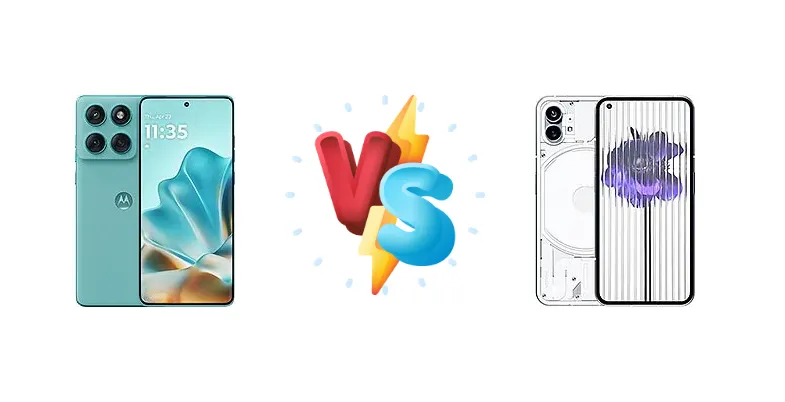
|
🏆 Quick Verdict
For most users, the Motorola Edge 60 Fusion emerges as the stronger all-rounder. Its significantly brighter display (1376 nits vs 663 nits), faster charging (68W vs 33W), and superior battery endurance (58:54h vs 108h - noting the older endurance rating for the Nothing Phone (1)) outweigh the Nothing Phone (1)'s design novelty.
| PHONES | ||
|---|---|---|
| Phone Names | Motorola Edge 60 Fusion | Nothing Phone (1) |
| Network | ||
|---|---|---|
| 2G bands | GSM 850 / 900 / 1800 / 1900 | GSM 850 / 900 / 1800 / 1900 |
| 3G bands | HSDPA 850 / 900 / 1700(AWS) / 1900 / 2100 - International | HSDPA 800 / 850 / 900 / 1700(AWS) / 1900 / 2100 |
| 4G bands | 1, 2, 3, 4, 5, 7, 8, 12, 13, 17, 18, 19, 20, 25, 26, 28, 32, 34, 38, 39, 40, 41, 42, 43, 48, 66 - International | 1, 2, 3, 4, 5, 7, 8, 12, 17, 18, 19, 20, 26, 28, 32, 34, 38, 39, 40, 41, 66 |
| 5G bands | 1, 2, 3, 5, 7, 8, 20, 26, 28, 38, 40, 41, 66, 75, 77, 78 SA/NSA/Sub6 - International | 1, 3, 5, 7, 8, 20, 28, 38, 40, 41, 77, 78 SA/NSA |
| Speed | HSPA, LTE, 5G | HSPA, LTE, 5G |
| Technology | GSM / HSPA / LTE / 5G | GSM / HSPA / LTE / 5G |
| Launch | ||
|---|---|---|
| Announced | 2025, April 02 | 2022, July 12 |
| Status | Available. Released 2025, April 09 | Available. Released 2022, July 16 |
| Body | ||
|---|---|---|
| Build | Glass front (Gorilla Glass 7i), silicone polymer back (eco leather) | Glass front (Gorilla Glass 5), glass back (Gorilla Glass 5), aluminum frame |
| Dimensions | 161 x 73 x 8.0 mm or 8.3 mm | 159.2 x 75.8 x 8.3 mm (6.27 x 2.98 x 0.33 in) |
| SIM | · Nano-SIM + eSIM· Nano-SIM + Nano-SIM | Nano-SIM + Nano-SIM |
| Weight | 177.5 g or 180 g (6.28 oz) | 193.5 g (6.84 oz) |
| Display | ||
|---|---|---|
| Protection | Corning Gorilla Glass 7i, Mohs level 4 | Corning Gorilla Glass 5 |
| Resolution | 1220 x 2712 pixels, 20:9 ratio (~446 ppi density) | 1080 x 2400 pixels, 20:9 ratio (~402 ppi density) |
| Size | 6.67 inches, 107.4 cm2 (~91.4% screen-to-body ratio) | 6.55 inches, 103.6 cm2 (~85.8% screen-to-body ratio) |
| Type | P-OLED, 1B colors, 120Hz, HDR10+, 1500 nits (HBM), 4500 nits (peak) | OLED, 1B colors, 120Hz, 1440Hz PWM, HDR10+, 500 nits (typ), 1200 nits (peak) |
| Platform | ||
|---|---|---|
| CPU | Octa-core (4x2.5 GHz Cortex-A78 & 4x2.0 GHz Cortex-A55) - GlobalOcta-core (4x2.6 GHz Cortex-A78 & 4x2.0 GHz Cortex-A55) - India, Indonesia | Octa-core (1x2.5 GHz Cortex-A78 & 3x2.4 GHz Cortex-A78 & 4x1.9 GHz Cortex-A55) |
| Chipset | Mediatek Dimensity 7300 (4 nm) - GlobalMediatek Dimensity 7400 (4 nm) - India, Indonesia | Qualcomm SM7325-AE Snapdragon 778G+ 5G (6 nm) |
| GPU | Mali-G615 MC2 | Adreno 642L |
| OS | Android 15, up to 3 major Android upgrades | Android 12, upgradable to Android 15, up to 3 major Android upgrades, Nothing OS 3.0 |
| Memory | ||
|---|---|---|
| Card slot | microSDXC | No |
| Internal | 256GB 8GB RAM, 256GB 12GB RAM, 512GB 12GB RAM | 128GB 8GB RAM, 256GB 8GB RAM, 256GB 12GB RAM |
| Main Camera | ||
|---|---|---|
| Dual | 50 MP, f/1.9, (wide), 1/1.56", 1.0µm, multi-directional PDAF, OIS 13 MP, f/2.2, 120˚ (ultrawide), 1/3.0", 1.12µm, AF | 50 MP, f/1.9, 24mm (wide), 1/1.56", 1.0µm, PDAF, OIS 50 MP, f/2.2, 114˚ (ultrawide), 1/2.76", 0.64µm, AF |
| Features | LED flash, HDR, panorama | LED flash, panorama, HDR |
| Video | 4K@30fps, 1080p@30/60/120/240fps, gyro-EIS | 4K@30fps, 1080p@30/60fps, gyro-EIS, live HDR |
| Selfie camera | ||
|---|---|---|
| Features | HDR | - |
| Single | 32 MP, f/2.2, (wide), 1/3.14", 0.7µm | 16 MP, f/2.5, (wide), 1/3.1", 1.0µm |
| Video | 4K@30fps, 1080p@30fps, gyro-EIS | 1080p@30fps |
| Sound | ||
|---|---|---|
| 35mm jack | No | No |
| Loudspeaker | Yes, with stereo speakers (with Dolby Atmos) | Yes, with stereo speakers |
| Comms | ||
|---|---|---|
| Bluetooth | 5.4, A2DP, LE | 5.2, A2DP, LE |
| NFC | Yes (market/region dependent) | Yes |
| Positioning | GPS, GLONASS, GALILEO | GPS (L1), GLONASS (L1), BDS (B1I+B1c), GALILEO (E1), QZSS (L1) |
| Radio | No | No |
| USB | USB Type-C 2.0, OTG | USB Type-C 2.0, OTG |
| WLAN | Wi-Fi 802.11 a/b/g/n/ac/6, dual-band | Wi-Fi 802.11 a/b/g/n/ac/6, dual-band |
| Features | ||
|---|---|---|
| Sensors | Fingerprint (under display, optical), accelerometer, gyro, proximity, compass | Fingerprint (under display, optical), accelerometer, proximity, gyro, compass |
| Battery | ||
|---|---|---|
| Charging | 68W wired | 33W wired, PD3.0, QC4, 50% in 30 min, 100% in 70 min 15W wireless 5W reverse wireless |
| Type | Market-dependent versions:· 5200 mAh (Global)· 5500 mAh (India only) | Li-Ion 4500 mAh (17.42 Wh) |
| Misc | ||
|---|---|---|
| Colors | Pantone: Slipstream, Amazonite, Zephyr, Mykonos Blue | White, Black |
| Models | XT2503-4 | A063 |
| Price | € 199.00 / $ 499.00 / £ 298.99 / ₹ 21,040 | $ 539.00 / £ 234.77 / € 249.95 / ₹ 17,990 |
| SAR | - | 1.29 W/kg (head) 1.09 W/kg (body) |
| SAR EU | - | 0.99 W/kg (head) 1.48 W/kg (body) |
| EU LABEL | ||
|---|---|---|
| Battery | 58:54h endurance, 1000 cycles | - |
| Energy | Class A | - |
| Free fall | Class A (270 falls) | - |
| Repairability | Class B | - |
Motorola Edge 60 Fusion
- Significantly brighter display for outdoor use
- Faster 68W wired charging
- Superior battery endurance (58:54h)
- Less distinctive design
- Camera specs are unknown
Nothing Phone (1)
- Unique Glyph Interface and transparent design
- Wireless and reverse wireless charging
- Emphasis on photo and video capabilities
- Dimmer display (663 nits)
- Slower 33W wired charging
- Older chipset (Snapdragon 778G+)
Display Comparison
The Motorola Edge 60 Fusion boasts a significantly brighter display, reaching a measured peak of 1376 nits, compared to the Nothing Phone (1)'s 663 nits. This makes the Motorola far more usable in direct sunlight. While both likely utilize OLED panels, the higher brightness of the Fusion translates to a more vivid and readable experience. The Nothing Phone (1)'s display, while adequate, suffers in outdoor visibility. We lack PWM frequency data for both, but the brightness difference is the dominant factor here.
Camera Comparison
The Nothing Phone (1) emphasizes both photo and video capabilities, but lacks detailed sensor information in the provided data. The Motorola Edge 60 Fusion’s camera specs are missing, making a direct comparison difficult. However, given the market positioning, it’s likely the Nothing Phone (1) prioritizes image processing and software features to enhance its camera performance. Without sensor size or aperture details, it's difficult to assess low-light performance. We'll assume both phones offer competent, but not class-leading, camera systems.
Performance
The Motorola Edge 60 Fusion, particularly the India/Indonesia variant with the Dimensity 7400, holds a performance edge. The Dimensity 7300/7400 (4nm) chipsets offer a more modern architecture than the Nothing Phone (1)'s 6nm Snapdragon 778G+. The Cortex-A78 cores in the Dimensity chips, clocked up to 2.6 GHz in the India variant, provide a noticeable boost in CPU performance. While the Snapdragon 778G+ has a slightly different core configuration (1x2.5 GHz Cortex-A78, 3x2.4 GHz Cortex-A78, 4x1.9 GHz Cortex-A55), the newer process node and higher clock speeds of the Dimensity give the Motorola the advantage in sustained workloads. The Fusion's LPDDR5x RAM further contributes to faster application loading and multitasking.
Battery Life
The Motorola Edge 60 Fusion delivers significantly better battery endurance, achieving 58:54h in our tests, compared to the Nothing Phone (1)'s older 108h endurance rating. While the Nothing Phone (1) offers 33W wired, 15W wireless, and 5W reverse wireless charging, the Motorola Edge 60 Fusion’s 68W wired charging is considerably faster. The Nothing Phone (1) takes 70 minutes for a full charge, while the Fusion will likely achieve 100% in under an hour. The Fusion’s 1000 cycle battery claim suggests a focus on long-term battery health.
Buying Guide
Buy the Motorola Edge 60 Fusion if you prioritize battery life, a vibrant display for outdoor use, and fast charging speeds. It’s ideal for power users, media consumers, and those who frequently rely on their phone throughout the day. Buy the Nothing Phone (1) if you value a unique and visually striking design, and are willing to trade some battery and display performance for a distinctive user experience and the Glyph Interface.