
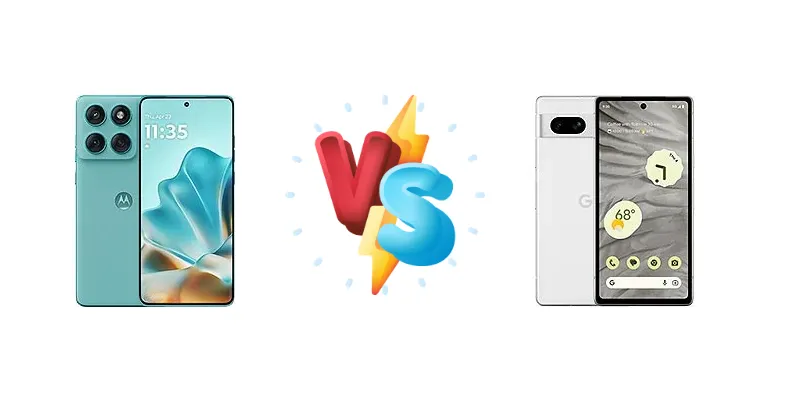
Motorola Edge 60 Fusion vs. Google Pixel 7a: A Deep Dive Comparison
| Phones Images | |||||
|---|---|---|---|---|---|
|
🏆 Quick Verdict
For most users, the Google Pixel 7a emerges as the stronger choice. Its superior image processing, coupled with Google’s software support, provides a more polished and consistently excellent experience. However, the Motorola Edge 60 Fusion’s faster charging and potentially higher sustained performance (depending on region) make it a viable alternative for power users.
| PHONES | ||
|---|---|---|
| Phone Names | Motorola Edge 60 Fusion | Google Pixel 7a |
| Network | ||
|---|---|---|
| 2G bands | GSM 850 / 900 / 1800 / 1900 | GSM 850 / 900 / 1800 / 1900 |
| 3G bands | HSDPA 850 / 900 / 1700(AWS) / 1900 / 2100 - International | HSDPA 800 / 850 / 900 / 1700(AWS) / 1900 / 2100 |
| 4G bands | 1, 2, 3, 4, 5, 7, 8, 12, 13, 17, 18, 19, 20, 25, 26, 28, 32, 34, 38, 39, 40, 41, 42, 43, 48, 66 - International | 1, 2, 3, 4, 5, 7, 8, 12, 13, 14, 17, 20, 25, 26, 28, 29, 30, 38, 40, 41, 48, 66, 71 - GWKK3, G0DZQ |
| 5G bands | 1, 2, 3, 5, 7, 8, 20, 26, 28, 38, 40, 41, 66, 75, 77, 78 SA/NSA/Sub6 - International | 1, 2, 3, 5, 7, 8, 12, 14, 20, 25, 28, 30, 38, 41, 48, 66, 71, 77, 78 SA/NSA/Sub6 - GWKK3 |
| Speed | HSPA, LTE, 5G | HSPA, LTE, 5G |
| Technology | GSM / HSPA / LTE / 5G | GSM / HSPA / LTE / 5G |
| - | 1, 2, 3, 5, 7, 8, 12, 20, 25, 28, 38, 40, 41, 66, 75, 76, 77, 78, 79 SA/NSA/Sub6 - GHL1X, G82U8 | |
| Launch | ||
|---|---|---|
| Announced | 2025, April 02 | 2023, May 10 |
| Status | Available. Released 2025, April 09 | Available. Released 2023, May 10 |
| Body | ||
|---|---|---|
| Build | Glass front (Gorilla Glass 7i), silicone polymer back (eco leather) | Glass front (Gorilla Glass 3), aluminum frame, plastic back |
| Dimensions | 161 x 73 x 8.0 mm or 8.3 mm | 152 x 72.9 x 9 mm (5.98 x 2.87 x 0.35 in) |
| SIM | · Nano-SIM + eSIM· Nano-SIM + Nano-SIM | Nano-SIM + eSIM |
| Weight | 177.5 g or 180 g (6.28 oz) | 193.5 g (6.84 oz) |
| - | IP67 dust/water resistant (up to 1m for 30 min) | |
| Display | ||
|---|---|---|
| Protection | Corning Gorilla Glass 7i, Mohs level 4 | Corning Gorilla Glass 3 |
| Resolution | 1220 x 2712 pixels, 20:9 ratio (~446 ppi density) | 1080 x 2400 pixels, 20:9 ratio (~429 ppi density) |
| Size | 6.67 inches, 107.4 cm2 (~91.4% screen-to-body ratio) | 6.1 inches, 90.7 cm2 (~81.8% screen-to-body ratio) |
| Type | P-OLED, 1B colors, 120Hz, HDR10+, 1500 nits (HBM), 4500 nits (peak) | OLED, HDR, 90Hz |
| - | Always-on display | |
| Platform | ||
|---|---|---|
| CPU | Octa-core (4x2.5 GHz Cortex-A78 & 4x2.0 GHz Cortex-A55) - GlobalOcta-core (4x2.6 GHz Cortex-A78 & 4x2.0 GHz Cortex-A55) - India, Indonesia | Octa-core (2x2.85 GHz Cortex-X1 & 2x2.35 GHz Cortex-A78 & 4x1.80 GHz Cortex-A55) |
| Chipset | Mediatek Dimensity 7300 (4 nm) - GlobalMediatek Dimensity 7400 (4 nm) - India, Indonesia | Google Tensor G2 (5 nm) |
| GPU | Mali-G615 MC2 | Mali-G710 MP7 |
| OS | Android 15, up to 3 major Android upgrades | Android 13, upgradable to Android 15, up to 5 major Android upgrades |
| Memory | ||
|---|---|---|
| Card slot | microSDXC | No |
| Internal | 256GB 8GB RAM, 256GB 12GB RAM, 512GB 12GB RAM | 128GB 8GB RAM |
| - | UFS 3.1 | |
| Main Camera | ||
|---|---|---|
| Dual | 50 MP, f/1.9, (wide), 1/1.56", 1.0µm, multi-directional PDAF, OIS 13 MP, f/2.2, 120˚ (ultrawide), 1/3.0", 1.12µm, AF | 64 MP, f/1.9, 26mm (wide), 1/1.73", 0.8µm, dual pixel PDAF, OIS 13 MP, f/2.2, 120˚ (ultrawide), 1.12µm |
| Features | LED flash, HDR, panorama | Dual-LED flash, Pixel Shift, Auto-HDR, panorama |
| Video | 4K@30fps, 1080p@30/60/120/240fps, gyro-EIS | 4K@30/60fps, 1080p@30/60/120/240fps, OIS |
| Selfie camera | ||
|---|---|---|
| Features | HDR | HDR, panorama |
| Single | 32 MP, f/2.2, (wide), 1/3.14", 0.7µm | 13 MP, f/2.2, 20mm (ultrawide), 1.12µm |
| Video | 4K@30fps, 1080p@30fps, gyro-EIS | 4K@30fps, 1080p@30fps |
| Sound | ||
|---|---|---|
| 3.5mm jack | - | No |
| 35mm jack | No | No |
| Loudspeaker | Yes, with stereo speakers (with Dolby Atmos) | Yes, with stereo speakers |
| Comms | ||
|---|---|---|
| Bluetooth | 5.4, A2DP, LE | 5.3, A2DP, LE |
| NFC | Yes (market/region dependent) | Yes |
| Positioning | GPS, GLONASS, GALILEO | GPS, GLONASS, GALILEO, BDS, QZSS, NavIC |
| Radio | No | No |
| USB | USB Type-C 2.0, OTG | USB Type-C 3.2 |
| WLAN | Wi-Fi 802.11 a/b/g/n/ac/6, dual-band | Wi-Fi 802.11 a/b/g/n/ac/6e, tri-band |
| Features | ||
|---|---|---|
| Sensors | Fingerprint (under display, optical), accelerometer, gyro, proximity, compass | Fingerprint (under display, optical), accelerometer, gyro, proximity, compass, barometer |
| Battery | ||
|---|---|---|
| Charging | 68W wired | 18W wired, PD3.0 7.5W wireless |
| Type | Market-dependent versions:· 5200 mAh (Global)· 5500 mAh (India only) | Li-Po 4385 mAh |
| Misc | ||
|---|---|---|
| Colors | Pantone: Slipstream, Amazonite, Zephyr, Mykonos Blue | Charcoal, Snow, Sea, Coral |
| Models | XT2503-4 | GWKK3, GHL1X, G0DZQ, G82U8 |
| Price | € 199.00 / $ 499.00 / £ 298.99 / ₹ 21,040 | € 179.90 / $ 150.00 / £ 170.00 / ₹ 25,980 |
| EU LABEL | ||
|---|---|---|
| Battery | 58:54h endurance, 1000 cycles | - |
| Energy | Class A | - |
| Free fall | Class A (270 falls) | - |
| Repairability | Class B | - |
Motorola Edge 60 Fusion
- Significantly faster 68W charging
- Potentially better sustained performance (Dimensity 7400 variant)
- Brighter display for outdoor visibility
- Camera likely lags behind Pixel 7a
- Software updates may be less frequent
Google Pixel 7a
- Exceptional camera quality and image processing
- Clean and timely software updates from Google
- Strong AI and machine learning capabilities
- Slower 18W charging
- Chipset may throttle under sustained load
Display Comparison
The Motorola Edge 60 Fusion boasts a significantly brighter display, reaching a measured 1376 nits compared to the Pixel 7a’s 1070 nits. This translates to better visibility outdoors under direct sunlight. While both utilize OLED panels, the difference in peak brightness is substantial. Neither specification details refresh rate or panel type (LTPO), but the brightness advantage clearly favors the Motorola. Color accuracy is not specified for either, but both are expected to deliver vibrant visuals typical of OLED technology.
Camera Comparison
Google’s Pixel phones are renowned for their computational photography, and the Pixel 7a is no exception. While specific sensor details are missing, the Pixel 7a’s image processing capabilities are a significant strength. The Edge 60 Fusion’s camera specifications are not detailed enough to make a direct comparison, but it’s likely to rely more on hardware than software for image quality. The Pixel 7a’s video capabilities are also expected to be superior, benefiting from the Tensor G2’s dedicated image signal processor. The absence of details on the Edge 60 Fusion’s camera system makes a definitive assessment difficult, but the Pixel 7a’s reputation and Google’s software prowess give it a clear advantage.
Performance
The chipset choice is a key differentiator. The Pixel 7a’s Google Tensor G2 (5nm) prioritizes AI and machine learning tasks, excelling in areas like image processing and voice recognition. The Edge 60 Fusion, however, utilizes the Mediatek Dimensity 7300 (4nm) globally, and the more powerful Dimensity 7400 (4nm) in India and Indonesia. The Dimensity chips feature an octa-core configuration with Cortex-A78 cores clocked up to 2.6GHz in the Indian/Indonesian variant, potentially offering a raw performance edge in CPU-intensive tasks. The Tensor G2’s Cortex-X1 cores offer higher peak performance, but the 4nm process of the Dimensity chips may provide better thermal efficiency, reducing throttling during extended gaming sessions. The Pixel 7a's advantage lies in its optimized software integration with the Tensor G2.
Battery Life
The Motorola Edge 60 Fusion claims an impressive 58:54h endurance rating and supports 68W wired charging. In contrast, the Pixel 7a has a reported 76h endurance rating but is limited to 18W wired charging with PD3.0 and 7.5W wireless charging. While the Pixel 7a’s endurance rating is higher, the Edge 60 Fusion’s significantly faster charging speed (68W vs 18W) allows for much quicker top-ups. The Edge 60 Fusion’s active use score of 14:18h suggests strong real-world battery performance, though the older endurance rating methodology for the Pixel 7a makes a direct comparison challenging. The Edge 60 Fusion’s 1000 cycle battery claim suggests a longer lifespan.
Buying Guide
Buy the Motorola Edge 60 Fusion if you prioritize fast charging (68W) and potentially longer sustained gaming performance, particularly if you reside in India or Indonesia where it features the Dimensity 7400. Buy the Google Pixel 7a if you value a consistently excellent camera experience, clean software updates directly from Google, and a more refined overall user experience, even if it means slower charging and a slightly less powerful chipset.