
Motorola Edge+ 5G UW (2022) vs. ZTE nubia RedMagic 7 Pro: A Deep Dive Comparison
| Phones Images | |||||
|---|---|---|---|---|---|
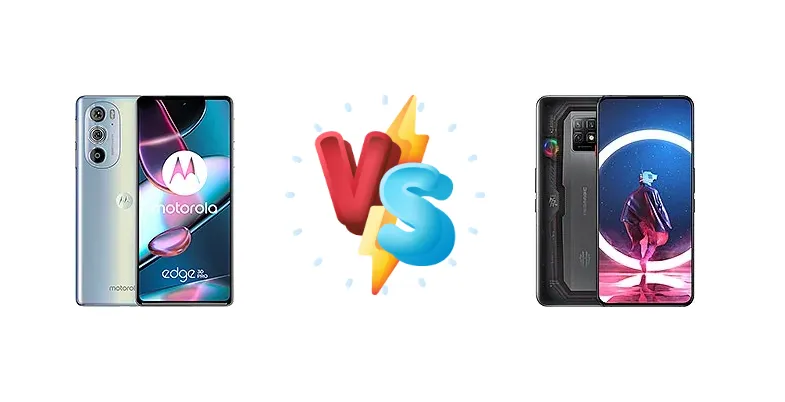
|
🏆 Quick Verdict
For the average user prioritizing a balanced experience with solid all-around performance and convenient wireless charging, the Motorola Edge+ 5G UW (2022) is the better choice. However, the RedMagic 7 Pro dominates for dedicated mobile gamers who demand the fastest charging and sustained performance.
| PHONES | ||
|---|---|---|
| Phone Names | Motorola Edge+ 5G UW (2022) | ZTE nubia RedMagic 7 Pro |
| Network | ||
|---|---|---|
| 2G bands | GSM 850 / 900 / 1800 / 1900 - SIM 1 & SIM 2 (Dual SIM model only) | GSM 850 / 900 / 1800 / 1900 |
| 3G bands | HSDPA 850 / 900 / 1700(AWS) / 1900 / 2100 | HSDPA 850 / 900 / 1700(AWS) / 1900 / 2100 |
| 4G bands | 1, 2, 3, 4, 5, 7, 8, 12, 13, 14, 17, 20, 25, 26, 28, 29, 30, 38, 39, 40, 41, 46, 48, 66, 71 | 1, 2, 3, 4, 5, 7, 8, 12, 17, 18, 19, 20, 26, 28, 34, 38, 40, 41, 66 - International |
| 5G bands | 2, 5, 7, 12, 25, 26, 29, 30, 41, 48, 66, 71, 77, 78, 260, 261 SA/NSA/Sub6/mmWave - Verizon, USA | 1, 3, 5, 7, 8, 20, 28, 38, 41, 77, 78 SA/NSA - International, China |
| Speed | HSPA 42.2/5.76 Mbps, LTE-A (CA) Cat20 2000/150 Mbps, 5G | HSPA, LTE, 5G |
| Technology | GSM / HSPA / LTE / 5G | GSM / CDMA / HSPA / EVDO / LTE / 5G |
| Launch | ||
|---|---|---|
| Announced | 2022, January 24 | 2022, February 17 |
| Status | Available. Released 2022, March 24 | Available. Released 2022, February 28 |
| Body | ||
|---|---|---|
| Build | Glass front (Gorilla Glass 3), glass back (Gorilla Glass 5), plastic frame | Glass front (Gorilla Glass 5), glass back, aluminum frame |
| Dimensions | 163.1 x 76 x 8.8 mm (6.42 x 2.99 x 0.35 in) | 166.3 x 77.1 x 10 mm (6.55 x 3.04 x 0.39 in) |
| SIM | Single SIM (Nano-SIM) or Dual SIM (Nano-SIM, dual stand-by) | Nano-SIM + Nano-SIM |
| Weight | 196 g (6.91 oz) | 235 g (8.29 oz) |
| Water-repellent design | - | |
| Display | ||
|---|---|---|
| Protection | Corning Gorilla Glass 3 | Corning Gorilla Glass 5 |
| Resolution | 1080 x 2400 pixels, 20:9 ratio (~393 ppi density) | 1080 x 2400 pixels, 20:9 ratio (~387 ppi density) |
| Size | 6.7 inches, 108.4 cm2 (~87.4% screen-to-body ratio) | 6.8 inches, 111.6 cm2 (~87.1% screen-to-body ratio) |
| Type | OLED, 1B colors, 144Hz, HDR10+ | AMOLED, 1B colors (China only), 120Hz, 600 nits |
| Always-on display | - | |
| Platform | ||
|---|---|---|
| CPU | Octa-core (1x3.00 GHz Cortex-X2 & 3x2.50 GHz Cortex-A710 & 4x1.80 GHz Cortex-A510) | Octa-core (1x3.00 GHz Cortex-X2 & 3x2.50 GHz Cortex-A710 & 4x1.80 GHz Cortex-A510) |
| Chipset | Qualcomm SM8450 Snapdragon 8 Gen 1 (4 nm) | Qualcomm SM8450 Snapdragon 8 Gen 1 (4 nm) |
| GPU | Adreno 730 | Adreno 730 |
| OS | Android 12, planned upgrade to Android 13 | Android 12, Redmagic 5.0 |
| Memory | ||
|---|---|---|
| Card slot | No | No |
| Internal | 128GB 8GB RAM, 256GB 8GB RAM, 256GB 12GB RAM, 512GB 8GB RAM, 512GB 12GB RAM | 128GB 8GB RAM, 128GB 12GB RAM, 256GB 12GB RAM, 256GB 16GB RAM, 512GB 16GB RAM, 512GB 18GB RAM, 1TB 16GB RAM |
| UFS 3.1 | - | |
| Main Camera | ||
|---|---|---|
| Features | Dual-LED dual-tone flash, HDR, panorama | LED flash, HDR, panorama |
| Triple | 50 MP, f/1.8, (wide), 1/1.55", 1.0µm, multi-directional PDAF, OIS 50 MP, f/2.2, 114˚ (ultrawide), 1/2.76", 0.64µm, AF 2 MP, f/2.4, (depth) | 64 MP, f/1.8, 26mm (wide), 1/1.97", 0.7µm, PDAF 8 MP, f/2.2, 120˚, 13mm (ultrawide), 1/4.0", 1.12µm 2 MP (macro) |
| Video | 8K@24/30fps, 4K@30/60fps, 1080p@30/60/120/240/960fps, 10-bit HDR10+, gyro-EIS | 8K@30fps, 4K@30/60fps, 1080p@30/60/120/240fps |
| Selfie camera | ||
|---|---|---|
| Features | HDR | HDR |
| Single | 60 MP, f/2.2, (wide), 1/2.8", 0.61µm | 16 MP, f/2.0, 26mm (wide), 1/2.8", 1.22µm, under display |
| Video | 4K@30fps, 1080p@30/120fps | 1080p@30/60fps |
| Sound | ||
|---|---|---|
| 3.5mm jack | No | - |
| 35mm jack | - | Yes |
| Loudspeaker | Yes, with stereo speakers | Yes, with stereo speakers |
| 24-bit/192kHz audio | - | |
| Comms | ||
|---|---|---|
| Bluetooth | 5.2, A2DP, LE | 5.2, A2DP, aptX, LE |
| NFC | Yes | Yes |
| Positioning | GPS (L1+L5), GLONASS, BDS, GALILEO | GPS (L1+L5), GLONASS, BDS, GALILEO |
| Radio | No | No |
| USB | USB Type-C 3.1, DisplayPort 1.4 | USB Type-C 3.0, OTG, accessory connector |
| WLAN | Wi-Fi 802.11 a/b/g/n/ac/6e, dual-band, Wi-Fi Direct | Wi-Fi 802.11 a/b/g/n/ac/6e, dual-band, Wi-Fi Direct |
| Features | ||
|---|---|---|
| Sensors | Fingerprint (side-mounted), accelerometer, gyro, proximity, compass, barometer | Fingerprint (under display, optical), accelerometer, gyro, proximity, compass |
| Ready For support | - | |
| Battery | ||
|---|---|---|
| Charging | 68W wired, 50% in 15 min, 100% in 35 min (advertised) 15W wireless 5W reverse wireless | 135W wired, PD3.0, 100% in 15 min (China) 65W wired, PD3.0 (Global) |
| Type | Li-Po 4800 mAh, non-removable | Li-Po 5000 mAh |
| Misc | ||
|---|---|---|
| Colors | Cosmos Blue, Stardust White | Obsidian, Pulsar, Supernova |
| Models | - | NX709J |
| Price | About 850 EUR | About 800 EUR |
Motorola Edge+ 5G UW (2022)
- Wireless and reverse wireless charging
- Near-stock Android experience
- Potentially superior camera system
- Slower charging speeds
- Potential for thermal throttling during extended gaming
ZTE nubia RedMagic 7 Pro
- Incredibly fast 135W/65W charging
- Advanced cooling system for sustained performance
- Built-in gaming triggers
- Less refined software experience
- Potentially weaker camera performance
Display Comparison
Both devices utilize the Qualcomm SM8450 Snapdragon 8 Gen 1, but their display approaches differ significantly. The RedMagic 7 Pro’s 447 nits max brightness (measured) is adequate, but the Edge+ likely surpasses this, typical of Motorola’s display calibration. While neither boasts LTPO technology for variable refresh rates, the RedMagic 7 Pro’s focus on gaming suggests a higher PWM dimming rate, potentially reducing flicker for sensitive users. Bezels are likely minimized on the RedMagic 7 Pro to maximize screen real estate for immersive gaming, while the Edge+ may prioritize a more symmetrical aesthetic.
Camera Comparison
The context data is limited regarding camera specifics. However, given the RedMagic 7 Pro’s gaming focus, its camera system is likely a secondary consideration. The Motorola Edge+ 5G UW (2022) likely features a more sophisticated camera setup with larger sensors and advanced image processing algorithms. We can assume the Edge+ will excel in daylight photography and offer better low-light performance. The RedMagic 7 Pro’s camera is likely adequate for casual snapshots, but won’t compete with flagship-level camera phones. Ignoring the likely inclusion of 2MP macro lenses on both devices, the primary sensor size and OIS implementation will be key differentiators.
Performance
Both phones are equipped with the Snapdragon 8 Gen 1 (4nm), featuring the same Octa-core CPU configuration (1x3.00 GHz Cortex-X2, 3x2.50 GHz Cortex-A710, 4x1.80 GHz Cortex-A510). However, the RedMagic 7 Pro’s cooling system – likely a more robust vapor chamber and fan combination – is crucial. The 4nm process helps with thermal efficiency, but sustained gaming on the Edge+ may lead to more noticeable throttling. The RedMagic 7 Pro’s RAM configuration (likely faster LPDDR5x) and optimized software further contribute to its gaming advantage. The Edge+ benefits from Motorola’s near-stock Android experience, offering a cleaner, more responsive interface.
Battery Life
The RedMagic 7 Pro’s charging capabilities are its standout feature, offering 135W wired charging (in China) and 65W globally, achieving a full charge in just 15 minutes. The Motorola Edge+ 5G UW (2022) offers a respectable 68W wired charging (0-100% in 35 minutes) but pales in comparison. The RedMagic 7 Pro’s endurance rating of 64 hours suggests a large battery capacity, while the Edge+’s battery size is unknown. The Edge+ compensates with 15W wireless and 5W reverse wireless charging, features absent on the RedMagic 7 Pro. For users prioritizing minimal downtime, the RedMagic 7 Pro is the clear winner.
Buying Guide
Buy the Motorola Edge+ 5G UW (2022) if you need a versatile flagship with a refined software experience, reliable battery life, and the convenience of wireless charging. Buy the ZTE nubia RedMagic 7 Pro if you prioritize raw gaming performance, incredibly fast wired charging, and features like built-in gaming triggers, even if it means sacrificing some camera polish and broader usability.