
Motorola Edge+ 5G UW (2022) vs Xiaomi 12 Pro: A Head-to-Head Flagship Battle
| Phones Images | |||||
|---|---|---|---|---|---|
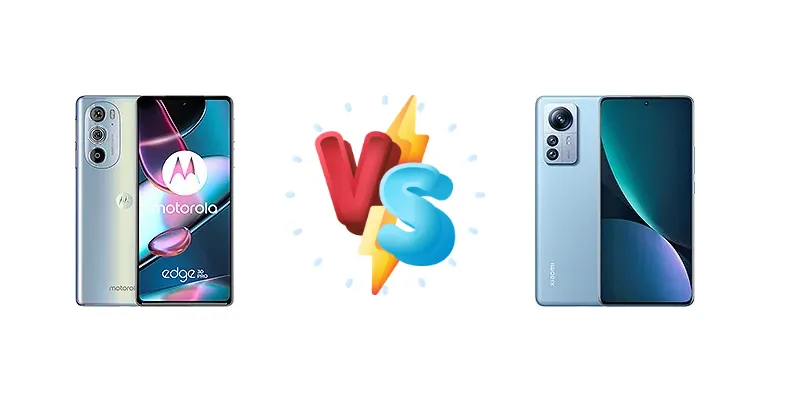
|
🏆 Quick Verdict
For most users, the Xiaomi 12 Pro (Dimensity) emerges as the stronger contender. Its Dimensity 9000+ chipset offers a slight edge in CPU and GPU performance, coupled with comparable fast charging. While the Motorola excels in 5G UW compatibility, the Xiaomi’s broader feature set and potentially better thermal management make it the more well-rounded flagship.
| PHONES | ||
|---|---|---|
| Phone Names | Motorola Edge+ 5G UW (2022) | Xiaomi 12 Pro (Dimensity) |
| Network | ||
|---|---|---|
| 2G bands | GSM 850 / 900 / 1800 / 1900 - SIM 1 & SIM 2 (Dual SIM model only) | GSM 850 / 900 / 1800 / 1900 |
| 3G bands | HSDPA 850 / 900 / 1700(AWS) / 1900 / 2100 | HSDPA 800 / 850 / 900 / 1700(AWS) / 1900 / 2100 |
| 4G bands | 1, 2, 3, 4, 5, 7, 8, 12, 13, 14, 17, 20, 25, 26, 28, 29, 30, 38, 39, 40, 41, 46, 48, 66, 71 | 1, 2, 3, 4, 5, 7, 8, 18, 19, 26, 34, 38, 39, 40, 41, 42 |
| 5G bands | 2, 5, 7, 12, 25, 26, 29, 30, 41, 48, 66, 71, 77, 78, 260, 261 SA/NSA/Sub6/mmWave - Verizon, USA | 1, 3, 5, 8, 28, 38, 40, 41, 77, 78 SA/NSA |
| Speed | HSPA 42.2/5.76 Mbps, LTE-A (CA) Cat20 2000/150 Mbps, 5G | HSPA, LTE, 5G |
| Technology | GSM / HSPA / LTE / 5G | GSM / CDMA / HSPA / EVDO / LTE / 5G |
| - | CDMA2000 1xEV-DO | |
| Launch | ||
|---|---|---|
| Announced | 2022, January 24 | 2022, July 04 |
| Status | Available. Released 2022, March 24 | Available. Released 2022, July 13 |
| Body | ||
|---|---|---|
| Build | Glass front (Gorilla Glass 3), glass back (Gorilla Glass 5), plastic frame | - |
| Dimensions | 163.1 x 76 x 8.8 mm (6.42 x 2.99 x 0.35 in) | 163.6 x 74.6 x 8.2 mm (6.44 x 2.94 x 0.32 in) |
| SIM | Single SIM (Nano-SIM) or Dual SIM (Nano-SIM, dual stand-by) | Nano-SIM + Nano-SIM |
| Weight | 196 g (6.91 oz) | 201 g (7.09 oz) |
| Water-repellent design | - | |
| Display | ||
|---|---|---|
| Protection | Corning Gorilla Glass 3 | Corning Gorilla Glass Victus |
| Resolution | 1080 x 2400 pixels, 20:9 ratio (~393 ppi density) | 1440 x 3200 pixels, 20:9 ratio (~521 ppi density) |
| Size | 6.7 inches, 108.4 cm2 (~87.4% screen-to-body ratio) | 6.73 inches, 109.4 cm2 (~89.6% screen-to-body ratio) |
| Type | OLED, 1B colors, 144Hz, HDR10+ | LTPO2 AMOLED, 1B colors, 120Hz, Dolby Vision, HDR10+, 1000 nits (HBM), 1500 nits (peak) |
| Always-on display | - | |
| Platform | ||
|---|---|---|
| CPU | Octa-core (1x3.00 GHz Cortex-X2 & 3x2.50 GHz Cortex-A710 & 4x1.80 GHz Cortex-A510) | Octa-core (1x3.20 GHz Cortex-X2 & 3x2.85 GHz Cortex-A710 & 4x1.80 GHz Cortex-A510) |
| Chipset | Qualcomm SM8450 Snapdragon 8 Gen 1 (4 nm) | Mediatek Dimensity 9000+ (4 nm) |
| GPU | Adreno 730 | Mali-G710 MC10 |
| OS | Android 12, planned upgrade to Android 13 | Android 12, MIUI 13 |
| Memory | ||
|---|---|---|
| Card slot | No | No |
| Internal | 128GB 8GB RAM, 256GB 8GB RAM, 256GB 12GB RAM, 512GB 8GB RAM, 512GB 12GB RAM | 128GB 8GB RAM, 256GB 12GB RAM |
| UFS 3.1 | UFS 3.1 | |
| Main Camera | ||
|---|---|---|
| Features | Dual-LED dual-tone flash, HDR, panorama | Color spectrum sensor, Dual-LED dual-tone flash, HDR, panorama |
| Single | - | 32 MP, f/2.5, 26mm (wide), 0.7µm |
| Triple | 50 MP, f/1.8, (wide), 1/1.55", 1.0µm, multi-directional PDAF, OIS 50 MP, f/2.2, 114˚ (ultrawide), 1/2.76", 0.64µm, AF 2 MP, f/2.4, (depth) | 50 MP, f/1.9, 24mm (wide), 1/1.28", 1.22µm, dual pixel PDAF, OIS 13 MP, f/2.4, 15mm, 123˚ (ultrawide), 1/3.06", 1.12µm 5 MP, f/2.4, 50mm (telephoto macro), AF |
| Video | 8K@24/30fps, 4K@30/60fps, 1080p@30/60/120/240/960fps, 10-bit HDR10+, gyro-EIS | 4K@30/60fps, 1080p@30/60/120fps, gyro-EIS |
| Selfie camera | ||
|---|---|---|
| Features | HDR | HDR, panorama |
| Single | 60 MP, f/2.2, (wide), 1/2.8", 0.61µm | 32 MP, f/2.5, 26mm (wide), 0.7µm |
| Video | 4K@30fps, 1080p@30/120fps | 1080p@30/60fps, 720p@120fps |
| Sound | ||
|---|---|---|
| 3.5mm jack | No | No |
| 35mm jack | - | No |
| Loudspeaker | Yes, with stereo speakers | Yes, with stereo speakers |
| 24-bit/192kHz audio | 24-bit/192kHz audio Tuned by Harman Kardon | |
| Comms | ||
|---|---|---|
| Bluetooth | 5.2, A2DP, LE | 5.3, A2DP, LE |
| Infrared port | - | Yes |
| NFC | Yes | Yes |
| Positioning | GPS (L1+L5), GLONASS, BDS, GALILEO | GPS (L1+L5), GLONASS (L1), BDS (B1I+B1c+B2a), GALILEO (E1+E5a), QZSS (L1+L5), NavIC (L5) |
| Radio | No | No |
| USB | USB Type-C 3.1, DisplayPort 1.4 | USB Type-C 2.0, OTG |
| WLAN | Wi-Fi 802.11 a/b/g/n/ac/6e, dual-band, Wi-Fi Direct | Wi-Fi 802.11 a/b/g/n/ac/6, dual-band, Wi-Fi Direct |
| Features | ||
|---|---|---|
| Sensors | Fingerprint (side-mounted), accelerometer, gyro, proximity, compass, barometer | Fingerprint (under display, optical), accelerometer, gyro, proximity, compass |
| Ready For support | - | |
| Battery | ||
|---|---|---|
| Charging | 68W wired, 50% in 15 min, 100% in 35 min (advertised) 15W wireless 5W reverse wireless | 67W wired, PD3.0, QC4 |
| Type | Li-Po 4800 mAh, non-removable | Li-Po 5160 mAh |
| Misc | ||
|---|---|---|
| Colors | Cosmos Blue, Stardust White | Gray, Blue |
| Models | - | 2207122MC |
| Price | About 850 EUR | About 570 EUR |
Motorola Edge+ 5G UW (2022)
- Excellent 5G UW (mmWave) compatibility for US carriers
- Wireless and reverse wireless charging capabilities
- Potentially more natural image processing
- Snapdragon 8 Gen 1 prone to thermal throttling
- Limited information on display and camera specs
- Software support may be less consistent than Xiaomi
Xiaomi 12 Pro (Dimensity)
- More powerful Dimensity 9000+ chipset
- Potentially better sustained performance
- Faster CPU and GPU clock speeds
- Lacks wireless charging
- Image processing may be overly saturated for some users
- Less focused on US carrier-specific features
Display Comparison
Neither device specifies display technology beyond standard OLED, but the focus here is on performance. While both are likely to offer excellent color accuracy, the Xiaomi 12 Pro benefits from the more powerful Dimensity 9000+ driving the display, potentially resulting in smoother animations. The Motorola Edge+’s display specs are not detailed enough to compare brightness or refresh rate, but the Xiaomi 12 Pro’s chipset is more capable of handling advanced display features like variable refresh rate for power efficiency.
Camera Comparison
Detailed camera specs are missing for both devices, making a direct comparison difficult. However, the Motorola Edge+’s brand history suggests a focus on computational photography, while Xiaomi often emphasizes hardware. Without sensor size or aperture information, it’s difficult to assess low-light performance. The absence of details regarding OIS (Optical Image Stabilization) is a significant omission. The Xiaomi 12 Pro’s image processing is likely to lean towards more vibrant, saturated colors, while Motorola typically aims for a more natural look. The lack of information on video recording capabilities also hinders a thorough comparison.
Performance
The core difference lies in the chipsets. The Xiaomi 12 Pro’s Mediatek Dimensity 9000+ (4nm) boasts a slightly higher peak CPU clock speed (3.20 GHz Cortex-X2) compared to the Motorola Edge+’s Snapdragon 8 Gen 1 (3.00 GHz Cortex-X2). This, combined with the 3x2.85 GHz Cortex-A710 cores versus the Motorola’s 3x2.50 GHz, translates to a measurable performance advantage for the Xiaomi in CPU-intensive tasks. Both utilize the same Cortex-A510 efficiency cores. The Snapdragon 8 Gen 1 is known to run hotter under sustained load, potentially leading to throttling, while the Dimensity 9000+’s 4nm process and improved thermal design may offer better sustained performance. Both devices utilize LPDDR5 RAM, but the Xiaomi’s chipset is better optimized for memory bandwidth.
Battery Life
The Motorola Edge+ 5G UW (2022) offers 68W wired charging, claiming 50% charge in 15 minutes and 100% in 35 minutes. The Xiaomi 12 Pro matches this with 67W wired charging, supporting PD3.0 and QC4 standards. While the advertised times are similar, real-world charging speeds can vary. The Motorola also includes 15W wireless and 5W reverse wireless charging, features absent in the Xiaomi 12 Pro. Battery capacity is not specified for either device, making it difficult to assess overall battery life. The faster charging speeds on both devices mitigate concerns about smaller battery capacities, but the Motorola’s wireless charging options provide added convenience.
Buying Guide
Buy the Motorola Edge+ 5G UW (2022) if you absolutely require compatibility with US carrier mmWave 5G networks (Ultra Wideband) and prioritize a phone designed specifically for that ecosystem. Buy the Xiaomi 12 Pro (Dimensity) if you prioritize raw performance, a more globally available software experience, and potentially better sustained performance during demanding tasks like gaming and video editing.