
Motorola Edge 5G UW (2021) vs Xiaomi Mi 11i: A Detailed Comparison
| Phones Images | |||||
|---|---|---|---|---|---|
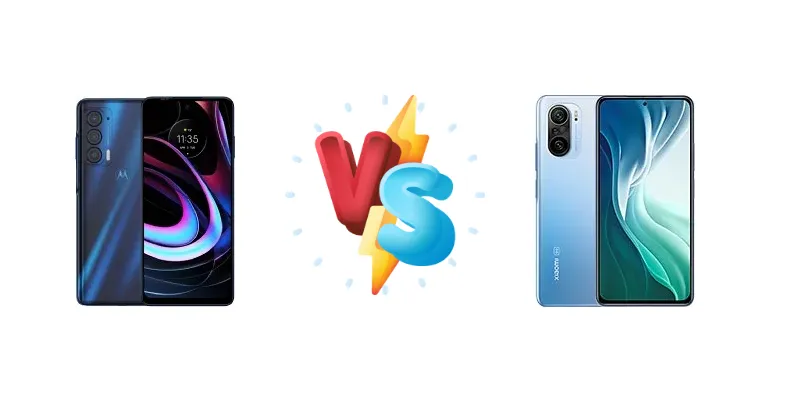
|
🏆 Quick Verdict
For most users, the Xiaomi Mi 11i emerges as the stronger choice. Its Snapdragon 888 provides a significant performance advantage, particularly for demanding tasks like gaming and video editing. While both phones offer similar battery endurance, the Mi 11i’s faster 33W charging is a practical benefit.
| PHONES | ||
|---|---|---|
| Phone Names | Motorola Edge 5G UW (2021) | Xiaomi Mi 11i |
| Network | ||
|---|---|---|
| 2G bands | GSM 850 / 900 / 1800 / 1900 | GSM 850 / 900 / 1800 / 1900 |
| 3G bands | HSDPA 850 / 900 / 1700(AWS) / 1900 / 2100 | HSDPA 850 / 900 / 1700(AWS) / 1900 / 2100 |
| 4G bands | 1, 2, 3, 4, 5, 7, 8, 12, 13, 14, 17, 18, 19, 20, 25, 26, 29, 30, 38, 39, 40, 41, 66, 71 | 1, 2, 3, 4, 5, 7, 8, 12, 17, 20, 28, 38, 40, 41, 66 |
| 5G bands | 2, 5, 25, 41, 66, 71, 77, 78, 260, 261 SA/NSA/Sub6/mmWave - Verizon, USA | 1, 3, 5, 7, 8, 20, 28, 38, 41, 77, 78 SA/NSA |
| Speed | HSPA 42.2/5.76 Mbps, LTE Cat18 1200/150 Mbps, 5G | HSPA, LTE, 5G |
| Technology | GSM / HSPA / LTE / 5G | GSM / HSPA / LTE / 5G |
| Launch | ||
|---|---|---|
| Announced | 2021, October 14 | 2021, March 29 |
| Status | Available. Released 2021, October 14 | Available. Released 2021, May 31 |
| Body | ||
|---|---|---|
| Build | Glass front, plastic back | - |
| Dimensions | 169 x 75.6 x 9 mm (6.65 x 2.98 x 0.35 in) | 163.7 x 76.4 x 7.8 mm (6.44 x 3.01 x 0.31 in) |
| SIM | Nano-SIM | Nano-SIM + Nano-SIM |
| Weight | 200 g (7.05 oz) | 196 g (6.91 oz) |
| Water-repellent design | IP53, dust and splash resistant | |
| Display | ||
|---|---|---|
| Protection | Corning Gorilla Glass 3 | Corning Gorilla Glass 5 |
| Resolution | 1080 x 2460 pixels (~395 ppi density) | 1080 x 2400 pixels, 20:9 ratio (~395 ppi density) |
| Size | 6.8 inches, 109.8 cm2 (~85.9% screen-to-body ratio) | 6.67 inches, 107.4 cm2 (~85.9% screen-to-body ratio) |
| Type | LCD, 144Hz, HDR10 | Super AMOLED, 120Hz, HDR10+, 900 nits (HBM), 1300 nits (peak) |
| Platform | ||
|---|---|---|
| CPU | Octa-core (1x2.4 GHz Cortex-A78 & 3x2.2 GHz Cortex-A78 & 4x1.9 GHz Cortex-A55) | Octa-core (1x2.84 GHz Cortex-X1 & 3x2.42 GHz Cortex-A78 & 4x1.80 GHz Cortex-A55) |
| Chipset | Qualcomm SM7325 Snapdragon 778G 5G (6 nm) | Qualcomm SM8350 Snapdragon 888 5G (5 nm) |
| GPU | Adreno 642L | Adreno 660 |
| OS | Android 11 | Android 11, MIUI 12 |
| Memory | ||
|---|---|---|
| Card slot | No | No |
| Internal | 128GB 6GB RAM, 256GB 6GB RAM | 128GB 8GB RAM, 256GB 8GB RAM |
| - | UFS 3.1 | |
| Main Camera | ||
|---|---|---|
| Features | Dual-LED dual-tone flash, HDR, panorama | Color spectrum sensor, LED flash, HDR, panorama |
| Single | - | 20 MP, f/2.5, (wide), 1/3.4", 0.8µm |
| Triple | 108 MP, f/1.9, (wide), 1/1.52", 0.7µm, PDAF 8 MP, f/2.2, 119˚ (ultrawide), 1.12µm, AF Auxiliary lens | 108 MP, f/1.8, 26mm (wide), 1/1.52", 0.7µm, PDAF 8 MP, f/2.2, 119˚ (ultrawide) 5 MP, f/2.4, 50mm (telephoto macro), 1/5.0", 1.12µm, AF |
| Video | 4K@30fps, 1080p@30/60/120ps, 720p@960fps, gyro-EIS | 8K@30fps, 4K@30/60fps, 1080p@30/60/120/240/960fps, gyro-EIS, HDR10+ |
| Selfie camera | ||
|---|---|---|
| Features | HDR | HDR |
| Single | 32 MP, f/2.3, (wide), 0.7µm | 20 MP, f/2.5, (wide), 1/3.4", 0.8µm |
| Video | 4K@30fps, 1080p@30/120fps | 1080p@30fps, 720p@120fps |
| Sound | ||
|---|---|---|
| 3.5mm jack | No | No |
| 35mm jack | No | No |
| Loudspeaker | Yes | Yes, with stereo speakers |
| - | 24-bit/192kHz audio | |
| Comms | ||
|---|---|---|
| Bluetooth | 5.2, A2DP, LE | 5.2, A2DP, LE |
| Infrared port | - | Yes |
| NFC | Yes | Yes (market/region dependent) |
| Positioning | GPS, GLONASS, GALILEO | GPS (L1+L5), GLONASS (L1), BDS (B1I+B1c+B2a), GALILEO (E1+E5a), QZSS (L1+L5), NavIC (L5) |
| Radio | No | No |
| USB | USB Type-C 2.0 | USB Type-C 2.0, OTG |
| WLAN | Wi-Fi 802.11 a/b/g/n/ac/6e, dual-band, Wi-Fi Direct | Wi-Fi 802.11 a/b/g/n/ac/6, dual-band, Wi-Fi Direct |
| Features | ||
|---|---|---|
| Sensors | Fingerprint (side-mounted), accelerometer, gyro, proximity, compass, barometer | Fingerprint (side-mounted), accelerometer, gyro, proximity, compass, barometer |
| Battery | ||
|---|---|---|
| Charging | 30W wired | 33W wired, PD3.0, QC3, 100% in 52 min |
| Type | Li-Po 5000 mAh | Li-Po 4520 mAh |
| Misc | ||
|---|---|---|
| Colors | Nebula Blue | Celestial Silver, Frosty White, Cosmic Black |
| Models | - | M2012K11G |
| Price | About 550 EUR | About 230 EUR |
| SAR | - | 0.95 W/kg (head) 0.74 W/kg (body) |
| SAR EU | - | 0.57 W/kg (head) 0.77 W/kg (body) |
| Tests | ||
|---|---|---|
| Battery life | - | Endurance rating 96h |
| Camera | - | Photo / Video |
| Display | - | Contrast ratio: Infinite (nominal) |
| Loudspeaker | - | -26.0 LUFS (Very good) |
| Performance | - | AnTuTu: 690021 (v8) GeekBench: 3641 (v5.1) |
Motorola Edge 5G UW (2021)
- Potentially better thermal management due to less powerful chipset.
- Likely more refined software experience (Motorola's near-stock Android).
- Efficient 6nm Snapdragon 778G offers good all-day battery life.
- Significantly lower peak performance compared to the Snapdragon 888.
- Less detailed display specifications.
- Slower charging speed (30W vs 33W).
Xiaomi Mi 11i
- Flagship-level performance with the Snapdragon 888.
- Brighter display for better outdoor visibility.
- Faster 33W charging with PD3.0 and QC3 support.
- Potential for thermal throttling under sustained heavy loads.
- Xiaomi's MIUI software can be polarizing.
- Higher power consumption compared to the Snapdragon 778G.
Display Comparison
The Xiaomi Mi 11i boasts a notably brighter display, reaching a measured 939 nits, compared to an unspecified brightness for the Motorola Edge 5G UW. This higher peak brightness translates to better visibility outdoors under direct sunlight. While both likely utilize AMOLED panels for vibrant colors, the Mi 11i’s infinite contrast ratio suggests deeper blacks. The Edge’s display specifications are less detailed, making a direct comparison of color accuracy and other parameters difficult, but it’s reasonable to assume the Mi 11i has a slight edge in overall display quality.
Camera Comparison
Both devices are listed as having Photo/Video capabilities, but detailed camera specifications are lacking. Without sensor size, aperture, or OIS details, a definitive comparison is impossible. However, the market positioning suggests the Mi 11i likely features a more capable primary sensor. The presence of a 2MP macro camera on many Xiaomi phones suggests a similar inclusion on the Mi 11i, a sensor generally offering limited practical benefit. The Motorola Edge 5G UW may prioritize image processing for more natural colors, a common Motorola trait, while Xiaomi often leans towards more saturated images.
Performance
The core difference lies in the chipsets. The Xiaomi Mi 11i’s Snapdragon 888 (5nm) is a flagship processor, featuring a Cortex-X1 prime core clocked at 2.84 GHz, significantly outperforming the Motorola Edge 5G UW’s Snapdragon 778G (6nm). The 778G, while efficient, uses Cortex-A78 cores at lower frequencies (up to 2.4 GHz). The 5nm process of the 888 *should* offer better power efficiency, but its higher peak power draw often leads to thermal throttling. The Edge 5G UW’s 6nm process and less powerful chipset will likely result in more consistent performance over extended periods, even if peak performance is lower. Both phones benefit from ample RAM, though the specific LPDDR version isn't specified.
Battery Life
Both the Motorola Edge 5G UW and the Xiaomi Mi 11i achieve an endurance rating of 96 hours, indicating similar real-world battery life. However, the Mi 11i’s 33W wired charging, complete with PD3.0 and QC3 support, offers a faster 0-100% charge time of 52 minutes. The Edge 5G UW’s 30W charging is slower, meaning users will spend more time tethered to an outlet. The similar endurance ratings suggest the more powerful Snapdragon 888 in the Mi 11i doesn’t significantly impact battery drain despite its higher power consumption.
Buying Guide
Buy the Motorola Edge 5G UW (2021) if you prioritize a more refined software experience and a potentially cooler running device during sustained loads, accepting a performance trade-off. Buy the Xiaomi Mi 11i if you demand maximum performance for gaming, content creation, or simply want a faster overall experience, and are comfortable with potential thermal throttling under heavy use.