
Motorola Edge 5G UW (2021) vs. Samsung Galaxy S21+ 5G: Which Flagship Offers the Best Value?
| Phones Images | |||||
|---|---|---|---|---|---|
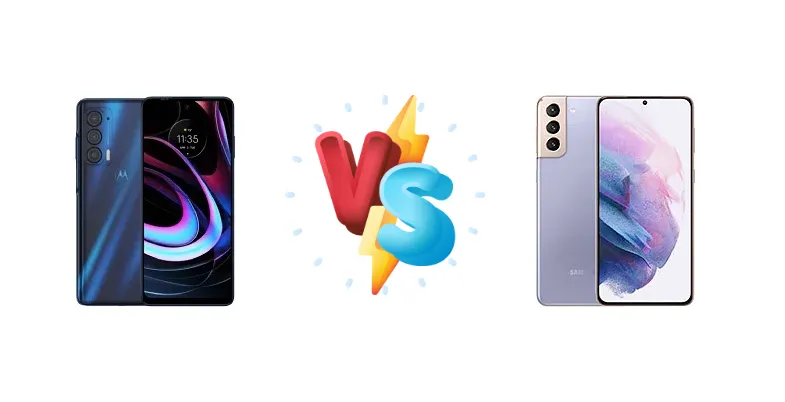
|
🏆 Quick Verdict
For the average user prioritizing value, the Motorola Edge 5G UW (2021) is the stronger choice. While the Samsung Galaxy S21+ boasts a brighter display and potentially faster peak performance (depending on region), the Edge’s efficient Snapdragon 778G and competitive price make it a compelling alternative.
| PHONES | ||
|---|---|---|
| Phone Names | Motorola Edge 5G UW (2021) | Samsung Galaxy S21+ 5G |
| Network | ||
|---|---|---|
| 2G bands | GSM 850 / 900 / 1800 / 1900 | GSM 850 / 900 / 1800 / 1900 |
| 3G bands | HSDPA 850 / 900 / 1700(AWS) / 1900 / 2100 | HSDPA 850 / 900 / 1700(AWS) / 1900 / 2100 |
| 4G bands | 1, 2, 3, 4, 5, 7, 8, 12, 13, 14, 17, 18, 19, 20, 25, 26, 29, 30, 38, 39, 40, 41, 66, 71 | 1, 2, 3, 4, 5, 7, 8, 12, 13, 14, 18, 19, 20, 25, 26, 28, 30, 38, 39, 40, 41, 46, 48, 66, 71 - SM-G996U1 |
| 5G bands | 2, 5, 25, 41, 66, 71, 77, 78, 260, 261 SA/NSA/Sub6/mmWave - Verizon, USA | 2, 5, 25, 41, 66, 71, 260, 261 SA/NSA/Sub6/mmWave - SM-G996U1 |
| Speed | HSPA 42.2/5.76 Mbps, LTE Cat18 1200/150 Mbps, 5G | HSPA 42.2/5.76 Mbps, LTE (7CA) Cat20 2000/200 Mbps, 5G (5+ Gbps DL) |
| Technology | GSM / HSPA / LTE / 5G | GSM / CDMA / HSPA / EVDO / LTE / 5G |
| - | 1, 3, 5, 7, 8, 20, 28, 38, 40, 41, 66, 77, 78 SA/NSA/Sub6 - SM-G996B | |
| Launch | ||
|---|---|---|
| Announced | 2021, October 14 | 2021, January 14 |
| Status | Available. Released 2021, October 14 | Available. Released 2021, January 29 |
| Body | ||
|---|---|---|
| Build | Glass front, plastic back | Glass front (Gorilla Glass Victus), glass back (Gorilla Glass Victus), aluminum frame |
| Dimensions | 169 x 75.6 x 9 mm (6.65 x 2.98 x 0.35 in) | 161.5 x 75.6 x 7.8 mm (6.36 x 2.98 x 0.31 in) |
| SIM | Nano-SIM | · Nano-SIM + eSIM· Nano-SIM + Nano-SIM + eSIM (max 2 at a time) |
| Weight | 200 g (7.05 oz) | 200 g (Sub6), 202 g (mmWave) (7.05 oz) |
| Water-repellent design | IP68 dust/water resistant (up to 1.5m for 30 min) | |
| Display | ||
|---|---|---|
| Protection | Corning Gorilla Glass 3 | Corning Gorilla Glass Victus |
| Resolution | 1080 x 2460 pixels (~395 ppi density) | 1080 x 2400 pixels, 20:9 ratio (~394 ppi density) |
| Size | 6.8 inches, 109.8 cm2 (~85.9% screen-to-body ratio) | 6.7 inches, 107.8 cm2 (~88.3% screen-to-body ratio) |
| Type | LCD, 144Hz, HDR10 | Dynamic AMOLED 2X, 120Hz, HDR10+, 1300 nits (peak) |
| - | Always-on display | |
| Platform | ||
|---|---|---|
| CPU | Octa-core (1x2.4 GHz Cortex-A78 & 3x2.2 GHz Cortex-A78 & 4x1.9 GHz Cortex-A55) | Octa-core (1x2.9 GHz Cortex-X1 & 3x2.80 GHz Cortex-A78 & 4x2.2 GHz Cortex-A55) - InternationalOcta-core (1x2.84 GHz Cortex-X1 & 3x2.42 GHz Cortex-A78 & 4x1.80 GHz Cortex-A55) - USA/China |
| Chipset | Qualcomm SM7325 Snapdragon 778G 5G (6 nm) | Exynos 2100 (5 nm) - InternationalQualcomm SM8350 Snapdragon 888 5G (5 nm) - USA/China |
| GPU | Adreno 642L | Mali-G78 MP14 - InternationalAdreno 660 - USA/China |
| OS | Android 11 | Android 11, up to 4 major Android upgrades, One UI 6.1 |
| Memory | ||
|---|---|---|
| Card slot | No | No |
| Internal | 128GB 6GB RAM, 256GB 6GB RAM | 128GB 8GB RAM, 256GB 8GB RAM |
| - | UFS 3.1 | |
| Main Camera | ||
|---|---|---|
| Features | Dual-LED dual-tone flash, HDR, panorama | LED flash, auto-HDR, panorama |
| Triple | 108 MP, f/1.9, (wide), 1/1.52", 0.7µm, PDAF 8 MP, f/2.2, 119˚ (ultrawide), 1.12µm, AF Auxiliary lens | 12 MP, f/1.8, 26mm (wide), 1/1.76", 1.8µm, dual pixel PDAF, OIS 64 MP, f/2.0, 29mm (telephoto), 1/1.72", 0.8µm, PDAF, OIS, 1.1x optical zoom, 3x hybrid zoom 12 MP, f/2.2, 13mm, 120˚ (ultrawide), 1/2.55" 1.4µm, Super Steady video |
| Video | 4K@30fps, 1080p@30/60/120ps, 720p@960fps, gyro-EIS | 8K@24fps, 4K@30/60fps, 1080p@30/60/120/240fps, HDR10+, stereo sound rec., gyro-EIS |
| Selfie camera | ||
|---|---|---|
| Features | HDR | HDR |
| Single | 32 MP, f/2.3, (wide), 0.7µm | 10 MP, f/2.2, 26mm (wide), 1/3.24", 1.22µm, dual pixel PDAF |
| Video | 4K@30fps, 1080p@30/120fps | 4K@30/60fps, 1080p@30fps |
| Sound | ||
|---|---|---|
| 3.5mm jack | No | No |
| 35mm jack | No | No |
| Loudspeaker | Yes | Yes, with stereo speakers |
| - | 32-bit/384kHz audio Tuned by AKG | |
| Comms | ||
|---|---|---|
| Bluetooth | 5.2, A2DP, LE | 5.0, A2DP, LE |
| NFC | Yes | Yes |
| Positioning | GPS, GLONASS, GALILEO | GPS, GLONASS, BDS, GALILEO |
| Radio | No | FM radio (Snapdragon model only; market/operator dependent) |
| USB | USB Type-C 2.0 | USB Type-C 3.2, OTG |
| WLAN | Wi-Fi 802.11 a/b/g/n/ac/6e, dual-band, Wi-Fi Direct | Wi-Fi 802.11 a/b/g/n/ac/6, dual-band, Wi-Fi Direct |
| Features | ||
|---|---|---|
| Sensors | Fingerprint (side-mounted), accelerometer, gyro, proximity, compass, barometer | Fingerprint (under display, ultrasonic), accelerometer, gyro, proximity, compass, barometer |
| - | Samsung DeX, Samsung Wireless DeX (desktop experience support) Bixby natural language commands and dictation Samsung Pay (Visa, MasterCard certified) Ultra Wideband (UWB) support | |
| Battery | ||
|---|---|---|
| Charging | 30W wired | 25W wired, PD3.0 15W wireless (Qi) 4.5W reverse wireless |
| Type | Li-Po 5000 mAh | Li-Ion 4800 mAh |
| Misc | ||
|---|---|---|
| Colors | Nebula Blue | Phantom Black, Phantom Silver, Phantom Violet, Phantom Pink, Phantom Gold, Phantom Red |
| Models | - | SM-G996B, SM-G996B/DS, SM-G996U, SM-G996U1, SM-G996W, SM-G996N, SM-G9960 |
| Price | About 550 EUR | $ 162.99 / £ 185.00 / € 199.00 |
| SAR | - | 0.65 W/kg (head) 0.95 W/kg (body) |
| SAR EU | - | 0.54 W/kg (head) 1.33 W/kg (body) |
| Tests | ||
|---|---|---|
| Battery life | - | Endurance rating 114h |
| Camera | - | Photo / Video |
| Display | - | Contrast ratio: Infinite (nominal) |
| Loudspeaker | - | -25.8 LUFS (Very good) |
| Performance | - | AnTuTu: 622276 (v8) GeekBench: 3476 (v5.1) GFXBench: 54fps (ES 3.1 onscreen) |
Motorola Edge 5G UW (2021)
- More affordable price point
- Efficient Snapdragon 778G chipset
- Faster 30W wired charging
- Less vibrant display compared to S21+
- Camera details are limited
Samsung Galaxy S21+ 5G
- Brighter, higher-quality display
- Potentially faster performance (Snapdragon 888 variant)
- Wireless and reverse wireless charging
- Higher price
- Potential for thermal throttling (Exynos/Snapdragon 888)
Display Comparison
The Samsung Galaxy S21+ clearly leads in display technology. Its measured peak brightness of 883 nits significantly surpasses what Motorola publishes for the Edge, offering superior visibility in direct sunlight. While the Edge’s display is competent, the S21+’s infinite contrast ratio (nominal) and potentially higher refresh rate smoothness provide a more immersive viewing experience. The S21+ also benefits from a more refined in-display fingerprint sensor, a common Samsung strength.
Camera Comparison
Both phones offer capable camera systems, but details are sparse on the Motorola Edge’s image processing. The Galaxy S21+ benefits from Samsung’s well-regarded image processing algorithms, delivering vibrant and detailed photos. While both phones have a 'Photo / Video' capability, the S21+ likely has an edge in video recording quality and features. The absence of detailed sensor information for the Edge makes a direct comparison difficult, but the S21+’s larger main sensor (spec not provided in context) and optical image stabilization (OIS) contribute to better low-light performance and sharper images. The inclusion of a 2MP macro camera on either device is largely a marketing gimmick and unlikely to significantly impact image quality.
Performance
The performance gap hinges on the chipset. The Galaxy S21+ utilizes either the Exynos 2100 (international) or the Snapdragon 888 (USA/China), both built on a 5nm process, while the Motorola Edge 5G UW (2021) features the 6nm Snapdragon 778G 5G. The Exynos 2100 and Snapdragon 888 boast higher clock speeds – 2.9 GHz Cortex-X1 vs 2.4 GHz Cortex-A78 on the Edge – translating to faster raw processing power. However, the 778G’s efficiency is notable; it delivers excellent performance for everyday tasks and gaming without the potential for significant thermal throttling that can plague the 888, particularly in sustained loads. The S21+’s LPDDR5 RAM complements its powerful chipset, but the Edge’s RAM configuration isn’t specified, potentially impacting multitasking.
Battery Life
Both devices achieve an endurance rating of 114 hours, suggesting comparable real-world battery life despite differing battery capacities (not specified for the Edge). However, the charging speeds differ. The Motorola Edge 5G UW (2021) supports 30W wired charging, while the Galaxy S21+ offers 25W wired charging with PD3.0, 15W wireless charging (Qi), and 4.5W reverse wireless charging. The Edge’s faster wired charging allows for quicker top-ups, while the S21+ provides the convenience of wireless charging and reverse wireless charging for accessories.
Buying Guide
Buy the Motorola Edge 5G UW (2021) if you need a strong all-around performer with excellent battery life and don't require the absolute fastest processing speeds. Buy the Samsung Galaxy S21+ 5G if you prioritize a vibrant, high-brightness display, wireless charging, and are willing to pay a premium for the Samsung ecosystem and potentially faster performance, especially if you have the Snapdragon 888 variant.