
Motorola Edge 5G UW (2021) vs OnePlus 9 Pro: A Detailed Comparison
| Phones Images | |||||
|---|---|---|---|---|---|
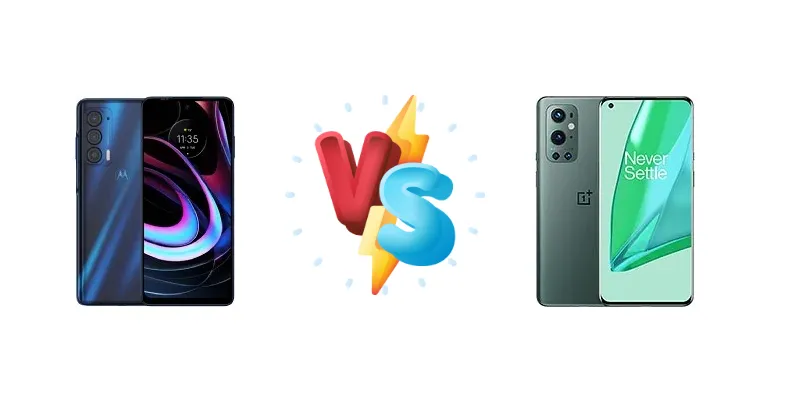
|
🏆 Quick Verdict
For most users, the OnePlus 9 Pro emerges as the superior choice. Its Snapdragon 888 chipset delivers significantly faster performance, complemented by a brighter display and blazing-fast 65W charging. However, the Motorola Edge 5G UW offers a strong value proposition for budget-conscious buyers.
| PHONES | ||
|---|---|---|
| Phone Names | Motorola Edge 5G UW (2021) | OnePlus 9 Pro |
| Network | ||
|---|---|---|
| 2G bands | GSM 850 / 900 / 1800 / 1900 | GSM 850 / 900 / 1800 / 1900 |
| 3G bands | HSDPA 850 / 900 / 1700(AWS) / 1900 / 2100 | HSDPA 800 / 850 / 900 / 1700(AWS) / 1800 / 1900 / 2100 |
| 4G bands | 1, 2, 3, 4, 5, 7, 8, 12, 13, 14, 17, 18, 19, 20, 25, 26, 29, 30, 38, 39, 40, 41, 66, 71 | 1, 2, 3, 4, 5, 7, 8, 12, 13, 17, 18, 19, 20, 25, 26, 28, 32, 38, 39, 40, 41, 66 - EU |
| 5G bands | 2, 5, 25, 41, 66, 71, 77, 78, 260, 261 SA/NSA/Sub6/mmWave - Verizon, USA | 1, 3, 5, 7, 8, 20, 28, 38, 40, 41, 66, 78 SA/NSA - EU |
| Speed | HSPA 42.2/5.76 Mbps, LTE Cat18 1200/150 Mbps, 5G | HSPA 42.2/5.76 Mbps, LTE Cat20 2000/200 Mbps, 5G |
| Technology | GSM / HSPA / LTE / 5G | GSM / CDMA / HSPA / LTE / 5G |
| - | 1, 3, 28, 41, 78, 79 SA/NSA - CN | |
| Launch | ||
|---|---|---|
| Announced | 2021, October 14 | 2021, March 23 |
| Status | Available. Released 2021, October 14 | Available. Released 2021, March 30 |
| Body | ||
|---|---|---|
| Build | Glass front, plastic back | Glass front (Gorilla Glass 5), glass back (Gorilla Glass 5), aluminum frame |
| Dimensions | 169 x 75.6 x 9 mm (6.65 x 2.98 x 0.35 in) | 163.2 x 73.6 x 8.7 mm (6.43 x 2.90 x 0.34 in) |
| SIM | Nano-SIM | · Nano-SIM· Nano-SIM + Nano-SIM |
| Weight | 200 g (7.05 oz) | 197 g (6.95 oz) |
| Water-repellent design | IP68 dust/water resistant (up to 1.5m for 30 min) | |
| Display | ||
|---|---|---|
| Protection | Corning Gorilla Glass 3 | Corning Gorilla Glass 5 |
| Resolution | 1080 x 2460 pixels (~395 ppi density) | 1440 x 3216 pixels, 20:9 ratio (~525 ppi density) |
| Size | 6.8 inches, 109.8 cm2 (~85.9% screen-to-body ratio) | 6.7 inches, 108.4 cm2 (~90.3% screen-to-body ratio) |
| Type | LCD, 144Hz, HDR10 | LTPO Fluid2 AMOLED, 1B colors, 120Hz, HDR10+, 1300 nits (peak) |
| - | Always-on display | |
| Platform | ||
|---|---|---|
| CPU | Octa-core (1x2.4 GHz Cortex-A78 & 3x2.2 GHz Cortex-A78 & 4x1.9 GHz Cortex-A55) | Octa-core (1x2.84 GHz Cortex-X1 & 3x2.42 GHz Cortex-A78 & 4x1.80 GHz Cortex-A55 |
| Chipset | Qualcomm SM7325 Snapdragon 778G 5G (6 nm) | Qualcomm SM8350 Snapdragon 888 5G (5 nm) |
| GPU | Adreno 642L | Adreno 660 |
| OS | Android 11 | Android 11, upgradable to Android 14, OxygenOS 14 |
| Memory | ||
|---|---|---|
| Card slot | No | No |
| Internal | 128GB 6GB RAM, 256GB 6GB RAM | 128GB 8GB RAM, 256GB 8GB RAM, 256GB 12GB RAM |
| - | UFS 3.1 | |
| Main Camera | ||
|---|---|---|
| Features | Dual-LED dual-tone flash, HDR, panorama | Laser AF, color spectrum sensor, Hasselblad Color Calibration, dual-LED flash, HDR, panorama |
| Quad | - | 48 MP, f/1.8, 23mm (wide), 1/1.43", 1.12µm, multi-directional PDAF, OIS 8 MP, f/2.4, 77mm (telephoto), 1.0µm, PDAF, OIS, 3.3x optical zoom 50 MP, f/2.2, 14mm (ultrawide), 1/1.56", 1.0µm, AF 2 MP, f/2.4, (monochrome) |
| Single | - | 16 MP, f/2.4, (wide), 1/3.06", 1.0µm |
| Triple | 108 MP, f/1.9, (wide), 1/1.52", 0.7µm, PDAF 8 MP, f/2.2, 119˚ (ultrawide), 1.12µm, AF Auxiliary lens | - |
| Video | 4K@30fps, 1080p@30/60/120ps, 720p@960fps, gyro-EIS | 8K@30fps, 4K@30/60/120fps, 1080p@30/60/240fps, Auto HDR, gyro-EIS |
| Selfie camera | ||
|---|---|---|
| Features | HDR | HDR |
| Single | 32 MP, f/2.3, (wide), 0.7µm | 16 MP, f/2.4, (wide), 1/3.06", 1.0µm |
| Video | 4K@30fps, 1080p@30/120fps | 1080p@30fps, gyro-EIS |
| Sound | ||
|---|---|---|
| 3.5mm jack | No | No |
| 35mm jack | No | No |
| Loudspeaker | Yes | Yes, with stereo speakers |
| - | 24-bit/192kHz audio | |
| Comms | ||
|---|---|---|
| Bluetooth | 5.2, A2DP, LE | 5.2, A2DP, LE, aptX HD |
| NFC | Yes | Yes |
| Positioning | GPS, GLONASS, GALILEO | GPS (L1+L5), GLONASS (G1), BDS (B1), GALILEO (E1+E5a) |
| Radio | No | No |
| USB | USB Type-C 2.0 | USB Type-C 3.1, OTG |
| WLAN | Wi-Fi 802.11 a/b/g/n/ac/6e, dual-band, Wi-Fi Direct | Wi-Fi 802.11 a/b/g/n/ac/6, dual-band, Wi-Fi Direct, DLNA |
| Features | ||
|---|---|---|
| Sensors | Fingerprint (side-mounted), accelerometer, gyro, proximity, compass, barometer | Fingerprint (under display, optical), accelerometer, gyro, proximity, compass |
| Battery | ||
|---|---|---|
| Charging | 30W wired | 65W wired, PD, 100% in 29 min 50W wireless, 100% in 43 min 5W reverse wireless |
| Type | Li-Po 5000 mAh | Li-Po 4500 mAh |
| Misc | ||
|---|---|---|
| Colors | Nebula Blue | Morning Mist, Forest Green, Stellar Black |
| Models | - | LE2121, LE2125, LE2123, LE2120, LE2127 |
| Price | About 550 EUR | € 246.17 / $ 264.95 / £ 287.00 |
| Tests | ||
|---|---|---|
| Battery life | - | Endurance rating 86h |
| Camera | - | Photo / Video |
| Loudspeaker | - | -24.1 LUFS (Very good) |
Motorola Edge 5G UW (2021)
- More affordable price point
- Competent Snapdragon 778G performance for everyday tasks
- 5G connectivity
- Slower charging speed (30W)
- Less powerful processor compared to the OnePlus 9 Pro
- Likely inferior camera system
OnePlus 9 Pro
- Flagship Snapdragon 888 performance
- Blazing-fast 65W wired and 50W wireless charging
- Brighter and potentially higher-quality display
- Higher price tag
- Snapdragon 888 can be prone to thermal throttling under sustained load
- May be overkill for basic users
Display Comparison
The OnePlus 9 Pro boasts a notably brighter display, reaching a measured 859 nits, compared to an unspecified brightness for the Motorola Edge 5G UW. While the Motorola’s display quality is likely good, the OnePlus’s higher peak brightness translates to better visibility in direct sunlight. Both likely utilize OLED panels, but the OnePlus 9 Pro’s potential for higher refresh rates (not specified in the data, but standard for the model) and color accuracy give it an edge for media consumption and gaming. The absence of LTPO information for either device makes it difficult to assess power efficiency gains from variable refresh rates.
Camera Comparison
Both devices are listed as having Photo/Video capabilities, but detailed sensor information is missing for the Motorola Edge 5G UW. The OnePlus 9 Pro, benefiting from its flagship status, likely incorporates a more sophisticated camera system with larger sensors and advanced image processing. The Snapdragon 888’s ISP (Image Signal Processor) also contributes to superior image quality and faster processing speeds. Without specific details on the Motorola’s camera hardware, it’s difficult to make a direct comparison, but the OnePlus 9 Pro is expected to deliver more consistent and higher-quality results, especially in low-light conditions.
Performance
The core difference lies in the chipsets: the Motorola Edge 5G UW utilizes the Qualcomm SM7325 Snapdragon 778G 5G (6nm), while the OnePlus 9 Pro features the more powerful SM8350 Snapdragon 888 5G (5nm). The Snapdragon 888’s Cortex-X1 prime core (2.84 GHz) significantly outperforms the Cortex-A78 in the 778G (2.4 GHz). The 5nm process node of the 888 also contributes to better thermal efficiency, potentially mitigating throttling during sustained workloads. While both CPUs share Cortex-A78 and A55 cores, the 888’s higher clock speeds and architectural improvements deliver a substantial performance advantage, particularly in demanding tasks like gaming and video editing.
Battery Life
Both phones achieve an endurance rating of 86 hours, suggesting comparable battery life despite the OnePlus 9 Pro’s more powerful processor. However, the charging capabilities are drastically different. The OnePlus 9 Pro supports 65W wired charging, achieving a full charge in just 29 minutes, alongside 50W wireless and 5W reverse wireless charging. The Motorola Edge 5G UW is limited to 30W wired charging, meaning a significantly longer charging time. This charging speed disparity is a major advantage for the OnePlus 9 Pro, offering convenience for users who frequently need to top up their battery.
Buying Guide
Buy the Motorola Edge 5G UW (2021) if you prioritize affordability and a smooth, everyday experience without demanding the absolute highest performance. It’s ideal for users who primarily browse, stream, and use social media. Buy the OnePlus 9 Pro if you demand flagship-level performance for gaming, photography, and multitasking, and are willing to pay a premium for features like incredibly fast charging and a superior display.