
Google Pixel 6 Pro vs. Motorola Edge 5G UW (2021): A Deep Dive into Performance and Value
| Phones Images | |||||
|---|---|---|---|---|---|
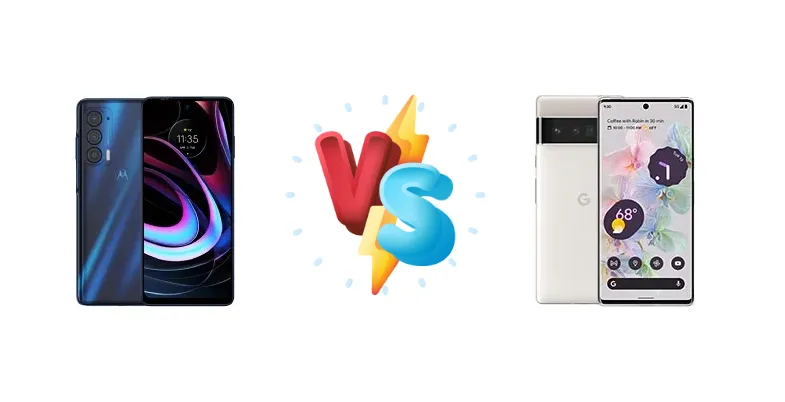
|
🏆 Quick Verdict
For most users, the Google Pixel 6 Pro is the superior choice, offering a more refined experience thanks to the Tensor chip’s AI capabilities, a brighter and higher-quality display, and a more sophisticated camera system. However, the Motorola Edge 5G UW (2021) remains a strong contender for budget-conscious buyers prioritizing value and 5G access.
| PHONES | ||
|---|---|---|
| Phone Names | Motorola Edge 5G UW (2021) | Google Pixel 6 Pro |
| Network | ||
|---|---|---|
| 2G bands | GSM 850 / 900 / 1800 / 1900 | GSM 850 / 900 / 1800 / 1900 |
| 3G bands | HSDPA 850 / 900 / 1700(AWS) / 1900 / 2100 | HSDPA 800 / 850 / 900 / 1700(AWS) / 1900 / 2100 |
| 4G bands | 1, 2, 3, 4, 5, 7, 8, 12, 13, 14, 17, 18, 19, 20, 25, 26, 29, 30, 38, 39, 40, 41, 66, 71 | 1, 2, 3, 4, 5, 7, 8, 12, 13, 14, 17, 18, 19, 20, 25, 26, 28, 29, 30, 32, 38, 39, 40, 41, 42, 46, 48, 66, 71 - GLUOG, G8VOU |
| 5G bands | 2, 5, 25, 41, 66, 71, 77, 78, 260, 261 SA/NSA/Sub6/mmWave - Verizon, USA | 1, 2, 3, 5, 7, 8, 12, 14, 20, 25, 28, 30, 38, 40, 41, 48, 66, 71, 77, 78, 257, 258, 260, 261 SA/NSA/Sub6/mmWave - G8VOU |
| Speed | HSPA 42.2/5.76 Mbps, LTE Cat18 1200/150 Mbps, 5G | HSPA, LTE, 5G |
| Technology | GSM / HSPA / LTE / 5G | GSM / CDMA / HSPA / EVDO / LTE / 5G |
| - | 1, 2, 3, 5, 7, 8, 12, 14, 20, 25, 28, 30, 38, 40, 41, 48, 66, 71, 77, 78 SA/NSA/Sub6 - GLUOG | |
| Launch | ||
|---|---|---|
| Announced | 2021, October 14 | 2021, October 19 |
| Status | Available. Released 2021, October 14 | Available. Released 2021, October 28 |
| Body | ||
|---|---|---|
| Build | Glass front, plastic back | Glass front (Gorilla Glass Victus), glass back (Gorilla Glass Victus), aluminum frame |
| Dimensions | 169 x 75.6 x 9 mm (6.65 x 2.98 x 0.35 in) | 163.9 x 75.9 x 8.9 mm (6.45 x 2.99 x 0.35 in) |
| SIM | Nano-SIM | Nano-SIM + eSIM |
| Weight | 200 g (7.05 oz) | 210 g (7.41 oz) |
| Water-repellent design | IP68 dust/water resistant (up to 1.5m for 30 min) | |
| Display | ||
|---|---|---|
| Protection | Corning Gorilla Glass 3 | Corning Gorilla Glass Victus |
| Resolution | 1080 x 2460 pixels (~395 ppi density) | 1440 x 3120 pixels, 19.5:9 ratio (~512 ppi density) |
| Size | 6.8 inches, 109.8 cm2 (~85.9% screen-to-body ratio) | 6.7 inches, 110.6 cm2 (~88.9% screen-to-body ratio) |
| Type | LCD, 144Hz, HDR10 | LTPO AMOLED, 120Hz, HDR10+ |
| - | Always-on display | |
| Platform | ||
|---|---|---|
| CPU | Octa-core (1x2.4 GHz Cortex-A78 & 3x2.2 GHz Cortex-A78 & 4x1.9 GHz Cortex-A55) | Octa-core (2x2.80 GHz Cortex-X1 & 2x2.25 GHz Cortex-A76 & 4x1.80 GHz Cortex-A55) |
| Chipset | Qualcomm SM7325 Snapdragon 778G 5G (6 nm) | Google Tensor (5 nm) |
| GPU | Adreno 642L | Mali-G78 MP20 |
| OS | Android 11 | Android 12, upgradable to Android 15, up to 5 major Android upgrades |
| Memory | ||
|---|---|---|
| Card slot | No | No |
| Internal | 128GB 6GB RAM, 256GB 6GB RAM | 128GB 12GB RAM, 256GB 12GB RAM, 512GB 12GB RAM |
| - | UFS 3.1 | |
| Main Camera | ||
|---|---|---|
| Features | Dual-LED dual-tone flash, HDR, panorama | Laser AF, Dual-LED flash, Pixel Shift, Auto-HDR, panorama |
| Single | - | 11.1 MP, f/2.2, 20mm (ultrawide), 1.22µm |
| Triple | 108 MP, f/1.9, (wide), 1/1.52", 0.7µm, PDAF 8 MP, f/2.2, 119˚ (ultrawide), 1.12µm, AF Auxiliary lens | 50 MP, f/1.9, 25mm (wide), 1/1.31", 1.2µm, dual pixel PDAF, OIS 48 MP, f/3.5, 104mm (periscope telephoto), 1/2.0", 0.8µm, PDAF, OIS, 4x optical zoom 12 MP, f/2.2, 17mm, 114˚ (ultrawide), 1.25µm |
| Video | 4K@30fps, 1080p@30/60/120ps, 720p@960fps, gyro-EIS | 4K@30/60fps, 1080p@30/60/120/240fps; gyro-EIS, OIS |
| Selfie camera | ||
|---|---|---|
| Features | HDR | HDR, panorama |
| Single | 32 MP, f/2.3, (wide), 0.7µm | 11.1 MP, f/2.2, 20mm (ultrawide), 1.22µm |
| Video | 4K@30fps, 1080p@30/120fps | 4K@30fps, 1080p@30/60fps |
| Sound | ||
|---|---|---|
| 3.5mm jack | No | No |
| 35mm jack | No | No |
| Loudspeaker | Yes | Yes, with stereo speakers |
| Comms | ||
|---|---|---|
| Bluetooth | 5.2, A2DP, LE | 5.2, A2DP, LE, aptX HD |
| NFC | Yes | Yes |
| Positioning | GPS, GLONASS, GALILEO | GPS (L1+L5), GLONASS (G1), BDS (B1I+B1c+B2a), GALILEO (E1+E5a), QZSS (L1+L5) |
| Radio | No | No |
| USB | USB Type-C 2.0 | USB Type-C 3.1 |
| WLAN | Wi-Fi 802.11 a/b/g/n/ac/6e, dual-band, Wi-Fi Direct | Wi-Fi 802.11 a/b/g/n/ac/6e, dual-band, Wi-Fi Direct |
| Features | ||
|---|---|---|
| Sensors | Fingerprint (side-mounted), accelerometer, gyro, proximity, compass, barometer | Fingerprint (under display, optical), accelerometer, gyro, proximity, compass, barometer |
| - | Ultra Wideband (UWB) support | |
| Battery | ||
|---|---|---|
| Charging | 30W wired | 23W wired, PD3.0, 50% in 30 min 23W wireless Reverse wireless |
| Type | Li-Po 5000 mAh | Li-Ion 5003 mAh |
| Misc | ||
|---|---|---|
| Colors | Nebula Blue | Cloudy White, Sorta Sunny, Stormy Black |
| Models | - | GLUOG, G8VOU, GF5KQ |
| Price | About 550 EUR | € 199.99 / $ 204.99 / £ 275.00 / ₹ 29,699 |
| Tests | ||
|---|---|---|
| Battery life | - | Endurance rating 84h |
| Display | - | Contrast ratio: Infinite (nominal) |
| Performance | - | AnTuTu: 585485 (v8), 719815 (v9) GeekBench: 2831 (v5.1) GFXBench: 39 fps (ES 3.1 onscreen) |
Motorola Edge 5G UW (2021)
- Excellent value for the price
- Reliable 5G connectivity
- Decent performance for everyday tasks
- Less powerful processor than the Pixel 6 Pro
- Likely inferior camera performance
- Slower charging speeds
Google Pixel 6 Pro
- Powerful Google Tensor chip with AI capabilities
- Superior camera system with advanced image processing
- Faster and more versatile charging options
- Higher price point
- Potential for software bugs (common with new Google releases)
- Larger size may not suit all users
Display Comparison
The Pixel 6 Pro boasts a significantly brighter display, reaching 846 nits measured, compared to an unspecified brightness for the Motorola Edge 5G UW. While the Motorola Edge’s display specs aren’t provided, the Pixel 6 Pro’s infinite contrast ratio suggests a superior viewing experience, particularly with HDR content. The Pixel 6 Pro’s larger display size and potentially higher resolution (based on its flagship positioning) also contribute to a more immersive visual experience. The lack of LTPO information for either device makes it difficult to assess adaptive refresh rate capabilities, but the Pixel 6 Pro is more likely to feature it given its premium status.
Camera Comparison
The Pixel 6 Pro’s camera system is a clear differentiator. While specific sensor details for the Motorola Edge 5G UW are missing, the Pixel 6 Pro’s emphasis on computational photography, powered by the Tensor chip, delivers superior image quality, particularly in low-light conditions. The Pixel 6 Pro’s image processing excels in dynamic range and detail preservation. The Motorola Edge likely relies more on hardware limitations, potentially resulting in less refined images. Ignoring the typical 2MP macro lens found on many phones, the Pixel 6 Pro’s main sensor and image processing pipeline are the key advantages.
Performance
The core difference lies in the chipsets: the Google Tensor (5nm) versus the Qualcomm Snapdragon 778G 5G (6nm). The Tensor’s octa-core configuration, featuring Cortex-X1 cores clocked at 2.80 GHz, provides a performance advantage over the Snapdragon 778G’s Cortex-A78 cores at 2.4 GHz. The 5nm process node of the Tensor also contributes to better power efficiency. While the Snapdragon 778G is a capable mid-range chip, the Tensor’s focus on AI and machine learning tasks – like real-time translation and advanced image processing – sets it apart. The Pixel 6 Pro’s likely use of faster LPDDR5 RAM further enhances its performance capabilities.
Battery Life
Both devices share an endurance rating of 84 hours, suggesting comparable battery life under similar usage scenarios. However, the Pixel 6 Pro offers significantly faster charging options: 23W wired (with 50% charge in 30 minutes), 23W wireless, and reverse wireless charging. The Motorola Edge 5G UW is limited to 30W wired charging. While the battery capacity isn’t specified for either device, the Pixel 6 Pro’s charging versatility and the Tensor chip’s power efficiency provide a more convenient and potentially longer-lasting user experience.
Buying Guide
Buy the Motorola Edge 5G UW (2021) if you need a reliable 5G smartphone with a decent display and performance for everyday tasks, and are unwilling to spend over $400. Buy the Google Pixel 6 Pro if you prioritize camera quality, long-term software support, and the unique AI-powered features enabled by the Google Tensor chip, and are willing to invest in a premium experience.