
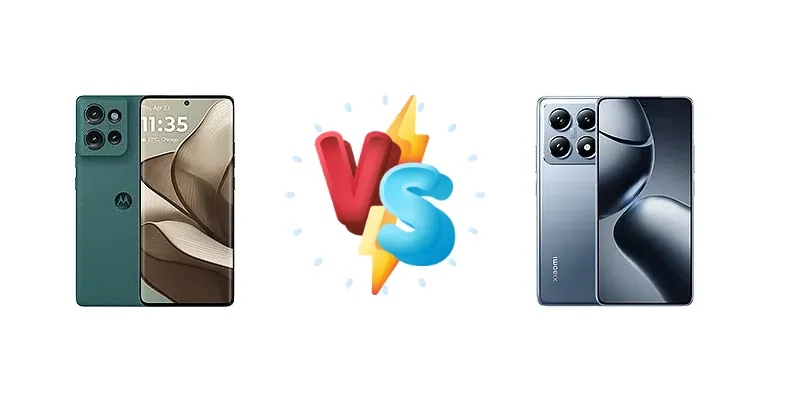
Xiaomi 14T Pro vs Motorola Edge 50: A Deep Dive into Performance, Battery, and Value
| Phones Images | |||||
|---|---|---|---|---|---|
|
🏆 Quick Verdict
For users prioritizing raw performance and incredibly fast charging, the Xiaomi 14T Pro is the clear winner. Its Dimensity 9300+ chipset and 120W charging significantly outperform the Motorola Edge 50’s Snapdragon 7 Gen 1 and 68W charging. However, the Edge 50 provides respectable battery endurance and a bright display at a potentially lower price point.
| PHONES | ||
|---|---|---|
| Phone Names | Motorola Edge 50 | Xiaomi 14T Pro |
| Network | ||
|---|---|---|
| 2G bands | GSM 850 / 900 / 1800 / 1900 | GSM 850 / 900 / 1800 / 1900 |
| 3G bands | HSDPA 850 / 900 / 1700(AWS) / 1900 / 2100 | HSDPA 800 / 850 / 900 / 1700(AWS) / 1900 / 2100 |
| 4G bands | 1, 2, 3, 4, 5, 7, 8, 12, 13, 17, 18, 19, 20, 25, 26, 28, 32, 38, 39, 40, 41, 42, 43, 48, 66 | 1, 2, 3, 4, 5, 7, 8, 12, 13, 17, 18, 19, 20, 25, 26, 28, 32, 38, 39, 40, 41, 42, 48, 66 |
| 5G bands | 1, 2, 3, 5, 7, 8, 20, 28, 38, 40, 41, 66, 77, 78 SA/NSA/Sub6 | 1, 2, 3, 5, 7, 8, 12, 20, 25, 26, 28, 38, 40, 41, 48, 66, 75, 77, 78 SA/NSA |
| Speed | HSPA, LTE, 5G | HSPA, LTE, 5G |
| Technology | GSM / HSPA / LTE / 5G | GSM / HSPA / LTE / 5G |
| Launch | ||
|---|---|---|
| Announced | 2024, August 01 | 2024, September 26 |
| Status | Available. Released 2024, August 08 | Available. Released 2024, September 26 |
| Body | ||
|---|---|---|
| Build | Glass front, aluminum frame, silicone polymer (eco leather or eco suede) back | Glass front (Gorilla Glass 5), aluminum frame, glass back (Panda X) |
| Dimensions | 160.8 x 72.4 x 7.8 mm (6.33 x 2.85 x 0.31 in) | 160.4 x 75.1 x 8.4 mm (6.31 x 2.96 x 0.33 in) |
| SIM | · Nano-SIM· Nano-SIM + eSIM· Nano-SIM + Nano-SIM | · Nano-SIM + eSIM· eSIM + eSIM· Nano-SIM + Nano-SIM |
| Weight | 180 g (6.35 oz) | 209 g (7.37 oz) |
| Display | ||
|---|---|---|
| Protection | Corning Gorilla Glass 5, Mohs level 4 | Corning Gorilla Glass 5 |
| Resolution | 1220 x 2712 pixels, 20:9 ratio (~446 ppi density) | 1220 x 2712 pixels, 20:9 ratio (~446 ppi density) |
| Size | 6.7 inches, 107.4 cm2 (~92.2% screen-to-body ratio) | 6.67 inches, 107.4 cm2 (~89.1% screen-to-body ratio) |
| Type | P-OLED, 1B colors, 120Hz, HDR10+, 1600 nits (peak) | AMOLED, 68B colors, 144Hz, 3840Hz PWM, Dolby Vision, HDR10+, 1600 nits (HBM), 4000 nits (peak) |
| Platform | ||
|---|---|---|
| CPU | Octa-core (1x2.5 GHz Cortex-A710 & 3x2.36 GHz Cortex-A710 & 4x1.8 GHz Cortex-A510) | Octa-core (1x3.4 GHz Cortex-X4 & 3x2.85 GHz Cortex-X4 & 4x2.0 GHz Cortex-A720) |
| Chipset | Qualcomm SM7450-AB Snapdragon 7 Gen 1 AE (4 nm) | Mediatek Dimensity 9300+ (4 nm) |
| GPU | Adreno 644 | Immortalis-G720 MC12 |
| OS | Android 14, up to 5 major Android upgrades | Android 14, HyperOS |
| Memory | ||
|---|---|---|
| Card slot | No | No |
| Internal | 256GB 8GB RAM, 256GB 12GB RAM, 512GB 12GB RAM | 256GB 12GB RAM, 512GB 12GB RAM, 512GB 16GB RAM, 1TB 12GB RAM |
| Main Camera | ||
|---|---|---|
| Features | LED flash, HDR, panorama | Leica lens, Ultra HDR, LED flash, HDR, panorama |
| Triple | 50 MP, f/1.8, 24mm (wide), 1/1.56", 1.0µm, multi-directional PDAF, OIS 10 MP, f2.0, 73mm (telephoto), 1/3.94", 1.0µm, PDAF, 3x optical zoom, OIS 13 MP, f/2.2, 13mm, 120˚ (ultrawide), 1/3.0", 1.12µm, PDAF | 50 MP, f/1.6, 23mm (wide), 1/1.31", 1.2µm, PDAF, OIS 50 MP, f/2.0, 60mm (telephoto), 1/2.88", 0.61µm, PDAF, 2.6x optical zoom 12 MP, f/2.2, 15mm (ultrawide), 1/3.06", 1.12µm |
| Video | 4K@30fps, 1080p@30/60/120/240fps | 8K@24/30fps, 4K@24/30/60fps, 1080p@30/60/120/240/960fps, gyro-EIS, 10-bit Rec. 2020, HDR10+ |
| Selfie camera | ||
|---|---|---|
| Features | HDR | HDR |
| Single | 32 MP, f/2.4, (wide), 1/3.14", 0.7µm | 32 MP, f/2.0, 25mm (wide), 1/3.44", 0.64µm |
| Video | 4K@30fps, 1080p@30/120fps | 4K@30fps, 1080p@30/60fps, HDR10+ |
| Sound | ||
|---|---|---|
| 35mm jack | No | No |
| Loudspeaker | Yes, with stereo speakers | Yes, with stereo speakers |
| Comms | ||
|---|---|---|
| Bluetooth | 5.2, A2DP, LE | 5.4, A2DP, LE, LHDC |
| Infrared port | - | Yes |
| NFC | Yes | Yes (market/region dependent) |
| Positioning | GPS, GLONASS, GALILEO | GPS (L1+L5), BDS (B1I+B1C+B2a+B2b), GALILEO (E1+E5a+E5b), QZSS (L1+L5), NavIC (L5), GLONASS |
| Radio | No | No |
| USB | USB Type-C 2.0, OTG | USB Type-C 2.0, OTG |
| WLAN | Wi-Fi 802.11 a/b/g/n/ac/6e, tri-band, Wi-Fi Direct | Wi-Fi 802.11 a/b/g/n/ac/6e/7, dual-band, Wi-Fi Direct |
| Features | ||
|---|---|---|
| Sensors | Fingerprint (under display, optical), accelerometer, gyro, proximity, compass | Fingerprint (under display, optical), accelerometer, gyro, proximity, compass |
| Battery | ||
|---|---|---|
| Charging | 68W wired 15W wireless | 120W wired, PD3.0, QC4, 100% in 19 min 50W wireless, 100% in 45 min |
| Type | 5000 mAh | Li-Po 5000 mAh |
| Misc | ||
|---|---|---|
| Colors | Koala Gray, Jungle Green, Peach Fuzz | Titan Gray, Titan Blue, Titan Black |
| Models | XT2407-1 | 2407FPN8EG |
| Price | $ 299.99 / ₹ 21,437 | $ 550.00 / £ 498.00 / € 539.99 |
| SAR EU | - | 0.99 W/kg (head) 1.00 W/kg (body) |
| EU LABEL | ||
|---|---|---|
| Battery | 45:48h endurance, 1200 cycles | - |
| Energy | Class B | - |
| Free fall | Class A (270 falls) | - |
| Repairability | Class B | - |
Motorola Edge 50
- Competitive battery endurance (45:48h)
- Bright display (1416 nits)
- Potentially more affordable price point
- Less powerful Snapdragon 7 Gen 1 chipset
- Slower 68W wired charging
Xiaomi 14T Pro
- Blazing-fast 120W wired charging (19 min 0-100%)
- Powerful Mediatek Dimensity 9300+ chipset
- Superior active use battery score (12:32h)
- Potentially higher price
- Slightly lower peak display brightness
Display Comparison
Both the Motorola Edge 50 and Xiaomi 14T Pro feature bright displays, with the Edge 50 reaching a measured peak brightness of 1416 nits and the 14T Pro hitting 1228 nits. While the Edge 50 edges out the 14T Pro in peak brightness, the difference is unlikely to be noticeable in most real-world scenarios. Neither specification details panel technology (LTPO, AMOLED) or refresh rate, so we must assume standard high-quality AMOLED panels. The absence of information on color accuracy and calibration leaves a gap in the comparison, but both brands typically deliver acceptable color performance.
Camera Comparison
Without detailed camera specifications beyond the core processors, a direct comparison is limited. However, the chipset difference suggests the 14T Pro will have a more powerful ISP (Image Signal Processor) capable of faster image processing and potentially better low-light performance. The absence of sensor size information is a critical omission. We can infer that Xiaomi, given the 14T Pro’s positioning, will likely employ a larger, higher-resolution main sensor than Motorola. The Edge 50’s image processing will likely focus on a balanced, natural look, while Xiaomi often leans towards more vibrant, saturated colors.
Performance
The performance gap between these two devices is substantial. The Xiaomi 14T Pro’s Mediatek Dimensity 9300+ (4nm) boasts a Cortex-X4 prime core clocked at 3.4 GHz, alongside three Cortex-X4 cores at 2.85 GHz, and four Cortex-A720 efficiency cores. This configuration is significantly more powerful than the Motorola Edge 50’s Qualcomm Snapdragon 7 Gen 1 AE (4nm), which utilizes a single Cortex-A710 prime core at 2.5 GHz, three Cortex-A710 cores at 2.36 GHz, and four Cortex-A510 cores. The Dimensity 9300+’s newer architecture and higher clock speeds translate to a demonstrably faster experience in demanding applications and games. The 14T Pro will exhibit less throttling under sustained load due to its superior thermal design, a common benefit of flagship-tier chipsets.
Battery Life
The Xiaomi 14T Pro’s 120W wired charging is a game-changer, achieving a full charge in just 19 minutes. This is a significant advantage over the Motorola Edge 50’s 68W charging. While the Edge 50 offers 15W wireless charging, the 14T Pro boasts 50W wireless charging, completing a full charge in 45 minutes. Despite the Edge 50’s reported 45:48h endurance and 9:56h active use score, the 14T Pro’s 12:32h active use score indicates superior efficiency, likely due to the Dimensity 9300+'s optimized power management. The faster charging of the 14T Pro mitigates any concerns about its potentially smaller battery capacity (not specified).
Buying Guide
Buy the Motorola Edge 50 if you need a well-rounded smartphone with good battery life and a bright display, and are comfortable with a more moderate level of performance. Buy the Xiaomi 14T Pro if you prioritize blazing-fast charging, top-tier processing power for demanding tasks like gaming, and are willing to pay a premium for those features. The 14T Pro is geared towards power users, while the Edge 50 caters to a broader audience.