
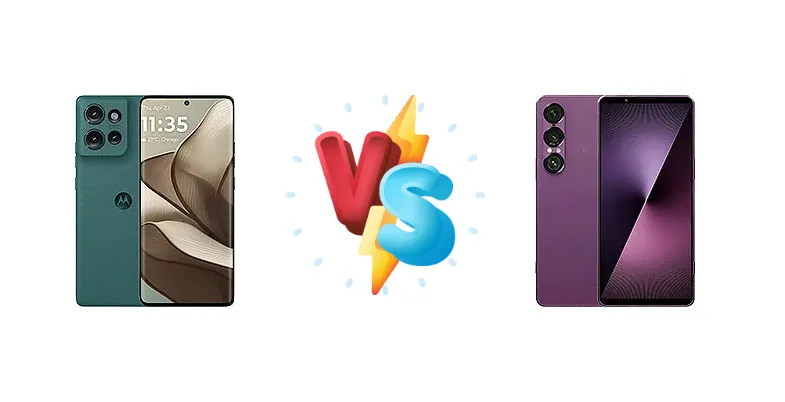
Motorola Edge 50 vs. Sony Xperia 1 VII: A Deep Dive into Performance and Battery Life
| Phones Images | |||||
|---|---|---|---|---|---|
|
🏆 Quick Verdict
For the average user prioritizing all-day battery and fast charging, the Motorola Edge 50 offers a compelling package. However, the Sony Xperia 1 VII’s significantly more powerful Snapdragon 8 Elite chipset and superior active use battery score make it the clear winner for power users and gamers.
| PHONES | ||
|---|---|---|
| Phone Names | Motorola Edge 50 | Sony Xperia 1 VII |
| Network | ||
|---|---|---|
| 2G bands | GSM 850 / 900 / 1800 / 1900 | GSM 850 / 900 / 1800 / 1900 |
| 3G bands | HSDPA 850 / 900 / 1700(AWS) / 1900 / 2100 | HSDPA 800 / 850 / 900 / 1700(AWS) / 1900 / 2100 |
| 4G bands | 1, 2, 3, 4, 5, 7, 8, 12, 13, 17, 18, 19, 20, 25, 26, 28, 32, 38, 39, 40, 41, 42, 43, 48, 66 | 1, 2, 3, 4, 5, 7, 8, 12, 13, 17, 19, 20, 25, 26, 28, 32, 34, 38, 39, 40, 41, 66 - Europe |
| 5G bands | 1, 2, 3, 5, 7, 8, 20, 28, 38, 40, 41, 66, 77, 78 SA/NSA/Sub6 | 1, 3, 5, 7, 8, 20, 28, 38, 40, 41, 75, 77, 78 SA/NSA/Sub6 - Europe |
| Speed | HSPA, LTE, 5G | HSPA, LTE, 5G |
| Technology | GSM / HSPA / LTE / 5G | GSM / HSPA / LTE / 5G |
| Launch | ||
|---|---|---|
| Announced | 2024, August 01 | 2025, May 13 |
| Status | Available. Released 2024, August 08 | Available. Released 2025, June 04 |
| Body | ||
|---|---|---|
| Build | Glass front, aluminum frame, silicone polymer (eco leather or eco suede) back | Glass front (Gorilla Glass Victus 2), glass back (Gorilla Glass Victus), aluminum frame |
| Dimensions | 160.8 x 72.4 x 7.8 mm (6.33 x 2.85 x 0.31 in) | 162 x 74 x 8.2 mm (6.38 x 2.91 x 0.32 in) |
| SIM | · Nano-SIM· Nano-SIM + eSIM· Nano-SIM + Nano-SIM | · Nano-SIM + eSIM· Nano-SIM + Nano-SIM |
| Weight | 180 g (6.35 oz) | 197 g (6.95 oz) |
| Display | ||
|---|---|---|
| Protection | Corning Gorilla Glass 5, Mohs level 4 | Corning Gorilla Glass Victus 2, Mohs level 5 |
| Resolution | 1220 x 2712 pixels, 20:9 ratio (~446 ppi density) | 1080 x 2340 pixels, 19.5:9 ratio (~396 ppi density) |
| Size | 6.7 inches, 107.4 cm2 (~92.2% screen-to-body ratio) | 6.5 inches, 103.7 cm2 (~86.5% screen-to-body ratio) |
| Type | P-OLED, 1B colors, 120Hz, HDR10+, 1600 nits (peak) | LTPO OLED, 1B colors, 120Hz, HDR BT.2020 |
| Platform | ||
|---|---|---|
| CPU | Octa-core (1x2.5 GHz Cortex-A710 & 3x2.36 GHz Cortex-A710 & 4x1.8 GHz Cortex-A510) | Octa-core (2x4.32 GHz Oryon V2 Phoenix L + 6x3.53 GHz Oryon V2 Phoenix M) |
| Chipset | Qualcomm SM7450-AB Snapdragon 7 Gen 1 AE (4 nm) | Qualcomm SM8750-AB Snapdragon 8 Elite (3 nm) |
| GPU | Adreno 644 | Adreno 830 |
| OS | Android 14, up to 5 major Android upgrades | Android 15, up to 4 major Android upgrades |
| Memory | ||
|---|---|---|
| Card slot | No | microSDXC (uses shared SIM slot) |
| Internal | 256GB 8GB RAM, 256GB 12GB RAM, 512GB 12GB RAM | 256GB 12GB RAM, 512GB 12GB RAM |
| Main Camera | ||
|---|---|---|
| Features | LED flash, HDR, panorama | Zeiss optics, Zeiss T* lens coating, color spectrum sensor, LED flash, panorama, HDR, eye tracking |
| Triple | 50 MP, f/1.8, 24mm (wide), 1/1.56", 1.0µm, multi-directional PDAF, OIS 10 MP, f2.0, 73mm (telephoto), 1/3.94", 1.0µm, PDAF, 3x optical zoom, OIS 13 MP, f/2.2, 13mm, 120˚ (ultrawide), 1/3.0", 1.12µm, PDAF | 48 MP, f/1.9, 24mm (wide), 1/1.35", 1.12µm, dual pixel PDAF, OIS 12 MP, f/2.3, 85mm (telephoto), f/3.5, 170mm (telephoto), 1/3.5", 1.0µm, dual pixel PDAF, 3.5x-7.1x continuous optical zoom, OIS, 4cm macro @ 120mm, no AF 48 MP, f/2.0, 16mm (ultrawide), 1/1.56", 1.0µm, PDAF |
| Video | 4K@30fps, 1080p@30/60/120/240fps | 4K@24/30/60/120fps HDR, 1080p@30/60/120fps; 5-axis gyro-EIS, OIS |
| Selfie camera | ||
|---|---|---|
| Features | HDR | HDR |
| Single | 32 MP, f/2.4, (wide), 1/3.14", 0.7µm | 12 MP, f/2.0, 24mm (wide), 1/2.9", 1.22µm |
| Video | 4K@30fps, 1080p@30/120fps | 4K@30/60fps, 1080p@30/60fps, 5-axis gyro-EIS |
| Sound | ||
|---|---|---|
| 35mm jack | No | Yes |
| Loudspeaker | Yes, with stereo speakers | Yes, with stereo speakers |
| Comms | ||
|---|---|---|
| Bluetooth | 5.2, A2DP, LE | 6.0, A2DP, LE Audio, aptX HD, aptX Adaptive, aptX Lossless |
| NFC | Yes | Yes |
| Positioning | GPS, GLONASS, GALILEO | GPS, GLONASS, BDS, GALILEO, QZSS |
| Radio | No | No |
| USB | USB Type-C 2.0, OTG | USB Type-C 3.2, OTG, video output |
| WLAN | Wi-Fi 802.11 a/b/g/n/ac/6e, tri-band, Wi-Fi Direct | Wi-Fi 802.11 a/b/g/n/ac/6e/7, tri-band, Wi-Fi Direct, DLNA |
| Features | ||
|---|---|---|
| Sensors | Fingerprint (under display, optical), accelerometer, gyro, proximity, compass | Fingerprint (side-mounted), accelerometer, gyro, proximity, barometer, compass |
| Battery | ||
|---|---|---|
| Charging | 68W wired 15W wireless | 30W wired, PD3.0, PPS, 50% in 30 min 15W wireless Reverse wireless |
| Type | 5000 mAh | 5000 mAh |
| Misc | ||
|---|---|---|
| Colors | Koala Gray, Jungle Green, Peach Fuzz | Moss Green, Orchid Purple, Slate Black |
| Models | XT2407-1 | XQ-FS54, XQFS54EUKCG.GC, XQFS54EUKCV.GC, XQFS54EUKCB.GC, PDX256 |
| Price | $ 299.99 / ₹ 21,437 | € 1,338.99 / $ 1,394.99 / £ 1,149.94 |
| EU LABEL | ||
|---|---|---|
| Battery | 45:48h endurance, 1200 cycles | 43:30h endurance, 1400 cycles |
| Energy | Class B | Class B |
| Free fall | Class A (270 falls) | Class B (181 falls) |
| Repairability | Class B | Class D |
Motorola Edge 50
- Faster 68W wired charging
- Excellent battery endurance (45:48h)
- More affordable price point
- Less powerful Snapdragon 7 Gen 1 chipset
- Lower active use battery score (9:56h)
Sony Xperia 1 VII
- Significantly more powerful Snapdragon 8 Elite chipset
- Superior active use battery score (15:32h)
- Reverse wireless charging
- Slower 30W wired charging
- Higher price tag
Display Comparison
Both the Motorola Edge 50 and Sony Xperia 1 VII boast high-quality displays, achieving peak brightness levels of 1416 nits and 1475 nits respectively. While the difference of 59 nits is noticeable, both screens will remain easily viewable in direct sunlight. The Xperia 1 VII’s slightly higher brightness, combined with Sony’s display calibration expertise, likely translates to more accurate color reproduction. Neither specification details refresh rate or panel technology (LTPO), but given the flagship positioning of the Xperia 1 VII, it is highly probable it features an LTPO panel for variable refresh rate and improved efficiency. The Edge 50’s display is still excellent, but the Xperia 1 VII likely offers a more refined visual experience.
Camera Comparison
Without detailed camera specifications, a direct comparison is limited. However, Sony’s history with camera technology suggests the Xperia 1 VII will likely prioritize image quality and advanced features. The Xperia 1 VII’s image processing will likely focus on color accuracy and dynamic range, appealing to photography enthusiasts. While the Edge 50 will likely offer a competent camera system, it’s unlikely to match the Xperia 1 VII’s capabilities in low-light conditions or with complex scenes. The absence of information regarding sensor sizes and lens apertures makes a definitive judgment impossible, but Sony’s flagship typically features larger sensors and wider apertures.
Performance
The performance gap between these two devices is substantial. The Motorola Edge 50 utilizes the Qualcomm SM7450-AB Snapdragon 7 Gen 1 AE (4 nm), a capable mid-range chipset. In contrast, the Sony Xperia 1 VII is powered by the Qualcomm SM8750-AB Snapdragon 8 Elite (3 nm). The 3nm process node of the Snapdragon 8 Elite offers significantly improved power efficiency and transistor density compared to the Edge 50’s 4nm chip. This translates to a substantial performance advantage for the Xperia 1 VII, particularly in demanding tasks like gaming and video editing. The Xperia 1 VII’s Oryon V2 Phoenix CPU cores (2x4.32 GHz + 6x3.53 GHz) are architecturally superior to the Edge 50’s Cortex-A710/A510 configuration (1x2.5 GHz + 3x2.36 GHz + 4x1.8 GHz), further widening the performance disparity. The Xperia 1 VII will handle graphically intensive games and multitasking with ease, while the Edge 50 may exhibit some slowdowns under heavy load.
Battery Life
The Motorola Edge 50 boasts a battery endurance of 45:48h with 1200 charge cycles, while the Sony Xperia 1 VII offers 43:30h endurance with 1400 charge cycles. While the Edge 50 has slightly better endurance, the Xperia 1 VII’s higher cycle count suggests a longer lifespan. More importantly, the active use score reveals a significant difference: 9:56h for the Edge 50 versus 15:32h for the Xperia 1 VII. This indicates the Xperia 1 VII’s more efficient chipset and potentially optimized software deliver substantially longer usage during active tasks. The Edge 50 charges faster at 68W wired, while the Xperia 1 VII tops out at 30W, but both support 15W wireless charging. The Edge 50’s faster wired charging will be appreciated by users who need a quick top-up, while the Xperia 1 VII’s reverse wireless charging adds convenience.
Buying Guide
Buy the Motorola Edge 50 if you need a balanced smartphone with excellent battery endurance, fast charging, and a vibrant display, all without breaking the bank. It’s ideal for everyday users, social media enthusiasts, and those who value longevity. Buy the Sony Xperia 1 VII if you prioritize raw performance, extended active use, and a premium multimedia experience. This phone is geared towards gamers, content creators, and users who demand the best possible processing power.