
Motorola Edge 50 vs. Samsung Galaxy S24 FE: A Deep Dive Comparison
| Phones Images | |||||
|---|---|---|---|---|---|
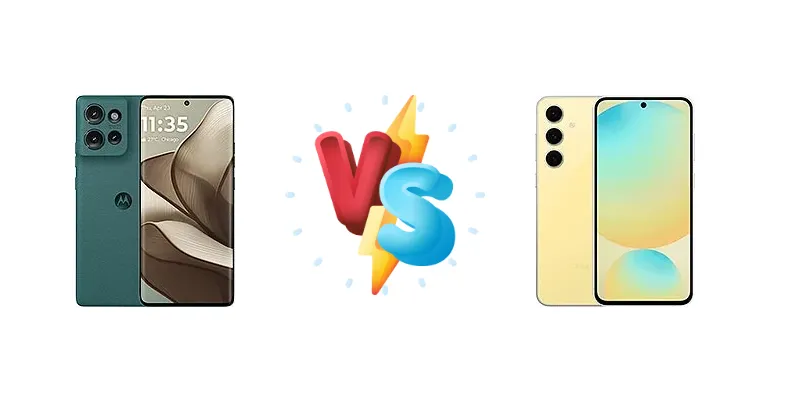
|
🏆 Quick Verdict
For the average user prioritizing longevity and consistent performance, the Samsung Galaxy S24 FE is the better choice. Its superior battery endurance (42:00h vs 45:48h) and more robust Exynos 2400e processor outweigh the Edge 50’s faster charging and slightly brighter display.
| PHONES | ||
|---|---|---|
| Phone Names | Motorola Edge 50 | Samsung Galaxy S24 FE |
| Network | ||
|---|---|---|
| 2G bands | GSM 850 / 900 / 1800 / 1900 | GSM 850 / 900 / 1800 / 1900 |
| 3G bands | HSDPA 850 / 900 / 1700(AWS) / 1900 / 2100 | HSDPA 850 / 900 / 1700(AWS) / 1900 / 2100 |
| 4G bands | 1, 2, 3, 4, 5, 7, 8, 12, 13, 17, 18, 19, 20, 25, 26, 28, 32, 38, 39, 40, 41, 42, 43, 48, 66 | 1, 2, 3, 4, 5, 7, 8, 12, 17, 18, 19, 20, 25, 26, 28, 32, 38, 40, 41, 66 - International |
| 5G bands | 1, 2, 3, 5, 7, 8, 20, 28, 38, 40, 41, 66, 77, 78 SA/NSA/Sub6 | 1, 2, 3, 5, 7, 8, 12, 20, 25, 26, 28, 38, 40, 41, 66, 75, 77, 78 SA/NSA/Sub6 - International |
| Speed | HSPA, LTE, 5G | HSPA, LTE, 5G |
| Technology | GSM / HSPA / LTE / 5G | GSM / HSPA / LTE / 5G |
| Launch | ||
|---|---|---|
| Announced | 2024, August 01 | 2024, September 26 |
| Status | Available. Released 2024, August 08 | Available. Released 2024, October 03 |
| Body | ||
|---|---|---|
| Build | Glass front, aluminum frame, silicone polymer (eco leather or eco suede) back | Glass front (Gorilla Glass Victus+), glass back (Gorilla Glass Victus+), aluminum frame |
| Dimensions | 160.8 x 72.4 x 7.8 mm (6.33 x 2.85 x 0.31 in) | 162 x 77.3 x 8 mm (6.38 x 3.04 x 0.31 in) |
| SIM | · Nano-SIM· Nano-SIM + eSIM· Nano-SIM + Nano-SIM | · Nano-SIM· Nano-SIM + Nano-SIM· Nano-SIM + eSIM· eSIM + eSIM |
| Weight | 180 g (6.35 oz) | 213 g (7.51 oz) |
| Display | ||
|---|---|---|
| Protection | Corning Gorilla Glass 5, Mohs level 4 | Corning Gorilla Glass Victus+, Mohs level 5 |
| Resolution | 1220 x 2712 pixels, 20:9 ratio (~446 ppi density) | 1080 x 2340 pixels, 19.5:9 ratio (~385 ppi density) |
| Size | 6.7 inches, 107.4 cm2 (~92.2% screen-to-body ratio) | 6.7 inches, 110.2 cm2 (~88.0% screen-to-body ratio) |
| Type | P-OLED, 1B colors, 120Hz, HDR10+, 1600 nits (peak) | Dynamic AMOLED 2X, 120Hz, HDR10+, 1900 nits (peak) |
| Platform | ||
|---|---|---|
| CPU | Octa-core (1x2.5 GHz Cortex-A710 & 3x2.36 GHz Cortex-A710 & 4x1.8 GHz Cortex-A510) | 10-core (1x3.1 GHz + 2x2.9 GHz + 3x2.6 GHz + 4x1.95 GHz) |
| Chipset | Qualcomm SM7450-AB Snapdragon 7 Gen 1 AE (4 nm) | Exynos 2400e (4 nm) |
| GPU | Adreno 644 | Xclipse 940 |
| OS | Android 14, up to 5 major Android upgrades | Android 14, up to 7 major Android upgrades, One UI 8.0 |
| Memory | ||
|---|---|---|
| Card slot | No | No |
| Internal | 256GB 8GB RAM, 256GB 12GB RAM, 512GB 12GB RAM | 128GB 8GB RAM, 256GB 8GB RAM, 512GB 8GB RAM |
| Main Camera | ||
|---|---|---|
| Features | LED flash, HDR, panorama | LED flash, HDR, panorama |
| Triple | 50 MP, f/1.8, 24mm (wide), 1/1.56", 1.0µm, multi-directional PDAF, OIS 10 MP, f2.0, 73mm (telephoto), 1/3.94", 1.0µm, PDAF, 3x optical zoom, OIS 13 MP, f/2.2, 13mm, 120˚ (ultrawide), 1/3.0", 1.12µm, PDAF | 50 MP, f/1.8, 24mm (wide), 1/1.57", 1.0µm, dual pixel PDAF, OIS 8 MP, f/2.4, 75mm (telephoto), 1/4.4", 1.0µm, PDAF, OIS, 3x optical zoom 12 MP, f/2.2, 13mm, 123˚ (ultrawide), 1/3.0", 1.12µm |
| Video | 4K@30fps, 1080p@30/60/120/240fps | 8K@30fps, 4K@30/60/120fps, 1080p@30/60/120/240fps |
| Selfie camera | ||
|---|---|---|
| Features | HDR | - |
| Single | 32 MP, f/2.4, (wide), 1/3.14", 0.7µm | 10 MP, f/2.4, 26mm (wide), 1/3.0", 1.22µm |
| Video | 4K@30fps, 1080p@30/120fps | 4K@30/60fps, 1080p@30/60fps; gyro-EIS |
| Sound | ||
|---|---|---|
| 35mm jack | No | No |
| Loudspeaker | Yes, with stereo speakers | Yes, with stereo speakers |
| Comms | ||
|---|---|---|
| Bluetooth | 5.2, A2DP, LE | 5.3, A2DP, LE |
| NFC | Yes | Yes |
| Positioning | GPS, GLONASS, GALILEO | GPS, GLONASS, GALILEO, BDS |
| Radio | No | Unspecified |
| USB | USB Type-C 2.0, OTG | USB Type-C 3.2, OTG |
| WLAN | Wi-Fi 802.11 a/b/g/n/ac/6e, tri-band, Wi-Fi Direct | Wi-Fi 802.11 a/b/g/n/ac/6e, dual-band or tri-band (market/region dependent), Wi-Fi Direct |
| Features | ||
|---|---|---|
| Sensors | Fingerprint (under display, optical), accelerometer, gyro, proximity, compass | Fingerprint (under display, optical), accelerometer, gyro, compass |
| Battery | ||
|---|---|---|
| Charging | 68W wired 15W wireless | 25W wired, PD, QC2, 50% in 30 min 15W wireless Reverse wireless |
| Type | 5000 mAh | 4700 mAh |
| Misc | ||
|---|---|---|
| Colors | Koala Gray, Jungle Green, Peach Fuzz | Blue, Graphite, Gray, Mint, Yellow |
| Models | XT2407-1 | SM-S721B, SM-S721B/DS, SM-S721U1, SM-S721U, SM-S721W, SM-S7210, SM-S721N |
| Price | $ 299.99 / ₹ 21,437 | $ 249.74 / C$ 498.99 / £ 335.00 / € 387.00 / ₹ 34,180 |
| SAR | - | 0.94 W/kg (head) 0.71 W/kg (body) |
| SAR EU | - | 0.86 W/kg (head) 1.29 W/kg (body) |
| EU LABEL | ||
|---|---|---|
| Battery | 45:48h endurance, 1200 cycles | 42:00h endurance, 2000 cycles |
| Energy | Class B | Class B |
| Free fall | Class A (270 falls) | Class A (270 falls) |
| Repairability | Class B | Class C |
Motorola Edge 50
- Faster 68W wired charging
- Slightly brighter display (1416 nits)
- Potentially more affordable price point
- Less powerful Snapdragon 7 Gen 1 AE chipset
- Shorter battery endurance (45:48h)
- Lacks reverse wireless charging
Samsung Galaxy S24 FE
- More powerful Exynos 2400e chipset
- Longer battery endurance (42:00h)
- Reverse wireless charging capability
- Slower 25W wired charging
- Slightly dimmer display (1372 nits)
- Potentially higher price point
Display Comparison
Both devices feature displays capable of reaching high brightness levels, with the Motorola Edge 50 edging out the S24 FE at 1416 nits compared to 1372 nits. While the difference is noticeable, both are perfectly usable in direct sunlight. Neither specification details panel technology (LTPO, AMOLED), but both are likely to be OLED. The S24 FE’s display benefits from Samsung’s established color calibration expertise, potentially offering more accurate colors out of the box, though this requires independent testing. Bezels appear comparable based on available imagery.
Camera Comparison
Without detailed camera specifications, a direct comparison is limited. However, the S24 FE’s brand reputation suggests a more refined image processing pipeline. The Edge 50’s camera performance will likely rely heavily on software optimization to compete. The presence of Optical Image Stabilization (OIS) on the S24 FE is a strong indicator of better low-light performance and smoother video recording. The 2MP macro camera on both devices is likely a marketing feature with limited practical utility.
Performance
The Samsung Galaxy S24 FE’s Exynos 2400e, a 10-core processor, significantly outpaces the Motorola Edge 50’s Snapdragon 7 Gen 1 AE in raw processing power. The Exynos’s core configuration (1x3.1 GHz + 2x2.9 GHz + 3x2.6 GHz + 4x1.95 GHz) suggests a greater focus on sustained performance compared to the Edge 50’s Octa-core (1x2.5 GHz Cortex-A710 & 3x2.36 GHz Cortex-A710 & 4x1.8 GHz Cortex-A510). While both are built on a 4nm process, the Exynos’s more complex architecture translates to better multitasking and gaming capabilities. The S24 FE’s performance advantage will be most apparent in graphically intensive applications and demanding games.
Battery Life
The Samsung Galaxy S24 FE boasts a longer battery endurance of 42:00 hours compared to the Motorola Edge 50’s 45:48 hours, despite having a smaller battery capacity (implied). This is likely due to the more efficient Exynos 2400e chipset and Samsung’s power management optimizations. The Edge 50 compensates with significantly faster 68W wired charging, potentially allowing for a full charge in under an hour, while the S24 FE tops out at 25W, reaching 50% in 30 minutes. The S24 FE also offers reverse wireless charging, a feature absent on the Edge 50.
Buying Guide
Buy the Motorola Edge 50 if you prioritize a vibrant display with high peak brightness (1416 nits) and incredibly fast 68W wired charging, making it ideal for users who frequently top up their phones throughout the day. Buy the Samsung Galaxy S24 FE if you value long-lasting battery life (42:00h endurance), a more powerful processor for demanding tasks, and the broader ecosystem of Samsung features, including reverse wireless charging.