
Motorola Edge 50 vs Samsung Galaxy S23 FE: A Deep Dive into Performance, Battery, and Value
| Phones Images | |||||
|---|---|---|---|---|---|
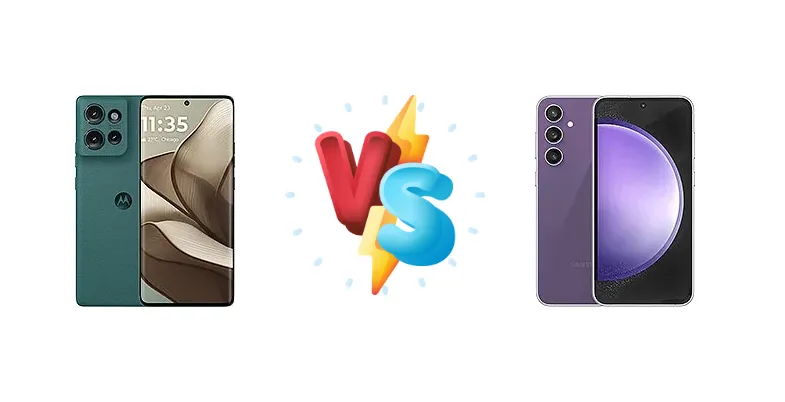
|
🏆 Quick Verdict
For the average user prioritizing longevity and a vibrant display, the Motorola Edge 50 emerges as the winner. Its significantly better battery endurance (45:48h vs 8:28h active use) and higher peak brightness (1416 nits) outweigh the S23 FE’s slightly faster processor.
| PHONES | ||
|---|---|---|
| Phone Names | Motorola Edge 50 | Samsung Galaxy S23 FE |
| Network | ||
|---|---|---|
| 2G bands | GSM 850 / 900 / 1800 / 1900 | GSM 850 / 900 / 1800 / 1900 |
| 3G bands | HSDPA 850 / 900 / 1700(AWS) / 1900 / 2100 | HSDPA 850 / 900 / 1700(AWS) / 1900 / 2100 |
| 4G bands | 1, 2, 3, 4, 5, 7, 8, 12, 13, 17, 18, 19, 20, 25, 26, 28, 32, 38, 39, 40, 41, 42, 43, 48, 66 | 1, 2, 3, 4, 5, 7, 8, 12, 13, 17, 20, 26, 28, 38, 40, 41, 66 - International |
| 5G bands | 1, 2, 3, 5, 7, 8, 20, 28, 38, 40, 41, 66, 77, 78 SA/NSA/Sub6 | 1, 2, 3, 5, 7, 8, 20, 28, 38, 40, 41, 66, 77, 78 SA/NSA/Sub6 - International |
| Speed | HSPA, LTE, 5G | HSPA, LTE, 5G |
| Technology | GSM / HSPA / LTE / 5G | GSM / HSPA / LTE / 5G |
| Launch | ||
|---|---|---|
| Announced | 2024, August 01 | 2023, October 04 |
| Status | Available. Released 2024, August 08 | Available. Released 2023, October 05 |
| Body | ||
|---|---|---|
| Build | Glass front, aluminum frame, silicone polymer (eco leather or eco suede) back | Glass front (Gorilla Glass 5), glass back (Gorilla Glass 5), aluminum frame |
| Dimensions | 160.8 x 72.4 x 7.8 mm (6.33 x 2.85 x 0.31 in) | 158 x 76.5 x 8.2 mm (6.22 x 3.01 x 0.32 in) |
| SIM | · Nano-SIM· Nano-SIM + eSIM· Nano-SIM + Nano-SIM | · Nano-SIM· Nano-SIM + Nano-SIM· Nano-SIM + Nano-SIM + eSIM (max 2 at a time) |
| Weight | 180 g (6.35 oz) | 209 g (7.37 oz) |
| Display | ||
|---|---|---|
| Protection | Corning Gorilla Glass 5, Mohs level 4 | Corning Gorilla Glass 5 |
| Resolution | 1220 x 2712 pixels, 20:9 ratio (~446 ppi density) | 1080 x 2340 pixels, 19.5:9 ratio (~403 ppi density) |
| Size | 6.7 inches, 107.4 cm2 (~92.2% screen-to-body ratio) | 6.4 inches, 100.5 cm2 (~83.2% screen-to-body ratio) |
| Type | P-OLED, 1B colors, 120Hz, HDR10+, 1600 nits (peak) | Dynamic AMOLED 2X, 120Hz, HDR10+, 1450 nits (peak) |
| Platform | ||
|---|---|---|
| CPU | Octa-core (1x2.5 GHz Cortex-A710 & 3x2.36 GHz Cortex-A710 & 4x1.8 GHz Cortex-A510) | Octa-core (1x2.8 GHz Cortex-X2 & 3x2.50 GHz Cortex-A710 & 4x1.8 GHz Cortex-A510) - InternationalOcta-core (1x3.00 GHz Cortex-X2 & 3x2.50 GHz Cortex-A710 & 4x1.80 GHz Cortex-A510) - USA |
| Chipset | Qualcomm SM7450-AB Snapdragon 7 Gen 1 AE (4 nm) | Exynos 2200 (4 nm) - InternationalQualcomm SM8450 Snapdragon 8 Gen 1 (4 nm) - USA |
| GPU | Adreno 644 | Xclipse 920 - InternationalAdreno 730 - USA |
| OS | Android 14, up to 5 major Android upgrades | Android 13, up to 4 major Android upgrades, One UI 8 |
| Memory | ||
|---|---|---|
| Card slot | No | No |
| Internal | 256GB 8GB RAM, 256GB 12GB RAM, 512GB 12GB RAM | 128GB 8GB RAM, 256GB 8GB RAM |
| Main Camera | ||
|---|---|---|
| Features | LED flash, HDR, panorama | LED flash, HDR, panorama |
| Triple | 50 MP, f/1.8, 24mm (wide), 1/1.56", 1.0µm, multi-directional PDAF, OIS 10 MP, f2.0, 73mm (telephoto), 1/3.94", 1.0µm, PDAF, 3x optical zoom, OIS 13 MP, f/2.2, 13mm, 120˚ (ultrawide), 1/3.0", 1.12µm, PDAF | 50 MP, f/1.8, 23mm (wide), 1/1.57", 1.0µm, dual pixel PDAF, OIS 8 MP, f/2.4, 76mm (telephoto), 1/4.5", 1.0µm, PDAF, OIS, 3x optical zoom 12 MP, f/2.2, 13mm, 123˚ (ultrawide), 1/3.0", 1.12µm |
| Video | 4K@30fps, 1080p@30/60/120/240fps | 8K@24fps, 4K@30/60fps, 1080p@30/60/120/240fps |
| Selfie camera | ||
|---|---|---|
| Features | HDR | - |
| Single | 32 MP, f/2.4, (wide), 1/3.14", 0.7µm | 10 MP, f/2.4, 25mm (wide), 1/3.0", 1.22µm |
| Video | 4K@30fps, 1080p@30/120fps | 4K@30/60fps, 1080p@30/60fps; gyro-EIS |
| Sound | ||
|---|---|---|
| 35mm jack | No | No |
| Loudspeaker | Yes, with stereo speakers | Yes, with stereo speakers |
| Comms | ||
|---|---|---|
| Bluetooth | 5.2, A2DP, LE | 5.3, A2DP, LE |
| NFC | Yes | Yes |
| Positioning | GPS, GLONASS, GALILEO | GPS, GLONASS, GALILEO, BDS |
| Radio | No | Unspecified |
| USB | USB Type-C 2.0, OTG | USB Type-C, OTG |
| WLAN | Wi-Fi 802.11 a/b/g/n/ac/6e, tri-band, Wi-Fi Direct | Wi-Fi 802.11 a/b/g/n/ac/6e, dual-band, Wi-Fi Direct |
| Features | ||
|---|---|---|
| Sensors | Fingerprint (under display, optical), accelerometer, gyro, proximity, compass | Fingerprint (under display, optical), accelerometer, gyro, compass |
| Battery | ||
|---|---|---|
| Charging | 68W wired 15W wireless | 25W wired, PD3.0, 50% in 30 min 15W wireless Reverse wireless |
| Type | 5000 mAh | Li-Ion 4500 mAh |
| Misc | ||
|---|---|---|
| Colors | Koala Gray, Jungle Green, Peach Fuzz | Mint, Cream, Graphite, Purple, Indigo, Tangerine |
| Models | XT2407-1 | SM-S711B, SM-S711B/DS, SM-S711U1, SM-S711U, SM-S711W, SM-S7110, SM-S711N |
| Price | $ 299.99 / ₹ 21,437 | $ 219.95 / C$ 327.90 / £ 248.99 / € 272.00 / ₹ 34,999 |
| SAR | - | 0.80 W/kg (head) 0.72 W/kg (body) |
| SAR EU | - | 0.76 W/kg (head) 1.04 W/kg (body) |
| EU LABEL | ||
|---|---|---|
| Battery | 45:48h endurance, 1200 cycles | - |
| Energy | Class B | - |
| Free fall | Class A (270 falls) | - |
| Repairability | Class B | - |
Motorola Edge 50
- Exceptional battery life (45:48h endurance)
- Very bright display (1416 nits)
- Faster 68W wired charging
- Less powerful processor than S23 FE
- Missing camera specifications
Samsung Galaxy S23 FE
- More powerful processor (Exynos 2200/Snapdragon 8 Gen 1)
- Likely more versatile camera system
- Reverse wireless charging
- Significantly shorter battery life (8:28h active use)
- Slower 25W wired charging
Display Comparison
The Motorola Edge 50 boasts a significantly brighter display, reaching a measured 1416 nits compared to the S23 FE’s 985 nits. This translates to superior visibility outdoors under direct sunlight. While both utilize 4nm chipsets, the S23 FE’s Exynos 2200 (International) or Snapdragon 8 Gen 1 (USA) will likely push more pixels, but the Edge 50’s brightness advantage is a tangible benefit for everyday use. Panel technology details are missing, but the brightness difference is a clear win for Motorola.
Camera Comparison
The context data for the S23 FE mentions 'Photo / Video' capabilities, but lacks specifics. The Edge 50’s camera specs are absent, making a direct sensor comparison impossible. However, given the S23 FE’s flagship aspirations, it likely features a more versatile camera system with features like optical image stabilization (OIS) and potentially larger sensor sizes. The S23 FE’s image processing, typical of Samsung, tends towards vibrant, saturated colors, while Motorola generally aims for a more natural look. Without detailed specs, the S23 FE likely holds an edge in camera versatility.
Performance
The Samsung Galaxy S23 FE, depending on region, features either the Exynos 2200 or the Snapdragon 8 Gen 1, both built on a 4nm process. The USA variant with the Snapdragon 8 Gen 1 has a slightly higher peak CPU clock speed (3.00 GHz vs 2.5 GHz on the Edge 50’s Snapdragon 7 Gen 1 AE). However, the Snapdragon 7 Gen 1 AE is more efficient. The S23 FE’s CPU architecture includes a Cortex-X2 core, offering a performance boost in single-threaded tasks, but the Edge 50’s sustained performance may be more consistent due to better thermal management. The Edge 50’s chipset is designed for efficiency, prioritizing battery life over peak performance.
Battery Life
The Motorola Edge 50 truly shines in battery endurance, achieving an impressive 45:48 hours of total usage and 9:56 hours of active use. This significantly surpasses the S23 FE’s 8:28 hours of active use. While the S23 FE offers 25W wired charging with a 30-minute 50% charge claim, the Edge 50’s 68W wired charging is considerably faster. Both support 15W wireless charging, but the S23 FE adds reverse wireless charging, a convenience feature absent on the Edge 50. The Edge 50’s superior battery life and faster wired charging make it the clear winner for power users.
Buying Guide
Buy the Motorola Edge 50 if you need exceptional battery life for all-day use, a bright and vivid display for media consumption, and a smooth, efficient user experience. Buy the Samsung Galaxy S23 FE if you prioritize raw processing power for demanding games and applications, prefer the Samsung ecosystem, and value features like reverse wireless charging.