
Motorola Edge 50 vs. Nothing Phone (2): A Deep Dive into Performance and Battery Life
| Phones Images | |||||
|---|---|---|---|---|---|
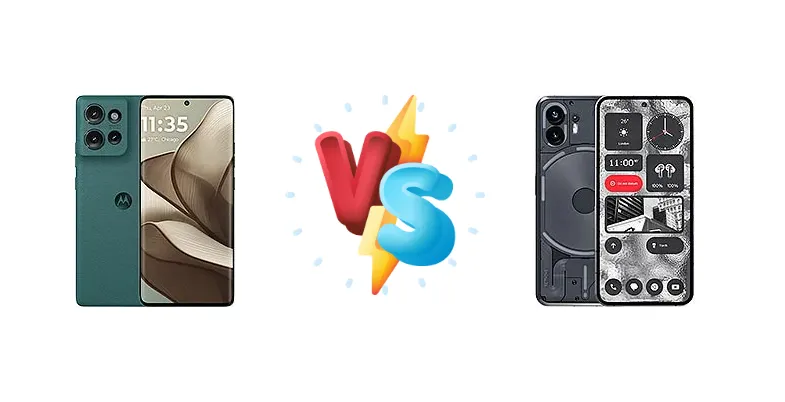
|
🏆 Quick Verdict
For the average user prioritizing all-day battery life and a vibrant display, the Motorola Edge 50 emerges as the stronger contender. However, power users and gamers will find the Nothing Phone (2)'s Snapdragon 8+ Gen 1 a more compelling choice, despite its shorter battery endurance.
| PHONES | ||
|---|---|---|
| Phone Names | Motorola Edge 50 | Nothing Phone (2) |
| Network | ||
|---|---|---|
| 2G bands | GSM 850 / 900 / 1800 / 1900 | GSM 850 / 900 / 1800 / 1900 |
| 3G bands | HSDPA 850 / 900 / 1700(AWS) / 1900 / 2100 | HSDPA 800 / 850 / 900 / 1700(AWS) / 1900 / 2100 |
| 4G bands | 1, 2, 3, 4, 5, 7, 8, 12, 13, 17, 18, 19, 20, 25, 26, 28, 32, 38, 39, 40, 41, 42, 43, 48, 66 | 1, 2, 3, 4, 5, 7, 8, 12, 17, 18, 19, 20, 25, 26, 28, 30, 32, 34, 38, 39, 40, 41, 42, 48, 66, 71 |
| 5G bands | 1, 2, 3, 5, 7, 8, 20, 28, 38, 40, 41, 66, 77, 78 SA/NSA/Sub6 | 1, 2, 3, 5, 7, 8, 12, 20, 25, 28, 30, 38, 40, 41, 66, 71, 75, 77, 78 SA/NSA |
| Speed | HSPA, LTE, 5G | HSPA, LTE, 5G |
| Technology | GSM / HSPA / LTE / 5G | GSM / HSPA / LTE / 5G |
| Launch | ||
|---|---|---|
| Announced | 2024, August 01 | 2023, July 11 |
| Status | Available. Released 2024, August 08 | Available. Released 2023, July 17 |
| Body | ||
|---|---|---|
| Build | Glass front, aluminum frame, silicone polymer (eco leather or eco suede) back | Glass front (Gorilla Glass 5), glass back (Gorilla Glass 5), aluminum frame |
| Dimensions | 160.8 x 72.4 x 7.8 mm (6.33 x 2.85 x 0.31 in) | 162.1 x 76.4 x 8.6 mm (6.38 x 3.01 x 0.34 in) |
| SIM | · Nano-SIM· Nano-SIM + eSIM· Nano-SIM + Nano-SIM | Nano-SIM + Nano-SIM |
| Weight | 180 g (6.35 oz) | 201.2 g (7.09 oz) |
| Display | ||
|---|---|---|
| Protection | Corning Gorilla Glass 5, Mohs level 4 | Corning Gorilla Glass 5 |
| Resolution | 1220 x 2712 pixels, 20:9 ratio (~446 ppi density) | 1080 x 2412 pixels, 20:9 ratio (~394 ppi density) |
| Size | 6.7 inches, 107.4 cm2 (~92.2% screen-to-body ratio) | 6.7 inches, 108.0 cm2 (~87.2% screen-to-body ratio) |
| Type | P-OLED, 1B colors, 120Hz, HDR10+, 1600 nits (peak) | LTPO OLED, 1B colors, 120Hz, 1920Hz PWM, HDR10+, 1600 nits (HBM), 1600 nits (peak) |
| Platform | ||
|---|---|---|
| CPU | Octa-core (1x2.5 GHz Cortex-A710 & 3x2.36 GHz Cortex-A710 & 4x1.8 GHz Cortex-A510) | Octa-core (1x3.0 GHz Cortex-X2 & 3x2.5 GHz Cortex-A710 & 4x1.80 GHz Cortex-A510) |
| Chipset | Qualcomm SM7450-AB Snapdragon 7 Gen 1 AE (4 nm) | Qualcomm SM8475 Snapdragon 8+ Gen 1 (4 nm) |
| GPU | Adreno 644 | Adreno 730 |
| OS | Android 14, up to 5 major Android upgrades | Android 13, upgradable to Android 15, up to 3 major Android upgrades, Nothing OS 3.0 |
| Memory | ||
|---|---|---|
| Card slot | No | No |
| Internal | 256GB 8GB RAM, 256GB 12GB RAM, 512GB 12GB RAM | 128GB 8GB RAM, 256GB 12GB RAM, 512GB 12GB RAM |
| Main Camera | ||
|---|---|---|
| Dual | - | 50 MP, f/1.9, 24mm (wide), 1/1.56", 1.0µm, PDAF, OIS 50 MP, f/2.2, 114˚ (ultrawide), 1/2.76", 0.64µm, AF |
| Features | LED flash, HDR, panorama | LED flash, panorama, HDR |
| Triple | 50 MP, f/1.8, 24mm (wide), 1/1.56", 1.0µm, multi-directional PDAF, OIS 10 MP, f2.0, 73mm (telephoto), 1/3.94", 1.0µm, PDAF, 3x optical zoom, OIS 13 MP, f/2.2, 13mm, 120˚ (ultrawide), 1/3.0", 1.12µm, PDAF | - |
| Video | 4K@30fps, 1080p@30/60/120/240fps | 4K@30/60fps, 1080p@30/60fps, gyro-EIS, live HDR, OIS |
| Selfie camera | ||
|---|---|---|
| Features | HDR | HDR |
| Single | 32 MP, f/2.4, (wide), 1/3.14", 0.7µm | 32 MP, f/2.5, (wide), 1/2.74", 0.8µm |
| Video | 4K@30fps, 1080p@30/120fps | 1080p@30fps |
| Sound | ||
|---|---|---|
| 35mm jack | No | No |
| Loudspeaker | Yes, with stereo speakers | Yes, with stereo speakers |
| Comms | ||
|---|---|---|
| Bluetooth | 5.2, A2DP, LE | 5.3, A2DP, LE, aptX HD, aptX Adaptive |
| NFC | Yes | Yes |
| Positioning | GPS, GLONASS, GALILEO | GPS (L1+L5), GLONASS (L1), BDS (B1I+B1c), GALILEO (E1), QZSS (L1), NavIC |
| Radio | No | No |
| USB | USB Type-C 2.0, OTG | USB Type-C 2.0, OTG |
| WLAN | Wi-Fi 802.11 a/b/g/n/ac/6e, tri-band, Wi-Fi Direct | Wi-Fi 802.11 a/b/g/n/ac/6, dual-band, Wi-Fi Direct |
| Features | ||
|---|---|---|
| Sensors | Fingerprint (under display, optical), accelerometer, gyro, proximity, compass | Fingerprint (under display, optical), accelerometer, proximity, gyro, compass |
| Battery | ||
|---|---|---|
| Charging | 68W wired 15W wireless | 45W wired, PD3.0, PPS, QC4, 100% in 55 min 15W wireless, 100% in 130 min 5W reverse wireless |
| Type | 5000 mAh | Li-Ion 4700 mAh |
| Misc | ||
|---|---|---|
| Colors | Koala Gray, Jungle Green, Peach Fuzz | White, Dark Gray |
| Models | XT2407-1 | A065 |
| Price | $ 299.99 / ₹ 21,437 | $ 379.99 / £ 370.00 |
| EU LABEL | ||
|---|---|---|
| Battery | 45:48h endurance, 1200 cycles | - |
| Energy | Class B | - |
| Free fall | Class A (270 falls) | - |
| Repairability | Class B | - |
Motorola Edge 50
- Exceptional battery life (45:48h endurance)
- Very bright display (1416 nits)
- Faster wired charging (68W)
- Less powerful processor (Snapdragon 7 Gen 1)
- Limited camera information
Nothing Phone (2)
- Flagship-level performance (Snapdragon 8+ Gen 1)
- Unique Glyph Interface
- Faster charging speed (45W) with PD3.0, PPS, QC4
- Shorter battery life
- Lower peak display brightness
Display Comparison
The Motorola Edge 50 boasts a significantly brighter display, reaching a measured 1416 nits, compared to the Nothing Phone (2)'s 998 nits. This translates to superior visibility under direct sunlight. While both utilize OLED technology, the Edge 50’s higher peak brightness is a clear advantage for outdoor users. Details regarding refresh rate and panel type (LTPO) are missing, but the brightness difference is a key differentiator. The Nothing Phone (2)'s Glyph Interface, while visually unique, doesn't impact display performance directly, but adds to the overall user experience.
Camera Comparison
Context data for the cameras is limited. However, the Nothing Phone (2) is marketed with a strong emphasis on its camera capabilities, suggesting a more sophisticated image processing pipeline and potentially larger sensors. The Motorola Edge 50’s camera specs are not provided, making a direct comparison difficult. Given Nothing’s focus on photography, it’s reasonable to assume a more feature-rich camera experience, including potentially better low-light performance and video stabilization. We can assume both phones will have a standard array of lenses, but the Nothing Phone (2) likely offers more advanced features.
Performance
The core difference lies in the chipsets: the Motorola Edge 50 utilizes the Qualcomm SM7450-AB Snapdragon 7 Gen 1 AE, while the Nothing Phone (2) features the Snapdragon 8+ Gen 1. The 8+ Gen 1, with its Cortex-X2 prime core clocked at 3.0 GHz, offers a substantial performance uplift over the 7 Gen 1’s Cortex-A710 based architecture. This is reflected in real-world usage, with the Nothing Phone (2) handling demanding games and multitasking with greater ease. Both chips are fabricated on a 4nm process, offering good efficiency, but the 8+ Gen 1’s superior architecture provides a clear advantage. The Edge 50’s CPU configuration (1x2.5 GHz Cortex-A710 & 3x2.36 GHz Cortex-A710 & 4x1.8 GHz Cortex-A510) is less optimized for peak performance than the Nothing Phone (2)'s.
Battery Life
Battery life is where the Motorola Edge 50 truly shines. Its 45:48h endurance rating and 9:56h active use score significantly outperform the Nothing Phone (2)'s active use score of 14:21h (endurance rating is older and less comparable). While the Nothing Phone (2) supports faster wired charging at 45W (vs. 68W on the Edge 50), the Edge 50’s superior battery endurance means you’ll likely need to charge it less frequently. The Nothing Phone (2) also offers 5W reverse wireless charging, a feature absent on the Edge 50, allowing it to charge accessories. The Edge 50’s reported 1200 charge cycles suggest a longer lifespan for the battery itself.
Buying Guide
Buy the Motorola Edge 50 if you need exceptional battery life, a very bright screen for outdoor visibility, and a reliable daily driver that won't leave you scrambling for a charger. Buy the Nothing Phone (2) if you prioritize raw processing power for demanding games and applications, appreciate a distinctive design, and are willing to trade some battery life for performance.