
Motorola Edge 50 Ultra vs Samsung Galaxy S24+: A Deep Dive into Flagship Performance
| Phones Images | |||||
|---|---|---|---|---|---|
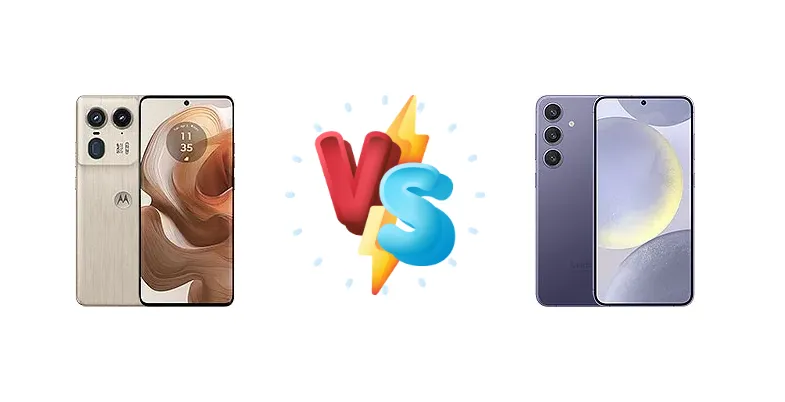
|
🏆 Quick Verdict
For users prioritizing charging speed and raw performance-per-dollar, the Motorola Edge 50 Ultra emerges as the winner. Its 125W charging and Snapdragon 8s Gen 3 offer a noticeable edge. However, the Galaxy S24+ counters with Samsung’s software ecosystem and potentially superior chipset depending on region.
| PHONES | ||
|---|---|---|
| Phone Names | Motorola Edge 50 Ultra | Samsung Galaxy S24+ |
| Network | ||
|---|---|---|
| 2G bands | GSM 850 / 900 / 1800 / 1900 | GSM 850 / 900 / 1800 / 1900 |
| 3G bands | HSDPA 850 / 900 / 1700(AWS) / 1900 / 2100 | HSDPA 850 / 900 / 1700(AWS) / 1900 / 2100 |
| 4G bands | 1, 2, 3, 4, 5, 7, 8, 12, 13, 17, 18, 19, 20, 25, 26, 28, 32, 38, 39, 40, 41, 42, 43, 66 | 1, 2, 3, 4, 5, 7, 8, 12, 13, 17, 18, 19, 20, 25, 26, 28, 32, 38, 39, 40, 41, 66 - International |
| 5G bands | 1, 2, 3, 5, 7, 8, 20, 26, 28, 38, 40, 41, 66, 71, 75, 77, 78 SA/NSA/Sub6 | 1, 2, 3, 5, 7, 8, 12, 20, 25, 26, 28, 38, 40, 41, 66, 75, 77, 78 SA/NSA/Sub6 - International |
| Speed | HSPA, LTE, 5G | HSPA, LTE (up to 7CA), 5G |
| Technology | GSM / HSPA / LTE / 5G | GSM / CDMA / HSPA / EVDO / LTE / 5G |
| Launch | ||
|---|---|---|
| Announced | 2024, April 16 | 2024, January 17 |
| Status | Available. Released 2024, May 15 | Available. Released 2024, January 24 |
| Body | ||
|---|---|---|
| Build | Glass front (Gorilla Glass Victus), wooden back or silicone polymer back (eco leather), aluminum frame | Glass front (Gorilla Glass Victus 2), glass back (Gorilla Glass Victus 2), aluminum frame |
| Dimensions | 161.1 x 72.4 x 8.6 mm (6.34 x 2.85 x 0.34 in) | 158.5 x 75.9 x 7.7 mm (6.24 x 2.99 x 0.30 in) |
| SIM | Nano-SIM + eSIM | · Nano-SIM + Nano-SIM + eSIM + eSIM (max 2 at a time) - INT· Nano-SIM + eSIM + eSIM (max 2 at a time) - USA· Nano-SIM + Nano-SIM - CN |
| Weight | 197 g (6.95 oz) | 196 g or 197 g (6.91 oz) |
| Display | ||
|---|---|---|
| Protection | Corning Gorilla Glass Victus | Corning Gorilla Glass Victus 2 |
| Resolution | 1220 x 2712 pixels, 20:9 ratio (~446 ppi density) | 1440 x 3120 pixels, 19.5:9 ratio (~513 ppi density) |
| Size | 6.7 inches, 107.4 cm2 (~92.1% screen-to-body ratio) | 6.7 inches, 110.2 cm2 (~91.6% screen-to-body ratio) |
| Type | P-OLED, 1B colors, 144Hz, HDR10+, 2500 nits (peak) | Dynamic LTPO AMOLED 2X, 120Hz, HDR10+, 2600 nits (peak) |
| Platform | ||
|---|---|---|
| CPU | Octa-core (1x3.0 GHz Cortex-X4 & 4x2.8 GHz Cortex-A720 & 3x2.0 GHz Cortex-A520) | 8-core (1x3.39GHz Cortex-X4 & 3x3.1GHz Cortex-A720 & 2x2.9GHz Cortex-A720 & 2x2.2GHz Cortex-A520)10-core (1x3.2GHz Cortex-X4 & 2x2.9GHz Cortex-A720 & 3x2.6GHz Cortex-A720 & 4x1.95GHz Cortex-A520) |
| Chipset | Qualcomm SM8635 Snapdragon 8s Gen 3 (4 nm) | Qualcomm SM8650-AC Snapdragon 8 Gen 3 (4 nm) - USA/Canada/ChinaExynos 2400 (4 nm) - International |
| GPU | Adreno 735 | Adreno 750 (1 GHz) - USA/Canada/ChinaXclipse 940 - International |
| OS | Android 14, upgradable to Android 16, up to 3 major Android upgrades | Android 14, up to 7 major Android upgrades, One UI 8.0 |
| Memory | ||
|---|---|---|
| Card slot | No | No |
| Internal | 512GB 12GB RAM, 512GB 16GB RAM, 1TB 16GB RAM | 256GB 12GB RAM, 512GB 12GB RAM |
| Main Camera | ||
|---|---|---|
| Features | Laser AF, Dual-LED flash, HDR, panorama | LED flash, auto-HDR, panorama |
| Triple | 50 MP, f/1.6, 23mm (wide), 1/1.3", 1.2µm, multi-directional PDAF, OIS 64 MP, f/2.4, 72mm (periscope telephoto), 1/2.0", 0.7µm, PDAF, OIS, 3x optical zoom 50 MP, f/2.0, 12mm, 122˚ (ultrawide), 1/2.76", 0.64µm, PDAF | 50 MP, f/1.8, 24mm (wide), 1/1.56", 1.0µm, dual pixel PDAF, OIS 10 MP, f/2.4, 67mm (telephoto), 1/3.94", 1.0µm, PDAF, OIS, 3x optical zoom 12 MP, f/2.2, 13mm, 120˚ (ultrawide), 1/2.55" 1.4µm, Super Steady video |
| Video | 4K@30/60fps, 1080p@30/60/120/240/960fps, 10-bit HDR10+, gyro-EIS | 8K@24/30fps, 4K@30/60fps, 1080p@30/60/120/240fps, HDR10+, stereo sound rec., gyro-EIS |
| Selfie camera | ||
|---|---|---|
| Features | HDR | HDR, HDR10+ |
| Single | 50 MP, f/1.9, 21mm (wide), 1/2.76", 0.64µm, PDAF | 12 MP, f/2.2, 26mm (wide), 1/3.2", 1.12µm, dual pixel PDAF |
| Video | 4K@30/60fps, 1080p@30/60/120fps, HDR | 4K@30/60fps, 1080p@30fps |
| Sound | ||
|---|---|---|
| 35mm jack | No | No |
| Loudspeaker | Yes, with stereo speakers | Yes, with stereo speakers |
| Comms | ||
|---|---|---|
| Bluetooth | 5.4, A2DP, LE | 5.3, A2DP, LE |
| NFC | Yes | Yes |
| Positioning | GPS, GLONASS, GALILEO, BDS, NavIC | GPS, GLONASS, BDS, GALILEO, QZSS |
| Radio | No | No |
| USB | USB Type-C 3.1 Gen2, OTG, DisplayPort 1.4 | USB Type-C 3.2, DisplayPort 1.2, OTG |
| WLAN | Wi-Fi 802.11 a/b/g/n/ac/6e/7, tri-band, Wi-Fi Direct | Wi-Fi 802.11 a/b/g/n/ac/6e, tri-band, Wi-Fi Direct |
| Features | ||
|---|---|---|
| Sensors | Fingerprint (under display, optical), accelerometer, gyro, proximity, compass | Fingerprint (under display, ultrasonic), accelerometer, gyro, proximity, compass, barometer |
| Battery | ||
|---|---|---|
| Charging | 125W wired 50W wireless 10W reverse wireless | 45W wired, PD3.0, 65% in 30 min 15W wireless (Qi) 4.5W reverse wireless |
| Type | 4500 mAh | Li-Ion 4900 mAh |
| Misc | ||
|---|---|---|
| Colors | Forest Grey, Nordic Wood, Peach Fuzz | Onyx Black, Marble Grey, Cobalt Violet, Amber Yellow, Jade Green, Sandstone Orange, Sapphire Blue |
| Models | - | SM-S926B, SM-S926B/DS, SM-S926U, SM-S926U1, SM-S926W, SM-S926N, SM-S9260, SM-S926E, SM-S926E/DS |
| Price | $ 939.00 / C$ 1,299.00 / £ 490.00 / € 609.90 / ₹ 59,999 | $ 429.50 / € 549.00 / £ 445.98 |
| SAR | - | 1.16 W/kg (head) 0.84 W/kg (body) |
| SAR EU | - | 0.74 W/kg (head) 1.25 W/kg (body) |
Motorola Edge 50 Ultra
- Blazing-fast 125W wired charging
- Potent Snapdragon 8s Gen 3 processor
- Competitive battery life (12:56h)
- Software support may be shorter than Samsung
- Camera details are currently unknown
Samsung Galaxy S24+
- Refined Samsung One UI software
- Potentially superior Snapdragon 8 Gen 3 performance (regional variant)
- Strong video recording capabilities
- Slower 45W wired charging
- Exynos variant may experience thermal throttling
Display Comparison
Both the Motorola Edge 50 Ultra and the Samsung Galaxy S24+ feature excellent displays, achieving measured peak brightness levels of 1473 nits and 1452 nits respectively. While the difference is minimal, the Edge 50 Ultra holds a slight advantage in raw brightness. Both likely utilize LTPO technology for adaptive refresh rates, though Motorola doesn’t explicitly state this. Samsung’s displays are renowned for color accuracy, and while the Edge 50 Ultra’s color science is likely excellent, Samsung’s calibration is a known strength. Bezels appear comparable, contributing to immersive viewing experiences on both devices.
Camera Comparison
While detailed camera analysis requires dedicated testing, the Motorola Edge 50 Ultra’s camera system is a key differentiator. The context data doesn’t provide specifics, but Motorola’s recent focus on high-resolution sensors suggests a strong emphasis on image detail. The Galaxy S24+ benefits from Samsung’s established image processing pipeline, known for vibrant colors and strong dynamic range. The S24+’s video capabilities are likely superior due to Samsung’s expertise in this area. The absence of detailed camera specs for the Edge 50 Ultra makes a definitive comparison difficult, but its potential for high-resolution photography is noteworthy.
Performance
The performance landscape is complex. The Galaxy S24+ utilizes either the Qualcomm SM8650-AC Snapdragon 8 Gen 3 (in USA/Canada/China) or the Exynos 2400 (International). The Snapdragon 8 Gen 3, with its 1x3.39GHz Cortex-X4 prime core and higher clock speeds on the A720 cores, theoretically offers a performance advantage over the Motorola’s Snapdragon 8s Gen 3 (1x3.0 GHz Cortex-X4). However, the 8s Gen 3 is a highly efficient chip, and its 4nm process node ensures competitive performance. The S24+’s CPU configuration (8-core vs 7-core) doesn’t necessarily translate to a real-world advantage, as architectural improvements in the 8 Gen 3 are more significant. The potential for thermal throttling on the Exynos 2400 variant of the S24+ is a concern, potentially diminishing sustained performance compared to the Snapdragon 8 Gen 3 or 8s Gen 3.
Battery Life
Both phones deliver impressive battery life, with the Motorola Edge 50 Ultra achieving 12:56h of active use and the Samsung Galaxy S24+ managing 12:30h. The Edge 50 Ultra’s 125W wired charging is a game-changer, significantly faster than the S24+’s 45W charging (65% in 30 minutes). This translates to a much quicker top-up, minimizing downtime. The Edge 50 Ultra also offers 50W wireless charging and 10W reverse wireless charging, exceeding the S24+’s 15W wireless and 4.5W reverse wireless capabilities. While the S24+’s battery life is slightly longer, the Edge 50 Ultra’s charging speed provides a more convenient user experience.
Buying Guide
Buy the Motorola Edge 50 Ultra if you need the absolute fastest charging available, prioritize peak performance in demanding tasks, and are comfortable with Motorola’s software approach. Buy the Samsung Galaxy S24+ if you prefer a polished software experience, value long-term software support, and require a device with broad carrier compatibility and a well-established ecosystem.