
Motorola Edge 50 Ultra vs Samsung Galaxy S24 Ultra: A Deep Dive Comparison
| Phones Images | |||||
|---|---|---|---|---|---|
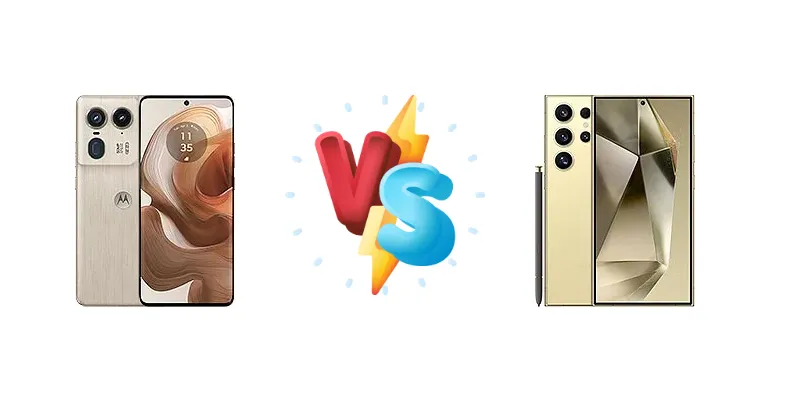
|
🏆 Quick Verdict
For the average user prioritizing all-around capability and a mature software experience, the Samsung Galaxy S24 Ultra remains the superior choice. However, the Motorola Edge 50 Ultra offers exceptional value, particularly for those who prioritize blazing-fast 125W charging and aren't deeply invested in the Samsung ecosystem.
| PHONES | ||
|---|---|---|
| Phone Names | Motorola Edge 50 Ultra | Samsung Galaxy S24 Ultra |
| Network | ||
|---|---|---|
| 2G bands | GSM 850 / 900 / 1800 / 1900 | GSM 850 / 900 / 1800 / 1900 |
| 3G bands | HSDPA 850 / 900 / 1700(AWS) / 1900 / 2100 | HSDPA 850 / 900 / 1700(AWS) / 1900 / 2100 |
| 4G bands | 1, 2, 3, 4, 5, 7, 8, 12, 13, 17, 18, 19, 20, 25, 26, 28, 32, 38, 39, 40, 41, 42, 43, 66 | 1, 2, 3, 4, 5, 7, 8, 12, 13, 17, 18, 19, 20, 25, 26, 28, 32, 38, 39, 40, 41, 66 - International |
| 5G bands | 1, 2, 3, 5, 7, 8, 20, 26, 28, 38, 40, 41, 66, 71, 75, 77, 78 SA/NSA/Sub6 | 1, 2, 3, 5, 7, 8, 12, 20, 25, 26, 28, 38, 40, 41, 66, 75, 77, 78 SA/NSA/Sub6 - International |
| Speed | HSPA, LTE, 5G | HSPA, LTE (up to 7CA), 5G |
| Technology | GSM / HSPA / LTE / 5G | GSM / CDMA / HSPA / EVDO / LTE / 5G |
| Launch | ||
|---|---|---|
| Announced | 2024, April 16 | 2024, January 17 |
| Status | Available. Released 2024, May 15 | Available. Released 2024, January 24 |
| Body | ||
|---|---|---|
| Build | Glass front (Gorilla Glass Victus), wooden back or silicone polymer back (eco leather), aluminum frame | Glass front (Corning Gorilla Armor), glass back (Corning Gorilla Armor), titanium frame (grade 2) |
| Dimensions | 161.1 x 72.4 x 8.6 mm (6.34 x 2.85 x 0.34 in) | 162.3 x 79 x 8.6 mm (6.39 x 3.11 x 0.34 in) |
| SIM | Nano-SIM + eSIM | · Nano-SIM + Nano-SIM + eSIM + eSIM (max 2 at a time) - INT· Nano-SIM + eSIM + eSIM (max 2 at a time) - USA· Nano-SIM + Nano-SIM - CN |
| Weight | 197 g (6.95 oz) | 232 g or 233 g (8.18 oz) |
| Display | ||
|---|---|---|
| Protection | Corning Gorilla Glass Victus | Corning Gorilla Armor |
| Resolution | 1220 x 2712 pixels, 20:9 ratio (~446 ppi density) | 1440 x 3120 pixels, 19.5:9 ratio (~505 ppi density) |
| Size | 6.7 inches, 107.4 cm2 (~92.1% screen-to-body ratio) | 6.8 inches, 113.5 cm2 (~88.5% screen-to-body ratio) |
| Type | P-OLED, 1B colors, 144Hz, HDR10+, 2500 nits (peak) | Dynamic LTPO AMOLED 2X, 120Hz, HDR10+, 2600 nits (peak) |
| Platform | ||
|---|---|---|
| CPU | Octa-core (1x3.0 GHz Cortex-X4 & 4x2.8 GHz Cortex-A720 & 3x2.0 GHz Cortex-A520) | 8-core (1x3.39GHz Cortex-X4 & 3x3.1GHz Cortex-A720 & 2x2.9GHz Cortex-A720 & 2x2.2GHz Cortex-A520) |
| Chipset | Qualcomm SM8635 Snapdragon 8s Gen 3 (4 nm) | Qualcomm SM8650-AC Snapdragon 8 Gen 3 (4 nm) |
| GPU | Adreno 735 | Adreno 750 (1 GHz) |
| OS | Android 14, upgradable to Android 16, up to 3 major Android upgrades | Android 14, up to 7 major Android upgrades, One UI 8.0 |
| Memory | ||
|---|---|---|
| Card slot | No | No |
| Internal | 512GB 12GB RAM, 512GB 16GB RAM, 1TB 16GB RAM | 256GB 12GB RAM, 512GB 12GB RAM, 1TB 12GB RAM |
| Main Camera | ||
|---|---|---|
| Features | Laser AF, Dual-LED flash, HDR, panorama | Laser AF, LED flash, auto-HDR, panorama |
| Quad | - | 200 MP, f/1.7, 24mm (wide), 1/1.3", 0.6µm, multi-directional PDAF, OIS 10 MP, f/2.4, 67mm (telephoto), 1/3.52", 1.12µm, PDAF, OIS, 3x optical zoom 50 MP, f/3.4, 111mm (periscope telephoto), 1/2.52", 0.7µm, PDAF, OIS, 5x optical zoom 12 MP, f/2.2, 13mm, 120˚ (ultrawide), 1/2.55", 1.4µm, dual pixel PDAF, Super Steady video |
| Triple | 50 MP, f/1.6, 23mm (wide), 1/1.3", 1.2µm, multi-directional PDAF, OIS 64 MP, f/2.4, 72mm (periscope telephoto), 1/2.0", 0.7µm, PDAF, OIS, 3x optical zoom 50 MP, f/2.0, 12mm, 122˚ (ultrawide), 1/2.76", 0.64µm, PDAF | - |
| Video | 4K@30/60fps, 1080p@30/60/120/240/960fps, 10-bit HDR10+, gyro-EIS | 8K@24/30fps, 4K@30/60/120fps, 1080p@30/60/120/240fps, HDR10+, stereo sound rec., gyro-EIS |
| Selfie camera | ||
|---|---|---|
| Features | HDR | HDR, HDR10+ |
| Single | 50 MP, f/1.9, 21mm (wide), 1/2.76", 0.64µm, PDAF | 12 MP, f/2.2, 26mm (wide), 1/3.2", 1.12µm, dual pixel PDAF |
| Video | 4K@30/60fps, 1080p@30/60/120fps, HDR | 4K@30/60fps, 1080p@30fps |
| Sound | ||
|---|---|---|
| 35mm jack | No | No |
| Loudspeaker | Yes, with stereo speakers | Yes, with stereo speakers |
| Comms | ||
|---|---|---|
| Bluetooth | 5.4, A2DP, LE | 5.3, A2DP, LE |
| NFC | Yes | Yes |
| Positioning | GPS, GLONASS, GALILEO, BDS, NavIC | GPS, GLONASS, BDS, GALILEO, QZSS |
| Radio | No | No |
| USB | USB Type-C 3.1 Gen2, OTG, DisplayPort 1.4 | USB Type-C 3.2, DisplayPort 1.2, OTG |
| WLAN | Wi-Fi 802.11 a/b/g/n/ac/6e/7, tri-band, Wi-Fi Direct | Wi-Fi 802.11 a/b/g/n/ac/6e/7, tri-band, Wi-Fi Direct |
| Features | ||
|---|---|---|
| Sensors | Fingerprint (under display, optical), accelerometer, gyro, proximity, compass | Fingerprint (under display, ultrasonic), accelerometer, gyro, proximity, compass, barometer |
| Battery | ||
|---|---|---|
| Charging | 125W wired 50W wireless 10W reverse wireless | 45W wired, PD3.0, 65% in 30 min 15W wireless (Qi) 4.5W reverse wireless |
| Type | 4500 mAh | Li-Ion 5000 mAh |
| Misc | ||
|---|---|---|
| Colors | Forest Grey, Nordic Wood, Peach Fuzz | Titanium Black, Titanium Gray, Titanium Violet, Titanium Yellow, Titanium Blue, Titanium Green, Titanium Orange |
| Models | - | SM-S928B, SM-S928B/DS, SM-S928U, SM-S928U1, SM-S928W, SM-S928N, SM-S9280, SM-S928E, SM-S928E/DS |
| Price | $ 939.00 / C$ 1,299.00 / £ 490.00 / € 609.90 / ₹ 59,999 | $ 514.94 / C$ 929.99 / £ 630.00 / € 658.53 / ₹ 84,999 |
| SAR | - | 1.26 W/kg (head) 0.62 W/kg (body) |
| SAR EU | - | 1.06 W/kg (head) 1.30 W/kg (body) |
Motorola Edge 50 Ultra
- Blazing-fast 125W wired charging
- Competitive Snapdragon 8s Gen 3 performance
- Potentially more affordable price point
- Slightly shorter battery life
- Less refined software experience compared to Samsung
Samsung Galaxy S24 Ultra
- Superior overall performance with Snapdragon 8 Gen 3
- More versatile and advanced camera system
- Polished software experience and ecosystem integration
- Slower 45W wired charging
- Higher price tag
Display Comparison
Both devices boast excellent displays, with the Motorola Edge 50 Ultra reaching a measured peak brightness of 1473 nits and the Samsung Galaxy S24 Ultra achieving 1447 nits. The difference is negligible in real-world use. While both likely utilize LTPO technology for adaptive refresh rates (not specified in the data), the S24 Ultra’s display benefits from Samsung’s established color calibration expertise. The S24 Ultra’s display is likely to have better color accuracy out of the box, though the Edge 50 Ultra’s brightness is slightly higher.
Camera Comparison
The provided data lacks specific camera details for both devices, making a direct comparison challenging. However, given Samsung’s history, the S24 Ultra likely features a more sophisticated camera system with a larger main sensor, more advanced image processing algorithms, and a wider range of shooting modes. The S24 Ultra’s video capabilities are also expected to be superior. While the Edge 50 Ultra may offer competitive image quality in good lighting conditions, the S24 Ultra will likely excel in low-light scenarios and provide greater versatility.
Performance
The Samsung Galaxy S24 Ultra’s Snapdragon 8 Gen 3 (1x3.39GHz Cortex-X4, 3x3.1GHz Cortex-A720, 2x2.9GHz Cortex-A720, 2x2.2GHz Cortex-A520) demonstrably outperforms the Motorola Edge 50 Ultra’s Snapdragon 8s Gen 3 (1x3.0 GHz Cortex-X4 & 4x2.8 GHz Cortex-A720 & 3x2.0 GHz Cortex-A520). The higher clock speeds of the prime and performance cores in the 8 Gen 3 translate to faster application loading and smoother multitasking. While both chipsets are fabricated on a 4nm process, the 8 Gen 3’s architectural improvements provide a performance edge. The S24 Ultra’s RAM configuration (likely LPDDR5x, though not specified) also contributes to its superior responsiveness.
Battery Life
The Samsung Galaxy S24 Ultra edges out the Motorola Edge 50 Ultra in battery life, achieving an active use score of 13:49h compared to the Edge 50 Ultra’s 12:56h. This difference, while not massive, suggests better power efficiency from the S24 Ultra’s chipset and software optimization. However, the Edge 50 Ultra compensates with significantly faster charging: 125W wired, capable of rapidly replenishing the battery, versus the S24 Ultra’s 45W wired charging (65% in 30 minutes). The Edge 50 Ultra also offers 50W wireless charging, dwarfing the S24 Ultra’s 15W wireless charging.
Buying Guide
Buy the Motorola Edge 50 Ultra if you need incredibly fast charging, a powerful Snapdragon 8s Gen 3 processor for demanding tasks, and are comfortable with Motorola’s near-stock Android experience. Buy the Samsung Galaxy S24 Ultra if you prefer a more polished software experience, a versatile camera system with extensive features, and the benefits of Samsung’s broader ecosystem of devices and services.