
Motorola Edge 50 Neo vs vivo V30e: A Deep Dive into Mid-Range Performance
| Phones Images | |||||
|---|---|---|---|---|---|
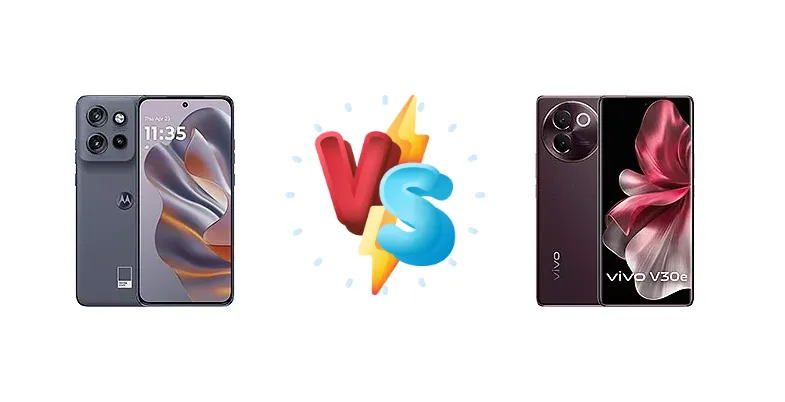
|
🏆 Quick Verdict
For users prioritizing sustained performance and a brighter display, the Motorola Edge 50 Neo is the stronger choice. Its Dimensity 7300 chipset and 1437 nits peak brightness offer a noticeable advantage. However, the vivo V30e’s efficient Snapdragon 6 Gen 1 and reverse wired charging provide a compelling alternative for those seeking longer battery life and added convenience.
| PHONES | ||
|---|---|---|
| Phone Names | Motorola Edge 50 Neo | vivo V30e |
| Network | ||
|---|---|---|
| 2G bands | GSM 850 / 900 / 1800 / 1900 | GSM 850 / 900 / 1800 / 1900 |
| 3G bands | HSDPA 800 / 850 / 900 / 1700(AWS) / 1900 / 2100 | HSDPA 850 / 900 / 1700(AWS) / 1900 / 2100 - Malaysia |
| 4G bands | 1, 2, 3, 4, 5, 7, 8, 12, 13, 17, 18, 19, 20, 25, 26, 28, 32, 34, 38, 39, 40, 41, 42, 43, 48, 66 | 1, 2, 3, 4, 5, 7, 8, 18, 19, 20, 26, 28, 38, 39, 40, 41 - Malaysia |
| 5G bands | 1, 2, 3, 5, 7, 8, 20, 26, 28, 38, 40, 41, 66, 75, 77, 78 SA/NSA/Sub6 | 1, 3, 5, 7, 8, 20, 28, 38, 40, 41, 77, 78 SA/NSA - Malaysia |
| Speed | HSPA, LTE, 5G | HSPA, LTE, 5G |
| Technology | GSM / HSPA / LTE / 5G | GSM / HSPA / LTE / 5G |
| Launch | ||
|---|---|---|
| Announced | 2024, August 29 | 2024, May 02 |
| Status | Available. Released 2024, August 29 | Available. Released 2024, May 09 |
| Body | ||
|---|---|---|
| Build | Glass front (Gorilla Glass 3), plastic frame, silicone polymer (eco leather) back | Glass front, plastic frame, glass back or plastic back |
| Dimensions | 154.1 x 71.2 x 8.1 mm (6.07 x 2.80 x 0.32 in) | 164.4 x 74.8 x 7.7 mm (6.47 x 2.94 x 0.30 in) |
| SIM | · Nano-SIM + eSIM· Nano-SIM + Nano-SIM | Nano-SIM + Nano-SIM |
| Weight | 171 g (6.03 oz) | 179 g or 188 g (6.31 oz) |
| Display | ||
|---|---|---|
| Protection | Corning Gorilla Glass 3, Mohs level 4 | Schott Xensation |
| Resolution | 1200 x 2670 pixels, 20:9 ratio (~460 ppi density) | 1080 x 2400 pixels, 20:9 ratio (~388 ppi density) |
| Size | 6.4 inches, 97.5 cm2 (~88.9% screen-to-body ratio) | 6.78 inches, 111.0 cm2 (~90.3% screen-to-body ratio) |
| Type | LTPO P-OLED, 1B colors, 120Hz, HDR10+, 3000 nits (peak) | AMOLED, 1B colors, 120Hz, 1300 nits (peak) |
| Platform | ||
|---|---|---|
| CPU | Octa-core (4x2.5 GHz Cortex-A78 & 4x2.0 GHz Cortex-A55) | Octa-core (4x2.2 GHz Cortex-A78 & 4x1.8 GHz Cortex-A55) |
| Chipset | Mediatek Dimensity 7300 (4 nm) | Qualcomm SM6450 Snapdragon 6 Gen 1 (4 nm) |
| GPU | Mali-G615 MC2 | Adreno 710 |
| OS | Android 14, up to 5 major Android upgrades | Android 14, Funtouch 14 |
| Memory | ||
|---|---|---|
| Card slot | No | microSDXC (uses shared SIM slot) |
| Internal | 256GB 8GB RAM, 256GB 12GB RAM, 512GB 12GB RAM | 128GB 8GB RAM, 256GB 8GB RAM, 256GB 12GB RAM |
| Main Camera | ||
|---|---|---|
| Dual | - | 50 MP, f/1.8, 26mm (wide), 1/1.95", 0.8µm, PDAF, OIS (India only) 8 MP, f/2.2, 120˚ (ultrawide), 1/4.0", 1.12µm |
| Features | LED flash, HDR, panorama | Ring-LED flash, panorama, HDR |
| Triple | 50 MP, f/1.8, 24mm (wide), 1/1.55", 1.0µm, multi-directional PDAF, OIS 10 MP, f/2.0, 73mm (telephoto), 1/3.94", 1.0µm, PDAF, OIS, 3x optical zoom 13 MP, f/2.2, 13mm, 120˚ (ultrawide), 1/3.0", 1.12µm, PDAF | - |
| Video | 4K@30fps, 1080p@30/60/120/240fps, gyro-EIS | 4K@30fps, 1080p@30fps |
| Selfie camera | ||
|---|---|---|
| Features | HDR | - |
| Single | 32 MP, f/2.4, (wide), 1/3.14", 0.7µm | 50 MP, f/2.5, 25mm (wide), AF - India 32 MP, f/2.0, 24mm (wide) - Malaysia |
| Video | 4K@30fps, 1080p@30/60/120fps | 4K@30fps (India only), 1080p@30fps |
| Sound | ||
|---|---|---|
| 35mm jack | No | No |
| Loudspeaker | Yes, with stereo speakers | Yes |
| Comms | ||
|---|---|---|
| Bluetooth | 5.3, A2DP, LE | 5.1, A2DP, LE |
| NFC | Yes | Yes (market/region dependent) |
| Positioning | GPS, GLONASS, GALILEO | GPS, GLONASS, GALILEO, BDS, QZSS, NavIC |
| Radio | No | No |
| USB | USB Type-C 2.0 | USB Type-C 2.0, OTG |
| WLAN | Wi-Fi 802.11 a/b/g/n/ac/6e, tri-band | Wi-Fi 802.11 a/b/g/n/ac, dual-band |
| Features | ||
|---|---|---|
| Sensors | Fingerprint (under display, optical), accelerometer, gyro, proximity, compass | Fingerprint (under display, optical), accelerometer, gyro, proximity, compass |
| Battery | ||
|---|---|---|
| Charging | 68W wired 15W wireless | 44W wired, PD Reverse wired |
| Type | 4310 mAh | Li-Ion 5500 mAh |
| Misc | ||
|---|---|---|
| Colors | Nautical Blue, Latte, Grisaille, Poinciana, Mocha Mousse | Velvet Red (Coco Brown), Silk Blue, Sky Mirror |
| Models | XT2409-1 | V2339 |
| Price | € 240.02 / $ 315.00 / £ 225.39 / ₹ 22,490 | ₹ 23,999 |
| EU LABEL | ||
|---|---|---|
| Battery | 50:44h endurance, 1200 cycles | - |
| Energy | Class A | - |
| Free fall | Class B (180 falls) | - |
| Repairability | Class B | - |
Motorola Edge 50 Neo
- Brighter display for outdoor visibility
- Faster 68W wired charging
- Wireless charging support
- Potentially higher battery drain due to brighter display
- May run warmer under sustained load
vivo V30e
- Excellent battery efficiency
- Reverse wired charging for accessories
- Potentially lower price point
- Slower 44W wired charging
- Less powerful chipset for demanding tasks
Display Comparison
The Motorola Edge 50 Neo boasts a significantly brighter display, reaching a measured peak of 1437 nits. This is a substantial advantage over what we’d expect from the vivo V30e, making the Edge 50 Neo far more usable in direct sunlight. While the V30e’s panel specifications aren’t available, vivo typically prioritizes color accuracy, but likely at the expense of peak brightness. The Edge 50 Neo’s higher brightness also suggests a more powerful backlight, potentially impacting battery consumption, but offering a superior viewing experience.
Camera Comparison
Without detailed camera specifications for either device, a direct comparison is difficult. However, given the market positioning, it’s reasonable to assume both phones will feature a primary camera around the 50MP mark. The Edge 50 Neo’s image processing will likely lean towards vibrant, saturated colors, typical of Motorola’s tuning. The V30e, drawing from vivo’s expertise, may prioritize natural-looking images with strong dynamic range. The presence or absence of Optical Image Stabilization (OIS) on the main sensor will be a key differentiator, impacting low-light performance and video stabilization. We can expect both phones to include standard auxiliary lenses, but their quality is unlikely to be a major factor.
Performance
The core difference lies in the chipsets: the Motorola Edge 50 Neo utilizes the Mediatek Dimensity 7300 (4nm) with its octa-core configuration (4x2.5 GHz Cortex-A78 & 4x2.0 GHz Cortex-A55), while the vivo V30e features the Qualcomm Snapdragon 6 Gen 1 (4nm) with a slightly lower clocked CPU (4x2.2 GHz Cortex-A78 & 4x1.8 GHz Cortex-A55). The Dimensity 7300’s higher clock speeds on the prime cores suggest better single-core performance, beneficial for responsive app launches and smoother multitasking. Both chips are built on a 4nm process, ensuring good efficiency, but the Dimensity 7300’s architecture is geared towards more demanding workloads. The V30e’s Snapdragon 6 Gen 1 will likely excel in sustained efficiency, potentially leading to less thermal throttling during extended use.
Battery Life
The Motorola Edge 50 Neo delivers an impressive 50:44h endurance rating with 1200 charge cycles, and an active use score of 13:29h. This suggests a well-optimized battery system. The 68W wired charging is significantly faster than the vivo V30e’s 44W wired charging, allowing for quicker top-ups. The Edge 50 Neo also adds 15W wireless charging, a feature absent on the V30e. While the V30e’s battery capacity isn’t specified, its Snapdragon 6 Gen 1 chipset is known for its efficiency. The V30e also offers reverse wired charging, allowing it to act as a power bank for other devices – a useful feature for users with multiple gadgets.
Buying Guide
Buy the Motorola Edge 50 Neo if you need a phone capable of handling demanding apps and games with relative ease, and value a vibrant, bright display for outdoor use. Buy the vivo V30e if you prioritize all-day battery life, appreciate the convenience of reverse wired charging to top up accessories, and prefer a more power-efficient processor for typical daily tasks.