
Xiaomi 13T vs Motorola Edge 40: Which Mid-Range Champion Reigns Supreme?
| Phones Images | |||||
|---|---|---|---|---|---|
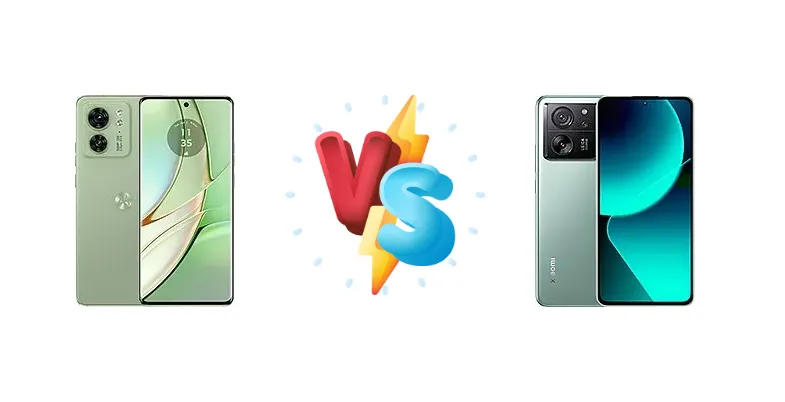
|
🏆 Quick Verdict
For most users, the Xiaomi 13T offers a more compelling package. Its Dimensity 8200 Ultra chipset delivers noticeably faster performance, and the 1264 nits peak brightness provides a superior viewing experience. While the Edge 40 remains a solid choice, the 13T’s advantages in power and display quality give it the edge.
| PHONES | ||
|---|---|---|
| Phone Names | Motorola Edge 40 | Xiaomi 13T |
| Network | ||
|---|---|---|
| 2G bands | GSM 850 / 900 / 1800 / 1900 | GSM 850 / 900 / 1800 / 1900 |
| 3G bands | HSDPA 850 / 900 / 1700(AWS) / 1900 / 2100 | HSDPA 800 / 850 / 900 / 1700(AWS) / 1900 / 2100 |
| 4G bands | 1, 2, 3, 4, 5, 7, 8, 12, 13, 17, 20, 26, 28, 32, 38, 39, 40, 41, 42, 43, 66 | 1, 2, 3, 4, 5, 7, 8, 12, 13, 17, 18, 19, 20, 26, 28, 32, 38, 40, 41, 66 |
| 5G bands | 1, 2, 3, 5, 7, 8, 20, 28, 38, 40, 41, 66, 77, 78 SA/NSA/Sub6 | 1, 3, 5, 7, 8, 20, 28, 38, 40, 41, 66, 77, 78 SA/NSA |
| Speed | HSPA, LTE, 5G | HSPA, LTE, 5G |
| Technology | GSM / HSPA / LTE / 5G | GSM / HSPA / LTE / 5G |
| Launch | ||
|---|---|---|
| Announced | 2023, May 04 | 2023, September 26 |
| Status | Available. Released 2023, May 04 | Available. Released 2023, September 26 |
| Body | ||
|---|---|---|
| Build | Glass front, aluminum frame, plastic back or eco leather back | Glass front (Gorilla Glass 5), glass back or silicone polymer back, plastic frame |
| Dimensions | 158.4 x 72 x 7.6 mm (6.24 x 2.83 x 0.30 in) | 162.2 x 75.7 x 8.5 mm (6.39 x 2.98 x 0.33 in) |
| SIM | · Nano-SIM· Nano-SIM + eSIM· Nano-SIM + Nano-SIM | · Nano-SIM + eSIM· Nano-SIM + Nano-SIM |
| Weight | 167 g or 171 g (5.89 oz) | 193 g or 197 g (6.81 oz) |
| IP68 dust/water resistant (up to 1.5m for 30 min) | - | |
| Display | ||
|---|---|---|
| Protection | - | Corning Gorilla Glass 5 |
| Resolution | 1080 x 2400 pixels, 20:9 ratio (~402 ppi density) | 1220 x 2712 pixels, 20:9 ratio (~446 ppi density) |
| Size | 6.55 inches, 103.6 cm2 (~90.8% screen-to-body ratio) | 6.67 inches, 107.4 cm2 (~87.5% screen-to-body ratio) |
| Type | P-OLED, 144Hz, HDR10+, 1200 nits (peak) | AMOLED, 68B colors, 144Hz, Dolby Vision, HDR10+, 1200 nits (HBM), 2600 nits (peak) |
| Platform | ||
|---|---|---|
| CPU | Octa-core (4x2.6 GHz Cortex-A78 & 4x2.0 GHz Cortex-A55) | Octa-core (1x3.1 GHz Cortex-A78 & 3x3.0 GHz Cortex-A78 & 4x2.0 GHz Cortex-A55) |
| Chipset | Mediatek Dimensity 8020 (6 nm) | Mediatek Dimensity 8200 Ultra (4 nm) |
| GPU | Mali-G77 MC9 | Mali-G610 MC6 |
| OS | Android 13, up to 2 major Android upgrades | Android 13, up to 4 major Android upgrades, HyperOS |
| Memory | ||
|---|---|---|
| Card slot | No | No |
| Internal | 128GB 8GB RAM, 256GB 8GB RAM | 256GB 8GB RAM, 256GB 12GB RAM |
| UFS 3.1 | - | |
| Main Camera | ||
|---|---|---|
| Dual | 50 MP, f/1.4, (wide), 1/1.55", 1.0µm, multi-directional PDAF, OIS 13 MP, f/2.2, 120˚ (ultrawide), 1/3.0", 1.12µm, AF | - |
| Features | Dual-LED flash, HDR, panorama | Leica lens, color spectrum sensor, LED flash, HDR, panorama |
| Triple | - | 50 MP, f/1.9, 24mm (wide), 1/1.28", 1.22µm, PDAF, OIS 50 MP, f/1.9, 50mm (telephoto), 1/2.88", 0.61µm, PDAF, 2x optical zoom 12 MP, f/2.2, 15mm (ultrawide), 1/3.06", 1.12µm |
| Video | 4K@30fps, 1080p@30/60/120fps, 720p@960fps, HDR10, gyro-EIS | 4K@30fps (HDR10+), 1080p@30/60/120fps, gyro-EIS |
| Selfie camera | ||
|---|---|---|
| Features | HDR | HDR |
| Single | 32 MP, f/2.4, (wide), 1/3.0", 0.7µm | 20 MP, f/2.2, (wide), 0.8µm |
| Video | 4K@30fps, 1080p@30/120fps | 1080p@30fps, HDR10+ |
| Sound | ||
|---|---|---|
| 3.5mm jack | No | - |
| 35mm jack | No | No |
| Loudspeaker | Yes, with stereo speakers | Yes, with stereo speakers |
| Comms | ||
|---|---|---|
| Bluetooth | 5.2, A2DP, LE | 5.4, A2DP, LE |
| Infrared port | - | Yes |
| NFC | Yes | Yes (market/region dependent) |
| Positioning | GPS, GLONASS, GALILEO, BDS | GPS (L1+L5), GLONASS (G1), GALILEO (E1+E5a), QZSS (L1+L5), NavIC (L5), BDS |
| Radio | No | No |
| USB | USB Type-C 2.0, OTG | USB Type-C 2.0, OTG |
| WLAN | Wi-Fi 802.11 a/b/g/n/ac/6e, tri-band, Wi-Fi Direct | Wi-Fi 802.11 a/b/g/n/ac/6, dual-band |
| Features | ||
|---|---|---|
| Sensors | Fingerprint (under display, optical), accelerometer, gyro, proximity, compass | Fingerprint (under display, optical), accelerometer, gyro, proximity, compass |
| Moto Ready For support | - | |
| Battery | ||
|---|---|---|
| Charging | 68W wired 15W wireless | 67W wired, PD3.0, QC4, 100% in 42 min |
| Type | Li-Po 4400 mAh | Li-Po 5000 mAh |
| Misc | ||
|---|---|---|
| Colors | Nebula Green, Lunar Blue, Eclipse Black, Viva Magenta | Alpine Blue, Meadow Green, Black |
| Models | XT2303-2 | 2306EPN60G |
| Price | € 202.03 / $ 419.99 / £ 199.00 / ₹ 29,999 | $ 255.96 / £ 326.27 / € 204.18 |
| SAR EU | - | 0.99 W/kg (head) 0.99 W/kg (body) |
| Tests | ||
|---|---|---|
| Battery life | Endurance rating 98h | - |
| Camera | Photo / Video | - |
| Display | Contrast ratio: Infinite (nominal) | - |
| Loudspeaker | -24.2 LUFS (Very good) | - |
| Performance | AnTuTu: 688347 (v9) GeekBench: 3320 (v5.1), 3603 (v6) GFXBench: 33fps (ES 3.1 onscreen) | - |
Motorola Edge 40
- Sleek and lightweight design
- 15W wireless charging support
- Balanced overall experience
- Less powerful chipset compared to the 13T
- Lower peak display brightness
Xiaomi 13T
- Faster and more efficient Dimensity 8200 Ultra chipset
- Brighter display for better outdoor visibility
- Faster wired charging with broader compatibility
- No wireless charging support
- Potentially less refined design aesthetic
Display Comparison
The Xiaomi 13T boasts a significantly brighter display, reaching a measured 1264 nits compared to the Motorola Edge 40’s 1043 nits. This translates to better visibility outdoors and a more vibrant HDR experience. While both displays feature an 'infinite' contrast ratio (typical for OLED panels), the higher peak brightness of the 13T is a tangible advantage. We lack PWM frequency data for both, but the 13T’s brightness advantage may mitigate flicker sensitivity for some users. Bezels appear comparable based on available imagery, and color accuracy is likely similar given both utilize OLED technology.
Camera Comparison
Both phones feature capable camera systems, but detailed sensor information is limited. We can assume both offer photo and video capabilities. The Xiaomi 13T’s advantage likely lies in its image processing pipeline, often tuned for vibrant and detailed images. Without specific sensor size or aperture data, it’s difficult to definitively declare a winner. However, Xiaomi’s history suggests a focus on computational photography, potentially giving it an edge in challenging lighting conditions. The inclusion of OIS (Optical Image Stabilization) on the main sensor of both devices is expected, aiding in low-light performance and video stabilization.
Performance
The Xiaomi 13T’s Mediatek Dimensity 8200 Ultra, fabricated on a 4nm process, represents a clear step up in performance compared to the Motorola Edge 40’s Dimensity 8020 (6nm). The 8200 Ultra features a more powerful CPU configuration – 1x3.1 GHz Cortex-A78, 3x3.0 GHz Cortex-A78, and 4x2.0 GHz Cortex-A55 – versus the Edge 40’s 4x2.6 GHz Cortex-A78 & 4x2.0 GHz Cortex-A55. This translates to faster app loading times, smoother multitasking, and improved gaming performance. The 4nm process also contributes to better thermal efficiency, potentially reducing throttling during sustained workloads. While both phones likely utilize LPDDR5x RAM, the chipset difference is the dominant factor.
Battery Life
The Xiaomi 13T delivers a more compelling battery and charging experience. While the Motorola Edge 40 boasts an endurance rating of 98 hours, the 13T achieves 101 hours and a real-world active use score of 12:23h. The 13T’s 67W wired charging, with a full charge in 42 minutes, is slightly faster than the Edge 40’s 68W charging. The 13T also supports PD3.0 and QC4, offering broader compatibility with chargers. The Edge 40 includes 15W wireless charging, a feature absent on the 13T, but the faster wired charging of the 13T is likely more beneficial for most users.
Buying Guide
Buy the Motorola Edge 40 if you prioritize a refined, lightweight design and a more subtle aesthetic. It’s ideal for users who value a balanced experience and don’t demand the absolute highest performance. Buy the Xiaomi 13T if you’re a power user who prioritizes gaming, multitasking, and fast charging. Its superior chipset and brighter display make it the better choice for demanding tasks and media consumption.