
Motorola Edge 40 vs vivo V27: A Head-to-Head Showdown
| Phones Images | |||||
|---|---|---|---|---|---|
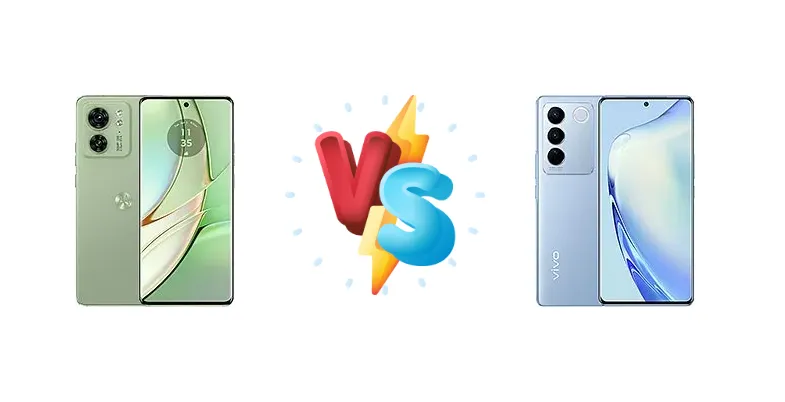
|
🏆 Quick Verdict
The vivo V27 edges out the Motorola Edge 40 thanks to its significantly longer battery life and efficient Dimensity 7200 chipset. While the Edge 40 boasts a slightly brighter display, the V27’s superior endurance and overall value make it the winner for most users.
| PHONES | ||
|---|---|---|
| Phone Names | Motorola Edge 40 | vivo V27 |
| Network | ||
|---|---|---|
| 2G bands | GSM 850 / 900 / 1800 / 1900 | GSM 850 / 900 / 1800 / 1900 |
| 3G bands | HSDPA 850 / 900 / 1700(AWS) / 1900 / 2100 | HSDPA 850 / 900 / 1700(AWS) / 1900 / 2100 - International |
| 4G bands | 1, 2, 3, 4, 5, 7, 8, 12, 13, 17, 20, 26, 28, 32, 38, 39, 40, 41, 42, 43, 66 | 1, 2, 3, 4, 5, 7, 8, 18, 19, 20, 26, 28, 38, 39, 40, 41 - International |
| 5G bands | 1, 2, 3, 5, 7, 8, 20, 28, 38, 40, 41, 66, 77, 78 SA/NSA/Sub6 | 1, 3, 5, 7, 8, 20, 28, 38, 40, 41, 77, 78 SA/NSA - International |
| Speed | HSPA, LTE, 5G | HSPA, LTE, 5G |
| Technology | GSM / HSPA / LTE / 5G | GSM / HSPA / LTE / 5G |
| - | 1, 3, 5, 8, 28, 78 SA/NSA - Asia | |
| Launch | ||
|---|---|---|
| Announced | 2023, May 04 | 2023, March 01 |
| Status | Available. Released 2023, May 04 | Available. Released 2023, March 01 |
| Body | ||
|---|---|---|
| Build | Glass front, aluminum frame, plastic back or eco leather back | Glass front, glass back |
| Dimensions | 158.4 x 72 x 7.6 mm (6.24 x 2.83 x 0.30 in) | 164.1 x 74.8 x 7.4 mm (6.46 x 2.94 x 0.29 in) |
| SIM | · Nano-SIM· Nano-SIM + eSIM· Nano-SIM + Nano-SIM | Nano-SIM + Nano-SIM |
| Weight | 167 g or 171 g (5.89 oz) | 180 g (6.35 oz) |
| IP68 dust/water resistant (up to 1.5m for 30 min) | Color changing back panel color | |
| Display | ||
|---|---|---|
| Resolution | 1080 x 2400 pixels, 20:9 ratio (~402 ppi density) | 1080 x 2400 pixels, 20:9 ratio (~388 ppi density) |
| Size | 6.55 inches, 103.6 cm2 (~90.8% screen-to-body ratio) | 6.78 inches, 111.0 cm2 (~90.4% screen-to-body ratio) |
| Type | P-OLED, 144Hz, HDR10+, 1200 nits (peak) | AMOLED, 1B colors, 120Hz, HDR10+ |
| Platform | ||
|---|---|---|
| CPU | Octa-core (4x2.6 GHz Cortex-A78 & 4x2.0 GHz Cortex-A55) | Octa-core (2x2.8 GHz Cortex-A715 & 6x Cortex-A510) |
| Chipset | Mediatek Dimensity 8020 (6 nm) | Mediatek Dimensity 7200 (4 nm) |
| GPU | Mali-G77 MC9 | Mali-G610 MC4 |
| OS | Android 13, up to 2 major Android upgrades | Android 13, Funtouch 13 |
| Memory | ||
|---|---|---|
| Card slot | No | No |
| Internal | 128GB 8GB RAM, 256GB 8GB RAM | 128GB 8GB RAM, 256GB 8GB RAM, 256GB 12GB RAM |
| UFS 3.1 | - | |
| Main Camera | ||
|---|---|---|
| Dual | 50 MP, f/1.4, (wide), 1/1.55", 1.0µm, multi-directional PDAF, OIS 13 MP, f/2.2, 120˚ (ultrawide), 1/3.0", 1.12µm, AF | - |
| Features | Dual-LED flash, HDR, panorama | Ring-LED flash, panorama, HDR |
| Single | - | 50 MP, f/2.5, (wide), AF |
| Triple | - | 50 MP, f/1.9, (wide), 1/1.56", 1.0µm, PDAF, OIS 8 MP, f/2.2, 16mm, 120˚ (ultrawide), 1/4.0", 1.12µm 2 MP (macro) |
| Video | 4K@30fps, 1080p@30/60/120fps, 720p@960fps, HDR10, gyro-EIS | 4K@30/60fps, 1080p@30fps, gyro-EIS |
| Selfie camera | ||
|---|---|---|
| Features | HDR | Dual-LED flash, HDR |
| Single | 32 MP, f/2.4, (wide), 1/3.0", 0.7µm | 50 MP, f/2.5, (wide), AF |
| Video | 4K@30fps, 1080p@30/120fps | 4K@30/60fps, 1080p@30fps, gyro-EIS |
| Sound | ||
|---|---|---|
| 3.5mm jack | No | No |
| 35mm jack | No | No |
| Loudspeaker | Yes, with stereo speakers | Yes |
| - | 24-bit/192kHz audio | |
| Comms | ||
|---|---|---|
| Bluetooth | 5.2, A2DP, LE | 5.3, A2DP, LE |
| NFC | Yes | Yes |
| Positioning | GPS, GLONASS, GALILEO, BDS | GPS, GLONASS, GALILEO, BDS, QZSS, NavIC |
| Radio | No | No |
| USB | USB Type-C 2.0, OTG | USB Type-C 2.0, OTG |
| WLAN | Wi-Fi 802.11 a/b/g/n/ac/6e, tri-band, Wi-Fi Direct | Wi-Fi 802.11 a/b/g/n/ac, dual-band, Wi-Fi Direct |
| Features | ||
|---|---|---|
| Sensors | Fingerprint (under display, optical), accelerometer, gyro, proximity, compass | Fingerprint (under display, optical), accelerometer, gyro, proximity, compass |
| Moto Ready For support | - | |
| Battery | ||
|---|---|---|
| Charging | 68W wired 15W wireless | 66W wired, 50% in 19 min |
| Type | Li-Po 4400 mAh | 4600 mAh |
| Misc | ||
|---|---|---|
| Colors | Nebula Green, Lunar Blue, Eclipse Black, Viva Magenta | Magic Blue, Noble Black, Emerald Green, Flowing Gold |
| Models | XT2303-2 | V2231, V2246 |
| Price | € 202.03 / $ 419.99 / £ 199.00 / ₹ 29,999 | About 380 EUR |
| Tests | ||
|---|---|---|
| Battery life | Endurance rating 98h | Endurance rating 134h |
| Camera | Photo / Video | Photo / Video |
| Display | Contrast ratio: Infinite (nominal) | Contrast ratio: Infinite (nominal) |
| Loudspeaker | -24.2 LUFS (Very good) | -28.2 LUFS (Average) |
| Performance | AnTuTu: 688347 (v9) GeekBench: 3320 (v5.1), 3603 (v6) GFXBench: 33fps (ES 3.1 onscreen) | AnTuTu: 613641 (v9) GeekBench: 2400 (v5.1), 2689 (v6) GFXBench: 34fps (ES 3.1 onscreen) |
Motorola Edge 40
- Slightly brighter display
- Fast charging (68W)
- Clean Android experience
- Shorter battery life
- Camera may lack polish compared to V27
- Less efficient chipset
vivo V27
- Exceptional battery life (134h)
- Efficient chipset
- Stylish design
- Good camera performance
- Performance slightly behind Edge 40 in raw benchmarks
- Software experience may not appeal to all
Display Comparison
Both phones feature stunning displays with excellent brightness (Edge 40: 1043 nits, V27: 1055 nits) and infinite contrast ratios. The Edge 40 has a slightly higher peak brightness, potentially offering a more visible screen in direct sunlight. However, the difference is minimal and unlikely to be noticeable in most everyday scenarios. Both utilize OLED technology for vibrant colors and deep blacks.
Camera Comparison
Both phones offer capable camera systems, but the vivo V27 is generally considered to have a slight edge. While specific camera specs are not fully detailed, the V27 is known for its vibrant color processing and good low-light performance. The Edge 40's camera is also good, but may lack the same level of polish. Both offer photo and video capabilities.
Performance
The Motorola Edge 40 utilizes a Mediatek Dimensity 8020, while the vivo V27 is powered by a Mediatek Dimensity 7200. While the Dimensity 8020 has a higher theoretical peak performance, the Dimensity 7200's 4nm process offers better efficiency and real-world performance is surprisingly close. The V27's chipset is generally considered more efficient, contributing to its longer battery life. Gaming performance is solid on both devices.
Battery Life
This is where the vivo V27 truly shines. It boasts an impressive endurance rating of 134 hours, significantly outperforming the Motorola Edge 40's 98 hours. The V27's efficient chipset and optimized software contribute to this exceptional battery life. The V27 also offers faster wired charging (66W) compared to the Edge 40 (68W), and includes wireless charging (15W).
Buying Guide
The Motorola Edge 40 is ideal for users prioritizing a vibrant display and a slightly faster processor for demanding tasks. The vivo V27 is a better choice for those who value long battery life, a stylish design, and a more balanced overall package, especially if photography is a key consideration.