
Motorola Edge 40 vs Samsung Galaxy S23 FE: A Detailed Comparison
| Phones Images | |||||
|---|---|---|---|---|---|
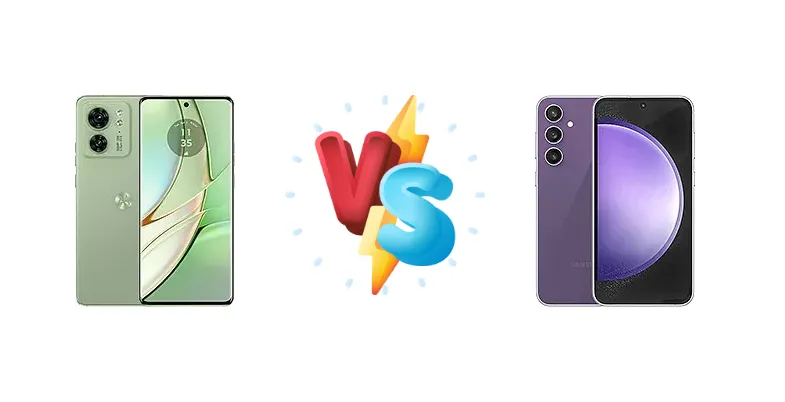
|
🏆 Quick Verdict
For the average user prioritizing brand recognition and broader software support, the Samsung Galaxy S23 FE is the safer bet. However, the Motorola Edge 40 delivers faster 68W charging and a comparable performance profile thanks to the Dimensity 8020, making it a compelling alternative for those seeking value and speed.
| PHONES | ||
|---|---|---|
| Phone Names | Motorola Edge 40 | Samsung Galaxy S23 FE |
| Network | ||
|---|---|---|
| 2G bands | GSM 850 / 900 / 1800 / 1900 | GSM 850 / 900 / 1800 / 1900 |
| 3G bands | HSDPA 850 / 900 / 1700(AWS) / 1900 / 2100 | HSDPA 850 / 900 / 1700(AWS) / 1900 / 2100 |
| 4G bands | 1, 2, 3, 4, 5, 7, 8, 12, 13, 17, 20, 26, 28, 32, 38, 39, 40, 41, 42, 43, 66 | 1, 2, 3, 4, 5, 7, 8, 12, 13, 17, 20, 26, 28, 38, 40, 41, 66 - International |
| 5G bands | 1, 2, 3, 5, 7, 8, 20, 28, 38, 40, 41, 66, 77, 78 SA/NSA/Sub6 | 1, 2, 3, 5, 7, 8, 20, 28, 38, 40, 41, 66, 77, 78 SA/NSA/Sub6 - International |
| Speed | HSPA, LTE, 5G | HSPA, LTE, 5G |
| Technology | GSM / HSPA / LTE / 5G | GSM / HSPA / LTE / 5G |
| Launch | ||
|---|---|---|
| Announced | 2023, May 04 | 2023, October 04 |
| Status | Available. Released 2023, May 04 | Available. Released 2023, October 05 |
| Body | ||
|---|---|---|
| Build | Glass front, aluminum frame, plastic back or eco leather back | Glass front (Gorilla Glass 5), glass back (Gorilla Glass 5), aluminum frame |
| Dimensions | 158.4 x 72 x 7.6 mm (6.24 x 2.83 x 0.30 in) | 158 x 76.5 x 8.2 mm (6.22 x 3.01 x 0.32 in) |
| SIM | · Nano-SIM· Nano-SIM + eSIM· Nano-SIM + Nano-SIM | · Nano-SIM· Nano-SIM + Nano-SIM· Nano-SIM + Nano-SIM + eSIM (max 2 at a time) |
| Weight | 167 g or 171 g (5.89 oz) | 209 g (7.37 oz) |
| IP68 dust/water resistant (up to 1.5m for 30 min) | - | |
| Display | ||
|---|---|---|
| Protection | - | Corning Gorilla Glass 5 |
| Resolution | 1080 x 2400 pixels, 20:9 ratio (~402 ppi density) | 1080 x 2340 pixels, 19.5:9 ratio (~403 ppi density) |
| Size | 6.55 inches, 103.6 cm2 (~90.8% screen-to-body ratio) | 6.4 inches, 100.5 cm2 (~83.2% screen-to-body ratio) |
| Type | P-OLED, 144Hz, HDR10+, 1200 nits (peak) | Dynamic AMOLED 2X, 120Hz, HDR10+, 1450 nits (peak) |
| Platform | ||
|---|---|---|
| CPU | Octa-core (4x2.6 GHz Cortex-A78 & 4x2.0 GHz Cortex-A55) | Octa-core (1x2.8 GHz Cortex-X2 & 3x2.50 GHz Cortex-A710 & 4x1.8 GHz Cortex-A510) - InternationalOcta-core (1x3.00 GHz Cortex-X2 & 3x2.50 GHz Cortex-A710 & 4x1.80 GHz Cortex-A510) - USA |
| Chipset | Mediatek Dimensity 8020 (6 nm) | Exynos 2200 (4 nm) - InternationalQualcomm SM8450 Snapdragon 8 Gen 1 (4 nm) - USA |
| GPU | Mali-G77 MC9 | Xclipse 920 - InternationalAdreno 730 - USA |
| OS | Android 13, up to 2 major Android upgrades | Android 13, up to 4 major Android upgrades, One UI 8 |
| Memory | ||
|---|---|---|
| Card slot | No | No |
| Internal | 128GB 8GB RAM, 256GB 8GB RAM | 128GB 8GB RAM, 256GB 8GB RAM |
| UFS 3.1 | - | |
| Main Camera | ||
|---|---|---|
| Dual | 50 MP, f/1.4, (wide), 1/1.55", 1.0µm, multi-directional PDAF, OIS 13 MP, f/2.2, 120˚ (ultrawide), 1/3.0", 1.12µm, AF | - |
| Features | Dual-LED flash, HDR, panorama | LED flash, HDR, panorama |
| Triple | - | 50 MP, f/1.8, 23mm (wide), 1/1.57", 1.0µm, dual pixel PDAF, OIS 8 MP, f/2.4, 76mm (telephoto), 1/4.5", 1.0µm, PDAF, OIS, 3x optical zoom 12 MP, f/2.2, 13mm, 123˚ (ultrawide), 1/3.0", 1.12µm |
| Video | 4K@30fps, 1080p@30/60/120fps, 720p@960fps, HDR10, gyro-EIS | 8K@24fps, 4K@30/60fps, 1080p@30/60/120/240fps |
| Selfie camera | ||
|---|---|---|
| Features | HDR | - |
| Single | 32 MP, f/2.4, (wide), 1/3.0", 0.7µm | 10 MP, f/2.4, 25mm (wide), 1/3.0", 1.22µm |
| Video | 4K@30fps, 1080p@30/120fps | 4K@30/60fps, 1080p@30/60fps; gyro-EIS |
| Sound | ||
|---|---|---|
| 3.5mm jack | No | - |
| 35mm jack | No | No |
| Loudspeaker | Yes, with stereo speakers | Yes, with stereo speakers |
| Comms | ||
|---|---|---|
| Bluetooth | 5.2, A2DP, LE | 5.3, A2DP, LE |
| NFC | Yes | Yes |
| Positioning | GPS, GLONASS, GALILEO, BDS | GPS, GLONASS, GALILEO, BDS |
| Radio | No | Unspecified |
| USB | USB Type-C 2.0, OTG | USB Type-C, OTG |
| WLAN | Wi-Fi 802.11 a/b/g/n/ac/6e, tri-band, Wi-Fi Direct | Wi-Fi 802.11 a/b/g/n/ac/6e, dual-band, Wi-Fi Direct |
| Features | ||
|---|---|---|
| Sensors | Fingerprint (under display, optical), accelerometer, gyro, proximity, compass | Fingerprint (under display, optical), accelerometer, gyro, compass |
| Moto Ready For support | - | |
| Battery | ||
|---|---|---|
| Charging | 68W wired 15W wireless | 25W wired, PD3.0, 50% in 30 min 15W wireless Reverse wireless |
| Type | Li-Po 4400 mAh | Li-Ion 4500 mAh |
| Misc | ||
|---|---|---|
| Colors | Nebula Green, Lunar Blue, Eclipse Black, Viva Magenta | Mint, Cream, Graphite, Purple, Indigo, Tangerine |
| Models | XT2303-2 | SM-S711B, SM-S711B/DS, SM-S711U1, SM-S711U, SM-S711W, SM-S7110, SM-S711N |
| Price | € 202.03 / $ 419.99 / £ 199.00 / ₹ 29,999 | $ 219.95 / C$ 327.90 / £ 248.99 / € 272.00 / ₹ 34,999 |
| SAR | - | 0.80 W/kg (head) 0.72 W/kg (body) |
| SAR EU | - | 0.76 W/kg (head) 1.04 W/kg (body) |
| Tests | ||
|---|---|---|
| Battery life | Endurance rating 98h | - |
| Camera | Photo / Video | - |
| Display | Contrast ratio: Infinite (nominal) | - |
| Loudspeaker | -24.2 LUFS (Very good) | - |
| Performance | AnTuTu: 688347 (v9) GeekBench: 3320 (v5.1), 3603 (v6) GFXBench: 33fps (ES 3.1 onscreen) | - |
Motorola Edge 40
- Significantly faster 68W wired charging
- Competitive performance with Dimensity 8020
- Potentially better standby battery life
- Less established brand recognition
- Potentially shorter software support lifespan
Samsung Galaxy S23 FE
- Stronger brand reputation and software support
- Snapdragon 8 Gen 1 variant offers top-tier performance (US)
- Reverse wireless charging
- Slower 25W wired charging
- Exynos 2200 variant may suffer from thermal throttling (International)
Display Comparison
Both devices feature vibrant displays, but subtle differences exist. The Motorola Edge 40 boasts a measured peak brightness of 1043 nits, slightly exceeding the Samsung Galaxy S23 FE’s 985 nits. While both are excellent for outdoor visibility, the Edge 40 has a marginal advantage. Both displays are advertised with infinite contrast ratios, typical of OLED panels. However, the S23 FE’s display benefits from Samsung’s established color calibration expertise, potentially offering more accurate color reproduction out of the box. Neither specification details refresh rate, but both are expected to offer adaptive refresh rates for smoother scrolling.
Camera Comparison
Both phones feature capable camera systems, but details are limited to 'Photo / Video' in the provided data. The S23 FE’s advantage likely lies in Samsung’s sophisticated image processing algorithms and potentially larger sensor sizes (though this is speculation without further specs). The Snapdragon 8 Gen 1/Exynos 2200 ISPs are well-regarded for their image processing capabilities. The Edge 40 will likely rely on MediaTek’s image signal processor, which has improved significantly in recent generations. Without sensor size or aperture information, it’s difficult to definitively declare a winner, but Samsung’s track record suggests a more polished and consistent camera experience. The presence of OIS on both devices is expected, but not confirmed.
Performance
The chipset choice is the defining performance differentiator. The Motorola Edge 40 utilizes the MediaTek Dimensity 8020, a 6nm chip, while the S23 FE comes in two flavors: the 4nm Exynos 2200 (International) and the 4nm Qualcomm Snapdragon 8 Gen 1 (USA). The 4nm process node of both S23 FE chips *should* offer better thermal efficiency than the 6nm Dimensity 8020, potentially leading to less throttling during sustained workloads. However, the Dimensity 8020’s CPU configuration – with four Cortex-A78 cores clocked at 2.6 GHz – is competitive with the Cortex-X2 and A710 cores found in the S23 FE’s chips. The Snapdragon 8 Gen 1 variant of the S23 FE will likely offer the best overall performance, but the Exynos 2200 has historically faced criticism for thermal management. The Edge 40’s performance will be very strong for its price point, but the S23 FE has a potential edge in sustained performance.
Battery Life
Battery life is a key area of divergence. The Motorola Edge 40 boasts an endurance rating of 98 hours, while the Samsung Galaxy S23 FE achieves 8:28 hours of active use. These metrics aren’t directly comparable, but suggest the Edge 40 offers superior standby efficiency. However, the S23 FE’s active use score indicates it can handle a full day of moderate to heavy use. The Edge 40’s 68W wired charging is significantly faster than the S23 FE’s 25W charging, allowing for a full charge in considerably less time. Both support 15W wireless charging, and the S23 FE adds reverse wireless charging, a convenient feature for topping up accessories.
Buying Guide
Buy the Motorola Edge 40 if you need exceptionally fast charging, a sleek design, and aren't heavily invested in the Samsung ecosystem. It’s ideal for users who prioritize quick top-ups and aren’t concerned about the potential for less frequent software updates. Buy the Samsung Galaxy S23 FE if you prefer a more established brand with a longer software support commitment, wider carrier compatibility (especially in the US with the Snapdragon variant), and a more refined camera experience, even if it means sacrificing charging speed.