
Motorola Edge 40 vs Realme 11 Pro: A Head-to-Head Showdown
| Phones Images | |||||
|---|---|---|---|---|---|
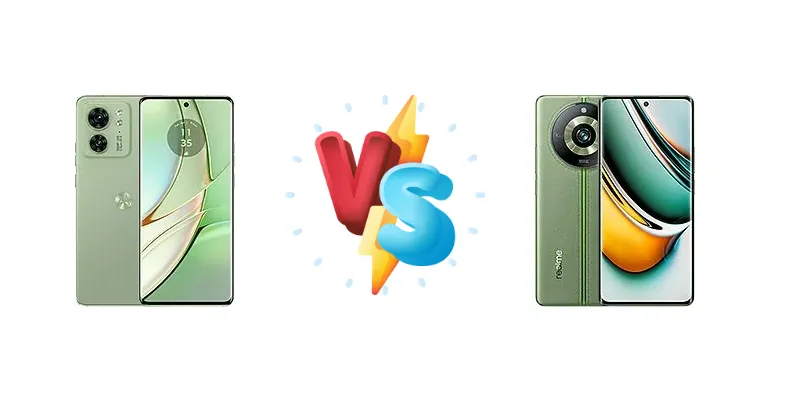
|
🏆 Quick Verdict
The Motorola Edge 40 boasts a brighter display and a slightly more powerful chipset, potentially offering a smoother experience. However, the Realme 11 Pro shines with exceptional battery endurance and a potentially more refined camera system. Ultimately, the choice depends on your priorities: performance and display versus battery life and camera.
| PHONES | ||
|---|---|---|
| Phone Names | Motorola Edge 40 | Realme 11 Pro |
| Network | ||
|---|---|---|
| 2G bands | GSM 850 / 900 / 1800 / 1900 | GSM 850 / 900 / 1800 / 1900 |
| 3G bands | HSDPA 850 / 900 / 1700(AWS) / 1900 / 2100 | HSDPA 850 / 900 / 2100 |
| 4G bands | 1, 2, 3, 4, 5, 7, 8, 12, 13, 17, 20, 26, 28, 32, 38, 39, 40, 41, 42, 43, 66 | 1, 3, 5, 7, 8, 28, 40, 41 - International |
| 5G bands | 1, 2, 3, 5, 7, 8, 20, 28, 38, 40, 41, 66, 77, 78 SA/NSA/Sub6 | 1, 3, 5, 8, 28, 40, 41, 77, 78 SA/NSA - International |
| Speed | HSPA, LTE, 5G | HSPA, LTE, 5G |
| Technology | GSM / HSPA / LTE / 5G | GSM / CDMA / HSPA / CDMA2000 / LTE / 5G |
| - | CDMA2000 1x | |
| Launch | ||
|---|---|---|
| Announced | 2023, May 04 | 2023, May 10 |
| Status | Available. Released 2023, May 04 | Available. Released 2023, May 15 |
| Body | ||
|---|---|---|
| Build | Glass front, aluminum frame, plastic back or eco leather back | Glass front, leather or plastic back, plastic frame |
| Dimensions | 158.4 x 72 x 7.6 mm (6.24 x 2.83 x 0.30 in) | 161.7 x 73.9 x 8.2 mm or 8.8 mm |
| SIM | · Nano-SIM· Nano-SIM + eSIM· Nano-SIM + Nano-SIM | Nano-SIM + Nano-SIM |
| Weight | 167 g or 171 g (5.89 oz) | 183 g or 189 g (6.46 oz) |
| IP68 dust/water resistant (up to 1.5m for 30 min) | - | |
| Display | ||
|---|---|---|
| Resolution | 1080 x 2400 pixels, 20:9 ratio (~402 ppi density) | 1080 x 2412 pixels, 20:9 ratio (~394 ppi density) |
| Size | 6.55 inches, 103.6 cm2 (~90.8% screen-to-body ratio) | 6.7 inches, 108.0 cm2 (~90.4% screen-to-body ratio) |
| Type | P-OLED, 144Hz, HDR10+, 1200 nits (peak) | AMOLED, 1B colors, HDR10+, 120Hz, 950 nits (peak) |
| Platform | ||
|---|---|---|
| CPU | Octa-core (4x2.6 GHz Cortex-A78 & 4x2.0 GHz Cortex-A55) | Octa-core (2x2.6 GHz Cortex-A78 & 6x2.0 GHz Cortex-A55) |
| Chipset | Mediatek Dimensity 8020 (6 nm) | Mediatek Dimensity 7050 (6 nm) |
| GPU | Mali-G77 MC9 | Mali-G68 MC4 |
| OS | Android 13, up to 2 major Android upgrades | Android 13, up to 2 major Android upgrades, Realme UI 5.0 |
| Memory | ||
|---|---|---|
| Card slot | No | No |
| Internal | 128GB 8GB RAM, 256GB 8GB RAM | 128GB 8GB RAM, 256GB 8GB RAM, 256GB 12GB RAM, 512GB 12GB RAM |
| UFS 3.1 | - | |
| Main Camera | ||
|---|---|---|
| Dual | 50 MP, f/1.4, (wide), 1/1.55", 1.0µm, multi-directional PDAF, OIS 13 MP, f/2.2, 120˚ (ultrawide), 1/3.0", 1.12µm, AF | 100 MP, f/1.8, 26mm (wide), PDAF, OIS Auxiliary lens |
| Features | Dual-LED flash, HDR, panorama | LED flash, HDR, panorama |
| Video | 4K@30fps, 1080p@30/60/120fps, 720p@960fps, HDR10, gyro-EIS | 4K@30fps, 1080p@30/60/120/480fps, 720p@960fps, gyro-EIS |
| Selfie camera | ||
|---|---|---|
| Features | HDR | Panorama |
| Single | 32 MP, f/2.4, (wide), 1/3.0", 0.7µm | 16 MP, f/2.5, 25mm (wide) |
| Video | 4K@30fps, 1080p@30/120fps | 1080p@30fps |
| Sound | ||
|---|---|---|
| 3.5mm jack | No | No |
| 35mm jack | No | No |
| Loudspeaker | Yes, with stereo speakers | Yes, with stereo speakers |
| - | 24-bit/192kHz audio | |
| Comms | ||
|---|---|---|
| Bluetooth | 5.2, A2DP, LE | 5.2, A2DP, LE, aptX HD |
| NFC | Yes | Yes (market/region dependent) |
| Positioning | GPS, GLONASS, GALILEO, BDS | GPS, GALILEO, GLONASS, BDS, QZSS |
| Radio | No | No |
| USB | USB Type-C 2.0, OTG | USB Type-C 2.0 |
| WLAN | Wi-Fi 802.11 a/b/g/n/ac/6e, tri-band, Wi-Fi Direct | Wi-Fi 802.11 a/b/g/n/ac/6, dual-band |
| Features | ||
|---|---|---|
| Sensors | Fingerprint (under display, optical), accelerometer, gyro, proximity, compass | Fingerprint (under display, optical), accelerometer, gyro, proximity, compass |
| Moto Ready For support | - | |
| Battery | ||
|---|---|---|
| Charging | 68W wired 15W wireless | 67W wired |
| Type | Li-Po 4400 mAh | 5000 mAh |
| Misc | ||
|---|---|---|
| Colors | Nebula Green, Lunar Blue, Eclipse Black, Viva Magenta | Astral Black, Sunrise Beige, Oasis Green |
| Models | XT2303-2 | RMX3771 |
| Price | € 202.03 / $ 419.99 / £ 199.00 / ₹ 29,999 | € 294.90 / ₹ 21,999 |
| Tests | ||
|---|---|---|
| Battery life | Endurance rating 98h | - |
| Camera | Photo / Video | - |
| Display | Contrast ratio: Infinite (nominal) | - |
| Loudspeaker | -24.2 LUFS (Very good) | - |
| Performance | AnTuTu: 688347 (v9) GeekBench: 3320 (v5.1), 3603 (v6) GFXBench: 33fps (ES 3.1 onscreen) | - |
Motorola Edge 40
- Brighter Display
- Slightly Faster Chipset
- Sleek Design
- Wireless Charging
- Shorter Battery Life
- Potentially Less Versatile Camera
Realme 11 Pro
- Exceptional Battery Life
- Potentially Better Camera
- Competitive Price
- Fast Charging
- Less Bright Display
- Slightly Slower Chipset
Display Comparison
The Motorola Edge 40 takes a clear lead in the display department with a measured peak brightness of 1043 nits, significantly higher than the Realme 11 Pro's 790 nits. This translates to better visibility in direct sunlight. Both phones likely feature OLED panels with vibrant colors and deep blacks, but the Edge 40's brightness advantage is noticeable. The Edge 40 also likely has a higher refresh rate (90Hz or 144Hz) compared to the Realme 11 Pro (90Hz or 120Hz), contributing to smoother scrolling and animations.
Camera Comparison
Camera performance is subjective and requires more in-depth testing. Both phones feature 'Photo / Video' capabilities, but the Realme 11 Pro is rumored to have a higher resolution main sensor (potentially 108MP) compared to the Edge 40 (likely 50MP). The Realme 11 Pro may also offer more advanced camera features like improved night mode or enhanced portrait modes. The Edge 40 might compensate with better image processing algorithms. Detailed camera comparisons would require side-by-side testing.
Performance
The Motorola Edge 40's Mediatek Dimensity 8020 generally outperforms the Realme 11 Pro's Dimensity 7050 in raw processing power. The Dimensity 8020's slightly higher clock speeds and overall architecture give it an edge in demanding tasks like gaming and video editing. However, both chipsets are capable of handling everyday tasks and most mobile games with ease. Real-world performance differences might be subtle for average users.
Battery Life
The Realme 11 Pro demonstrates a significant advantage in battery life. Its endurance rating of 112h is notably higher than the Motorola Edge 40's 98h. While the active use score (13:14h) is still impressive, the Realme 11 Pro is likely to last a full day or even longer with moderate usage, whereas the Edge 40 might require a top-up before the end of the day for heavier users. Both phones support fast charging, with the Edge 40 offering 68W wired and 15W wireless charging, while the Realme 11 Pro has 67W wired.
Buying Guide
The Motorola Edge 40 is ideal for users who prioritize a vibrant display, snappy performance for gaming and multitasking, and a sleek design. The Realme 11 Pro is a better fit for those who value long battery life, a potentially more versatile camera, and a more budget-friendly price point.