
Motorola Edge 40 vs Nothing Phone (2): A Detailed Comparison of Flagship Features
| Phones Images | |||||
|---|---|---|---|---|---|
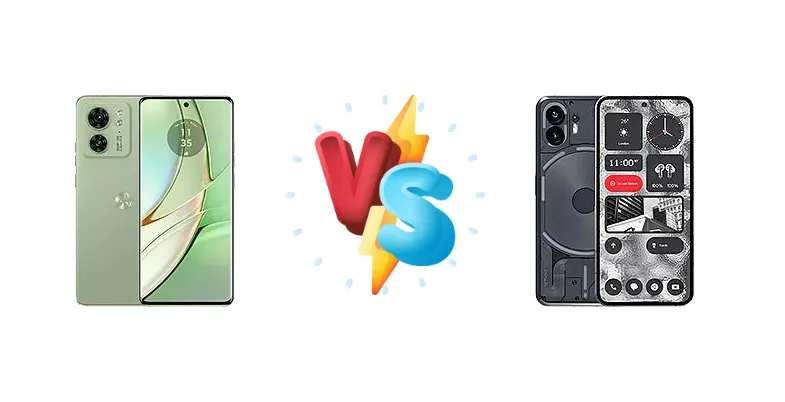
|
🏆 Quick Verdict
For most users, the Nothing Phone (2) emerges as the stronger contender. Its Snapdragon 8+ Gen 1 chipset delivers superior performance and thermal management, coupled with a slightly better battery endurance score. While the Edge 40 boasts a marginally brighter display, the Phone (2)'s overall package is more compelling.
| PHONES | ||
|---|---|---|
| Phone Names | Motorola Edge 40 | Nothing Phone (2) |
| Network | ||
|---|---|---|
| 2G bands | GSM 850 / 900 / 1800 / 1900 | GSM 850 / 900 / 1800 / 1900 |
| 3G bands | HSDPA 850 / 900 / 1700(AWS) / 1900 / 2100 | HSDPA 800 / 850 / 900 / 1700(AWS) / 1900 / 2100 |
| 4G bands | 1, 2, 3, 4, 5, 7, 8, 12, 13, 17, 20, 26, 28, 32, 38, 39, 40, 41, 42, 43, 66 | 1, 2, 3, 4, 5, 7, 8, 12, 17, 18, 19, 20, 25, 26, 28, 30, 32, 34, 38, 39, 40, 41, 42, 48, 66, 71 |
| 5G bands | 1, 2, 3, 5, 7, 8, 20, 28, 38, 40, 41, 66, 77, 78 SA/NSA/Sub6 | 1, 2, 3, 5, 7, 8, 12, 20, 25, 28, 30, 38, 40, 41, 66, 71, 75, 77, 78 SA/NSA |
| Speed | HSPA, LTE, 5G | HSPA, LTE, 5G |
| Technology | GSM / HSPA / LTE / 5G | GSM / HSPA / LTE / 5G |
| Launch | ||
|---|---|---|
| Announced | 2023, May 04 | 2023, July 11 |
| Status | Available. Released 2023, May 04 | Available. Released 2023, July 17 |
| Body | ||
|---|---|---|
| Build | Glass front, aluminum frame, plastic back or eco leather back | Glass front (Gorilla Glass 5), glass back (Gorilla Glass 5), aluminum frame |
| Dimensions | 158.4 x 72 x 7.6 mm (6.24 x 2.83 x 0.30 in) | 162.1 x 76.4 x 8.6 mm (6.38 x 3.01 x 0.34 in) |
| SIM | · Nano-SIM· Nano-SIM + eSIM· Nano-SIM + Nano-SIM | Nano-SIM + Nano-SIM |
| Weight | 167 g or 171 g (5.89 oz) | 201.2 g (7.09 oz) |
| IP68 dust/water resistant (up to 1.5m for 30 min) | - | |
| Display | ||
|---|---|---|
| Protection | - | Corning Gorilla Glass 5 |
| Resolution | 1080 x 2400 pixels, 20:9 ratio (~402 ppi density) | 1080 x 2412 pixels, 20:9 ratio (~394 ppi density) |
| Size | 6.55 inches, 103.6 cm2 (~90.8% screen-to-body ratio) | 6.7 inches, 108.0 cm2 (~87.2% screen-to-body ratio) |
| Type | P-OLED, 144Hz, HDR10+, 1200 nits (peak) | LTPO OLED, 1B colors, 120Hz, 1920Hz PWM, HDR10+, 1600 nits (HBM), 1600 nits (peak) |
| Platform | ||
|---|---|---|
| CPU | Octa-core (4x2.6 GHz Cortex-A78 & 4x2.0 GHz Cortex-A55) | Octa-core (1x3.0 GHz Cortex-X2 & 3x2.5 GHz Cortex-A710 & 4x1.80 GHz Cortex-A510) |
| Chipset | Mediatek Dimensity 8020 (6 nm) | Qualcomm SM8475 Snapdragon 8+ Gen 1 (4 nm) |
| GPU | Mali-G77 MC9 | Adreno 730 |
| OS | Android 13, up to 2 major Android upgrades | Android 13, upgradable to Android 15, up to 3 major Android upgrades, Nothing OS 3.0 |
| Memory | ||
|---|---|---|
| Card slot | No | No |
| Internal | 128GB 8GB RAM, 256GB 8GB RAM | 128GB 8GB RAM, 256GB 12GB RAM, 512GB 12GB RAM |
| UFS 3.1 | - | |
| Main Camera | ||
|---|---|---|
| Dual | 50 MP, f/1.4, (wide), 1/1.55", 1.0µm, multi-directional PDAF, OIS 13 MP, f/2.2, 120˚ (ultrawide), 1/3.0", 1.12µm, AF | 50 MP, f/1.9, 24mm (wide), 1/1.56", 1.0µm, PDAF, OIS 50 MP, f/2.2, 114˚ (ultrawide), 1/2.76", 0.64µm, AF |
| Features | Dual-LED flash, HDR, panorama | LED flash, panorama, HDR |
| Video | 4K@30fps, 1080p@30/60/120fps, 720p@960fps, HDR10, gyro-EIS | 4K@30/60fps, 1080p@30/60fps, gyro-EIS, live HDR, OIS |
| Selfie camera | ||
|---|---|---|
| Features | HDR | HDR |
| Single | 32 MP, f/2.4, (wide), 1/3.0", 0.7µm | 32 MP, f/2.5, (wide), 1/2.74", 0.8µm |
| Video | 4K@30fps, 1080p@30/120fps | 1080p@30fps |
| Sound | ||
|---|---|---|
| 3.5mm jack | No | - |
| 35mm jack | No | No |
| Loudspeaker | Yes, with stereo speakers | Yes, with stereo speakers |
| Comms | ||
|---|---|---|
| Bluetooth | 5.2, A2DP, LE | 5.3, A2DP, LE, aptX HD, aptX Adaptive |
| NFC | Yes | Yes |
| Positioning | GPS, GLONASS, GALILEO, BDS | GPS (L1+L5), GLONASS (L1), BDS (B1I+B1c), GALILEO (E1), QZSS (L1), NavIC |
| Radio | No | No |
| USB | USB Type-C 2.0, OTG | USB Type-C 2.0, OTG |
| WLAN | Wi-Fi 802.11 a/b/g/n/ac/6e, tri-band, Wi-Fi Direct | Wi-Fi 802.11 a/b/g/n/ac/6, dual-band, Wi-Fi Direct |
| Features | ||
|---|---|---|
| Sensors | Fingerprint (under display, optical), accelerometer, gyro, proximity, compass | Fingerprint (under display, optical), accelerometer, proximity, gyro, compass |
| Moto Ready For support | - | |
| Battery | ||
|---|---|---|
| Charging | 68W wired 15W wireless | 45W wired, PD3.0, PPS, QC4, 100% in 55 min 15W wireless, 100% in 130 min 5W reverse wireless |
| Type | Li-Po 4400 mAh | Li-Ion 4700 mAh |
| Misc | ||
|---|---|---|
| Colors | Nebula Green, Lunar Blue, Eclipse Black, Viva Magenta | White, Dark Gray |
| Models | XT2303-2 | A065 |
| Price | € 202.03 / $ 419.99 / £ 199.00 / ₹ 29,999 | $ 379.99 / £ 370.00 |
| Tests | ||
|---|---|---|
| Battery life | Endurance rating 98h | - |
| Camera | Photo / Video | - |
| Display | Contrast ratio: Infinite (nominal) | - |
| Loudspeaker | -24.2 LUFS (Very good) | - |
| Performance | AnTuTu: 688347 (v9) GeekBench: 3320 (v5.1), 3603 (v6) GFXBench: 33fps (ES 3.1 onscreen) | - |
Motorola Edge 40
- Sleek and lightweight design
- Slightly brighter display (1043 nits)
- Clean Android software experience
- Less powerful chipset (Dimensity 8020)
- Potentially more thermal throttling
- Slower charging speeds
Nothing Phone (2)
- More powerful chipset (Snapdragon 8+ Gen 1)
- Faster charging with multiple protocols
- Reverse wireless charging
- Slightly heavier and bulkier design
- Lower peak display brightness (998 nits)
- More visually distinct (Glyph Interface) may not appeal to everyone
Display Comparison
Both devices feature excellent displays, but with subtle differences. The Motorola Edge 40 achieves a measured peak brightness of 1043 nits, slightly surpassing the Nothing Phone (2)'s 998 nits. While this difference is noticeable in direct sunlight, both screens are perfectly usable outdoors. Neither specification details refresh rate or panel type, but both are expected to be high refresh rate OLED panels. The Edge 40's 'Infinite' contrast ratio is a marketing term, and both displays will offer excellent contrast. The user experience will likely be similar, with the Edge 40 potentially offering a slightly more vibrant image due to the higher peak brightness.
Camera Comparison
Both phones are listed as having 'Photo / Video' capabilities, lacking specific details. However, the market positioning suggests the Nothing Phone (2) will likely have a more refined camera system. While sensor size and aperture are unknown, the Snapdragon 8+ Gen 1’s image signal processor (ISP) is generally considered superior to MediaTek’s offerings. The Nothing Phone (2)'s software processing is also a key differentiator, with a focus on natural-looking images. The Edge 40 will likely deliver good results in well-lit conditions, but may struggle in low-light scenarios compared to the Phone (2).
Performance
The core difference lies in the chipsets. The Nothing Phone (2) utilizes the Qualcomm Snapdragon 8+ Gen 1 (4nm), a proven performer known for its efficiency and power. The Motorola Edge 40, on the other hand, employs the MediaTek Dimensity 8020 (6nm). The Snapdragon 8+ Gen 1’s 4nm process provides a thermal advantage, reducing the likelihood of throttling during sustained workloads. The CPU architecture also favors the Snapdragon, with its Cortex-X2 prime core (3.0 GHz) offering a significant performance boost over the Edge 40’s Cortex-A78 cores (2.6 GHz). This translates to faster app loading times, smoother multitasking, and a better gaming experience on the Nothing Phone (2).
Battery Life
The Nothing Phone (2) boasts an endurance rating of 103 hours, slightly exceeding the Motorola Edge 40’s 98 hours. However, real-world usage is better represented by the Phone (2)'s active use score of 14:21h. The Edge 40’s charging speeds are 68W wired and 15W wireless, while the Phone (2) offers 45W wired (with PD3.0, PPS, QC4 support, reaching 100% in 55 minutes), 15W wireless (130 minutes), and 5W reverse wireless charging. The Nothing Phone (2)'s faster wired charging and the addition of reverse wireless charging provide greater convenience and flexibility.
Buying Guide
Buy the Motorola Edge 40 if you prioritize a lighter, slimmer design and prefer a more traditional Android experience with minimal visual flair. It’s a solid all-rounder for users who value portability and a clean aesthetic. Buy the Nothing Phone (2) if you want a more powerful processor for demanding tasks like gaming and video editing, appreciate a unique and customizable user interface, and value faster charging speeds and reverse wireless charging capabilities.