
Google Pixel 8a vs Motorola Edge 40: A Detailed Comparison
| Phones Images | |||||
|---|---|---|---|---|---|
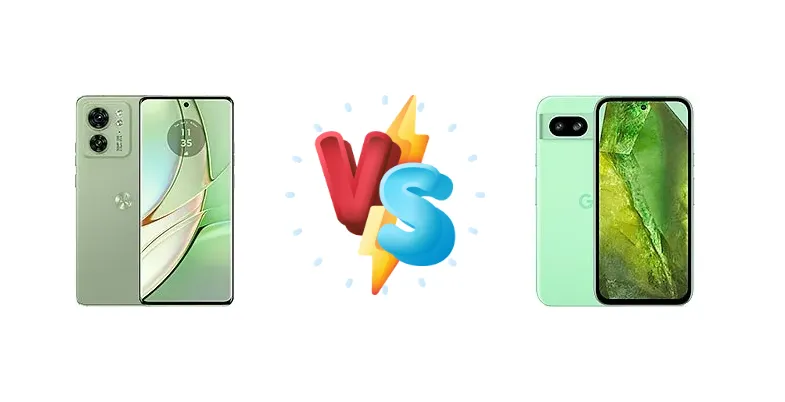
|
🏆 Quick Verdict
For most users, the Google Pixel 8a emerges as the stronger choice. Its superior camera capabilities, powered by the Tensor G3, and guaranteed software support outweigh the Motorola Edge 40’s faster charging and slightly brighter display. However, the Edge 40 remains a viable option for those prioritizing design and wireless charging.
| PHONES | ||
|---|---|---|
| Phone Names | Motorola Edge 40 | Google Pixel 8a |
| Network | ||
|---|---|---|
| 2G bands | GSM 850 / 900 / 1800 / 1900 | GSM 850 / 900 / 1800 / 1900 |
| 3G bands | HSDPA 850 / 900 / 1700(AWS) / 1900 / 2100 | HSDPA 800 / 850 / 900 / 1700(AWS) / 1900 / 2100 |
| 4G bands | 1, 2, 3, 4, 5, 7, 8, 12, 13, 17, 20, 26, 28, 32, 38, 39, 40, 41, 42, 43, 66 | 1, 2, 3, 4, 5, 7, 8, 12, 17, 18, 19, 20, 26, 28, 32, 38, 40, 41, 42, 66 - G6GPR (International) |
| 5G bands | 1, 2, 3, 5, 7, 8, 20, 28, 38, 40, 41, 66, 77, 78 SA/NSA/Sub6 | 1, 2, 3, 5, 7, 8, 12, 20, 26, 28, 38, 40, 41, 66, 75, 76, 77, 78 SA/NSA/Sub6 - G6GPR (International) |
| Speed | HSPA, LTE, 5G | HSPA, LTE, 5G |
| Technology | GSM / HSPA / LTE / 5G | GSM / HSPA / LTE / 5G |
| Launch | ||
|---|---|---|
| Announced | 2023, May 04 | 2024, May 07 |
| Status | Available. Released 2023, May 04 | Available. Released 2024, May 14 |
| Body | ||
|---|---|---|
| Build | Glass front, aluminum frame, plastic back or eco leather back | Glass front (Gorilla Glass 3), aluminum frame, plastic back |
| Dimensions | 158.4 x 72 x 7.6 mm (6.24 x 2.83 x 0.30 in) | 152.1 x 72.7 x 8.9 mm (5.99 x 2.86 x 0.35 in) |
| SIM | · Nano-SIM· Nano-SIM + eSIM· Nano-SIM + Nano-SIM | Nano-SIM + eSIM |
| Weight | 167 g or 171 g (5.89 oz) | 188 g (6.63 oz) |
| IP68 dust/water resistant (up to 1.5m for 30 min) | - | |
| Display | ||
|---|---|---|
| Protection | - | Corning Gorilla Glass 3, Mohs level 5 |
| Resolution | 1080 x 2400 pixels, 20:9 ratio (~402 ppi density) | 1080 x 2400 pixels, 20:9 ratio (~430 ppi density) |
| Size | 6.55 inches, 103.6 cm2 (~90.8% screen-to-body ratio) | 6.1 inches, 90.3 cm2 (~81.6% screen-to-body ratio) |
| Type | P-OLED, 144Hz, HDR10+, 1200 nits (peak) | OLED, HDR, 120Hz, 2000 nits (peak) |
| Platform | ||
|---|---|---|
| CPU | Octa-core (4x2.6 GHz Cortex-A78 & 4x2.0 GHz Cortex-A55) | Nona-core (1x3.0 GHz Cortex-X3 & 4x2.45 GHz Cortex-A715 & 4x2.15 GHz Cortex-A510) |
| Chipset | Mediatek Dimensity 8020 (6 nm) | Google Tensor G3 (4 nm) |
| GPU | Mali-G77 MC9 | Immortalis-G715s MC10 |
| OS | Android 13, up to 2 major Android upgrades | Android 14, upgradable to Android 16, up to 7 major Android upgrades |
| Memory | ||
|---|---|---|
| Card slot | No | No |
| Internal | 128GB 8GB RAM, 256GB 8GB RAM | 128GB 8GB RAM, 256GB 8GB RAM |
| UFS 3.1 | - | |
| Main Camera | ||
|---|---|---|
| Dual | 50 MP, f/1.4, (wide), 1/1.55", 1.0µm, multi-directional PDAF, OIS 13 MP, f/2.2, 120˚ (ultrawide), 1/3.0", 1.12µm, AF | 64 MP (16 MP eff.), f/1.9, 26mm (wide), 1/1.73", 0.8µm, dual pixel PDAF, OIS 13 MP, f/2.2, 120˚ (ultrawide), 1.12µm |
| Features | Dual-LED flash, HDR, panorama | Dual-LED flash, Pixel Shift, Ultra HDR, panorama, Best Take |
| Video | 4K@30fps, 1080p@30/60/120fps, 720p@960fps, HDR10, gyro-EIS | 4K@30/60fps, 1080p@30/60/120/240fps, OIS |
| Selfie camera | ||
|---|---|---|
| Features | HDR | HDR, panorama |
| Single | 32 MP, f/2.4, (wide), 1/3.0", 0.7µm | 13 MP, f/2.2, 20mm (ultrawide), 1.12µm |
| Video | 4K@30fps, 1080p@30/120fps | 4K@30fps, 1080p@30/60fps |
| Sound | ||
|---|---|---|
| 3.5mm jack | No | - |
| 35mm jack | No | No |
| Loudspeaker | Yes, with stereo speakers | Yes, with stereo speakers |
| Comms | ||
|---|---|---|
| Bluetooth | 5.2, A2DP, LE | 5.3, A2DP, LE |
| NFC | Yes | Yes |
| Positioning | GPS, GLONASS, GALILEO, BDS | GPS, GLONASS, GALILEO, BDS, QZSS, NavIC |
| Radio | No | No |
| USB | USB Type-C 2.0, OTG | USB Type-C 3.2 |
| WLAN | Wi-Fi 802.11 a/b/g/n/ac/6e, tri-band, Wi-Fi Direct | Wi-Fi 802.11 a/b/g/n/ac/6e, dual/tri-band (market/region dependent) |
| Features | ||
|---|---|---|
| Sensors | Fingerprint (under display, optical), accelerometer, gyro, proximity, compass | Fingerprint (under display, optical), accelerometer, gyro, proximity, compass, barometer |
| Moto Ready For support | - | |
| Battery | ||
|---|---|---|
| Charging | 68W wired 15W wireless | 18W wired, PD3.0 7.5W wireless Bypass charging |
| Type | Li-Po 4400 mAh | Li-Po 4492 mAh |
| Misc | ||
|---|---|---|
| Colors | Nebula Green, Lunar Blue, Eclipse Black, Viva Magenta | Obsidian, Porcelain, Bay, Aloe |
| Models | XT2303-2 | GKV4X, G6GPR, G8HHN, G576D |
| Price | € 202.03 / $ 419.99 / £ 199.00 / ₹ 29,999 | $ 229.98 / C$ 417.99 / £ 279.00 / € 299.99 / ₹ 33,300 |
| Tests | ||
|---|---|---|
| Battery life | Endurance rating 98h | - |
| Camera | Photo / Video | - |
| Display | Contrast ratio: Infinite (nominal) | - |
| Loudspeaker | -24.2 LUFS (Very good) | - |
| Performance | AnTuTu: 688347 (v9) GeekBench: 3320 (v5.1), 3603 (v6) GFXBench: 33fps (ES 3.1 onscreen) | - |
| EU LABEL | ||
|---|---|---|
| Battery | - | 40:06h endurance, 1000 cycles |
| Energy | - | Class B |
| Free fall | - | Class A (270 falls) |
| Repairability | - | Class B |
Motorola Edge 40
- Faster charging with 68W wired and 15W wireless
- Sleek and lightweight design
- Generally brighter display for outdoor use
- Less advanced chipset compared to Tensor G3
- Inferior camera performance compared to Pixel 8a
Google Pixel 8a
- Superior camera performance with Google’s computational photography
- More efficient Tensor G3 chipset
- Guaranteed software updates and long-term support
- Slower 18W charging
- Potentially less vibrant display in some lighting conditions
Display Comparison
The Pixel 8a boasts a significantly brighter display, reaching 1508 nits compared to the Edge 40’s 1043 nits. This translates to better visibility under direct sunlight. While the Edge 40 claims an 'infinite' contrast ratio, this is a nominal value; the Pixel 8a’s OLED panel will likely deliver comparable real-world contrast. Both devices utilize OLED technology, but the Pixel 8a’s higher peak brightness is a clear advantage for outdoor users. We lack PWM frequency data for both, but the Pixel series generally prioritizes flicker-free displays, potentially benefiting users sensitive to screen flicker.
Camera Comparison
The Pixel 8a is the clear winner in the camera department. While both phones offer photo and video capabilities, the Pixel 8a leverages Google’s renowned computational photography algorithms and the Tensor G3’s image signal processor. Although sensor sizes aren't specified, the Pixel’s image processing consistently delivers superior dynamic range, detail, and low-light performance. The Edge 40’s camera system is likely competent, but it lacks the software optimization that defines the Pixel experience. Ignoring the likely low-resolution macro lenses on both devices, the Pixel 8a’s overall image quality will be noticeably better.
Performance
The chipset battle pits the Mediatek Dimensity 8020 in the Edge 40 against Google’s Tensor G3 in the Pixel 8a. The Tensor G3, built on a 4nm process, offers a more efficient architecture than the 6nm Dimensity 8020. The Pixel 8a’s nona-core CPU configuration, featuring a Cortex-X3 prime core, provides a performance edge in demanding tasks and AI-driven features. While the Edge 40’s octa-core CPU is capable, the Tensor G3’s integrated machine learning capabilities give the Pixel 8a a distinct advantage in areas like image processing and voice recognition. The Pixel 8a’s RAM configuration (assumed LPDDR5x based on the segment) will also contribute to smoother multitasking.
Battery Life
The Motorola Edge 40 has an endurance rating of 98 hours, while the Pixel 8a scores 83 hours. However, this doesn’t tell the whole story. The Pixel 8a provides 11:25 hours of active use, while the Edge 40’s data is less granular. The Edge 40 supports 68W wired charging, significantly faster than the Pixel 8a’s 18W charging. This means the Edge 40 can replenish its battery much quicker. However, the Pixel 8a offers bypass charging, allowing it to be used while charging, minimizing heat buildup. The Pixel 8a also boasts 1000 charge cycles, suggesting greater long-term battery health.
Buying Guide
Buy the Motorola Edge 40 if you prioritize a sleek, lightweight design, fast 68W wired and 15W wireless charging, and a generally brighter display for outdoor visibility. Buy the Google Pixel 8a if you value exceptional camera performance, especially in low light, a clean and consistently updated Android experience, and long-term software support.