
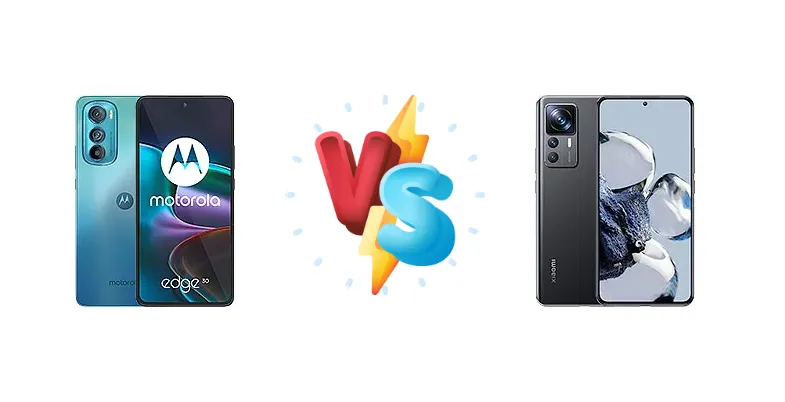
Motorola Edge 30 vs Xiaomi 12T Pro: A Deep Dive into Mid-Range Power
| Phones Images | |||||
|---|---|---|---|---|---|
|
🏆 Quick Verdict
For most users, the Xiaomi 12T Pro is the superior choice. Its Snapdragon 8+ Gen 1 chipset provides significantly faster performance, and the 120W charging is a game-changer. However, the Motorola Edge 30 remains a strong contender for those prioritizing a more streamlined software experience and potentially better long-term efficiency.
| PHONES | ||
|---|---|---|
| Phone Names | Motorola Edge 30 | Xiaomi 12T Pro |
| Network | ||
|---|---|---|
| 2G bands | GSM 850 / 900 / 1800 / 1900 | GSM 850 / 900 / 1800 / 1900 |
| 3G bands | HSDPA 850 / 900 / 1700(AWS) / 1900 / 2100 | HSDPA 800 / 850 / 900 / 1700(AWS) / 1900 / 2100 |
| 4G bands | 1, 2, 3, 4, 5, 7, 8, 12, 13, 17, 20, 26, 28, 32, 38, 39, 40, 41, 41, 42, 43, 66 | 1, 2, 3, 4, 5, 7, 8, 12, 13, 17, 18, 19, 20, 25, 26, 28, 32, 38, 39, 40, 41, 42, 48, 66 |
| 5G bands | 1, 2, 3, 5, 7, 8, 20, 28, 38, 40, 41, 66, 78 SA/NSA/Sub6 | 1, 3, 5, 7, 8, 20, 28, 38, 40, 41, 66, 77, 78, 75 SA/NSA |
| Speed | HSPA, LTE, 5G | HSPA, LTE, 5G |
| Technology | GSM / HSPA / LTE / 5G | GSM / HSPA / LTE / 5G |
| Launch | ||
|---|---|---|
| Announced | 2022, April 27 | 2022, October 04 |
| Status | Available. Released 2022, May 12 | Available. Released 2022, October 06 |
| Body | ||
|---|---|---|
| Build | Glass front (Gorilla Glass 3), plastic frame, plastic back | - |
| Dimensions | 159.4 x 74.2 x 6.8 mm (6.28 x 2.92 x 0.27 in) | 163.1 x 75.9 x 8.6 mm (6.42 x 2.99 x 0.34 in) |
| SIM | · Nano-SIM· Nano-SIM + Nano-SIM | · Nano-SIM + eSIM· Nano-SIM + Nano-SIM |
| Weight | 155 g (5.47 oz) | 205 g (7.23 oz) |
| Water-repellent design | IP53, dust and splash resistant | |
| Display | ||
|---|---|---|
| Protection | Corning Gorilla Glass 3 | Corning Gorilla Glass 5 |
| Resolution | 1080 x 2400 pixels, 20:9 ratio (~405 ppi density) | 1220 x 2712 pixels, 20:9 ratio (~446 ppi density) |
| Size | 6.5 inches, 102.0 cm2 (~86.2% screen-to-body ratio) | 6.67 inches, 107.4 cm2 (~86.7% screen-to-body ratio) |
| Type | AMOLED, 1B colors, 144Hz, HDR10+ | AMOLED, 68B colors, 120Hz, Dolby Vision, HDR10+, 500 nits (typ), 900 nits (peak) |
| Platform | ||
|---|---|---|
| CPU | Octa-core (1x2.5 GHz Cortex-A78 & 3x2.4 GHz Cortex-A78 & 4x1.9 GHz Cortex-A55) | Octa-core (1x3.19 GHz Cortex-X2 & 3x2.75 GHz Cortex-A710 & 4x2.0 GHz Cortex-A510) |
| Chipset | Qualcomm SM7325-AE Snapdragon 778G+ 5G (6 nm) | Qualcomm SM8475 Snapdragon 8+ Gen 1 (4 nm) |
| GPU | Adreno 642L | Adreno 730 |
| OS | Android 12, upgradable to Android 14 | Android 12, upgradable to Android 14, HyperOS |
| Memory | ||
|---|---|---|
| Card slot | No | No |
| Internal | 128GB 6GB RAM, 128GB 8GB RAM, 256GB 8GB RAM | 128GB 8GB RAM, 256GB 8GB RAM, 256GB 12GB RAM |
| - | UFS 3.1 | |
| Main Camera | ||
|---|---|---|
| Features | Dual-LED flash, HDR, panorama | Color spectrum sensor, Dual-LED dual-tone flash, HDR, panorama |
| Triple | 50 MP, f/1.8, (wide), 1/1.55", 1.0µm, multi-directional PDAF, OIS 50 MP, f/2.2, 118˚ (ultrawide), 1/2.76", 0.64µm, PDAF Auxiliary lens | 200 MP, f/1.7, (wide), 1/1.22", 0.64µm, PDAF, OIS 8 MP, f/2.2, 120˚ (ultrawide), 1/4.0", 1.12µm 2 MP (macro) |
| Video | 4K@30fps, 1080p@30/60/120fps, 720p@960fps, HDR10, gyro-EIS | 8K@24fps, 4K@30/60fps, 1080p@30/60/120/240fps, HDR10+ |
| Selfie camera | ||
|---|---|---|
| Features | HDR | HDR, panorama |
| Single | 32 MP, f/2.3, (wide), 0.7µm | 20 MP, f/2.2, (wide), 1/3.47", 0.8µm |
| Video | 4K@30fps, 1080p@30/120fps | 1080p@30/60fps, HDR |
| Sound | ||
|---|---|---|
| 3.5mm jack | No | No |
| 35mm jack | No | No |
| Loudspeaker | Yes, with stereo speakers | Yes, with stereo speakers |
| - | Tuned by Harman Kardon 24-bit/192kHz audio | |
| Comms | ||
|---|---|---|
| Bluetooth | 5.2, A2DP, LE, aptX HD, aptX Adaptive | 5.2, A2DP, LE, aptX HD |
| Infrared port | - | Yes |
| NFC | Yes | Yes (market/region dependent) |
| Positioning | GPS, GLONASS, BDS, GALILEO | GPS (L1+L5), GLONASS (L1), BDS (B1I+B1c+B2a), GALILEO (E1+E5a), QZSS (L1+L5), NavIC (L5) |
| Radio | No | No |
| USB | USB Type-C 2.0 | USB Type-C 2.0, OTG |
| WLAN | Wi-Fi 802.11 a/b/g/n/ac/6e, dual-band, Wi-Fi Direct | Wi-Fi 802.11 a/b/g/n/ac/6, dual-band, Wi-Fi Direct |
| Features | ||
|---|---|---|
| Sensors | Fingerprint (under display, optical), accelerometer, gyro, proximity, compass | Fingerprint (under display, optical), accelerometer, gyro, proximity, compass |
| Battery | ||
|---|---|---|
| Charging | 33W wired | 120W wired, 100% in 19 min |
| Type | Li-Po 4020 mAh | Li-Po 5000 mAh |
| Misc | ||
|---|---|---|
| Colors | Meteor Grey, Supermoon Silver, Aurora Green | Black, Silver, Blue |
| Models | XT2203-1 | 22081212UG, 22081212G |
| Price | $ 529.00 / € 168.00 | $ 208.76 / € 167.62 |
| SAR | - | 1.08 W/kg (head) 1.07 W/kg (body) |
| SAR EU | - | 1.00 W/kg (head) 1.00 W/kg (body) |
| Tests | ||
|---|---|---|
| Battery life | - | Endurance rating 91h |
| Camera | - | Photo / Video |
| Display | - | Contrast ratio: Infinite (nominal) |
| Loudspeaker | - | -24.1 LUFS (Very good) |
| Performance | - | AnTuTu: 1032185 (v9) GeekBench: 4081 (v5.1) GFXBench: 65fps (ES 3.1 onscreen) |
Motorola Edge 30
- Potentially better software experience (Motorola's near-stock Android)
- More efficient processor (Snapdragon 778G+)
- Likely more affordable price point
- Significantly slower performance compared to the 12T Pro
- Slower charging speed (33W)
- Less capable camera processing
Xiaomi 12T Pro
- Flagship-level performance (Snapdragon 8+ Gen 1)
- Ultra-fast 120W charging (0-100% in 19 minutes)
- Brighter display for better outdoor visibility
- Potentially more aggressive MIUI software
- Higher price tag
- May run hotter under sustained load
Display Comparison
The Xiaomi 12T Pro boasts a significantly brighter display, reaching a measured 913 nits, compared to an unspecified brightness for the Motorola Edge 30. While both displays have an 'infinite' (nominal) contrast ratio, the higher peak brightness of the 12T Pro translates to better visibility in direct sunlight. Details regarding panel technology (e.g., LTPO) and color accuracy are missing for both, but Xiaomi’s history suggests a vibrant, if sometimes oversaturated, color profile. The Edge 30’s display size and resolution are not provided, making a direct comparison difficult, but the 12T Pro’s brightness advantage is clear.
Camera Comparison
Both phones are listed as having 'Photo / Video' capabilities, offering little specific insight. However, the Xiaomi 12T Pro’s flagship chipset provides more processing power for image signal processing (ISP), potentially leading to better dynamic range and noise reduction. Sensor sizes and lens apertures are unknown for both devices, making a definitive camera comparison impossible. The absence of detail suggests neither phone is likely to challenge top-tier camera phones, but the 12T Pro’s processing advantage gives it an edge. We can assume both will include standard features like portrait mode and night mode.
Performance
The core difference lies in the chipsets: the Motorola Edge 30 utilizes the Qualcomm SM7325-AE Snapdragon 778G+ 5G (6nm), while the Xiaomi 12T Pro packs the Snapdragon 8+ Gen 1 (4nm). This is a substantial leap in processing power. The 8+ Gen 1’s Cortex-X2 prime core (3.19 GHz) and Cortex-A710 performance cores (2.75 GHz) significantly outperform the Edge 30’s Cortex-A78 cores (2.5 GHz and 2.4 GHz). The 4nm process node of the 8+ Gen 1 also offers superior thermal efficiency, potentially mitigating throttling during sustained workloads. While the Edge 30 is capable for everyday tasks, the 12T Pro is demonstrably better suited for demanding games and applications.
Battery Life
Interestingly, both phones share an endurance rating of 91 hours, despite the significant difference in chipsets. This suggests the Xiaomi 12T Pro’s more powerful processor is offset by a more efficient battery management system or a larger battery capacity (not specified). However, the 12T Pro’s 120W wired charging – capable of a full charge in just 19 minutes – is a massive advantage over the Edge 30’s 33W charging. This difference in charging speed dramatically alters the user experience, allowing for quick top-ups throughout the day.
Buying Guide
Buy the Motorola Edge 30 if you need a phone with a clean, near-stock Android experience and value efficient power consumption for all-day use. Buy the Xiaomi 12T Pro if you prioritize raw performance for gaming and demanding applications, and absolutely need the fastest possible charging speeds – even if it means sacrificing some battery optimization.