
Motorola Edge 30 vs Samsung Galaxy S22 5G: Which Android Flagship Wins?
| Phones Images | |||||
|---|---|---|---|---|---|
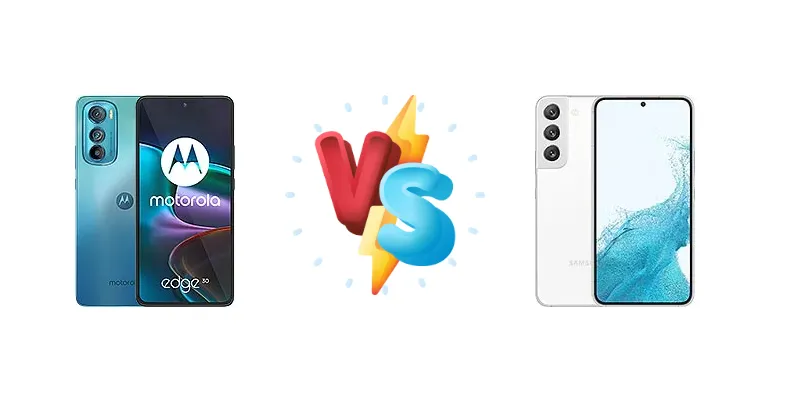
|
🏆 Quick Verdict
For most users, the Motorola Edge 30 offers a more consistently smooth experience and better value. While the Galaxy S22’s peak performance is higher, the potential for thermal throttling with the Exynos variant and its higher price tag make the Edge 30 the more sensible choice for everyday use.
| PHONES | ||
|---|---|---|
| Phone Names | Motorola Edge 30 | Samsung Galaxy S22 5G |
| Network | ||
|---|---|---|
| 2G bands | GSM 850 / 900 / 1800 / 1900 | GSM 850 / 900 / 1800 / 1900 |
| 3G bands | HSDPA 850 / 900 / 1700(AWS) / 1900 / 2100 | HSDPA 850 / 900 / 1700(AWS) / 1900 / 2100 |
| 4G bands | 1, 2, 3, 4, 5, 7, 8, 12, 13, 17, 20, 26, 28, 32, 38, 39, 40, 41, 41, 42, 43, 66 | 1, 2, 3, 4, 5, 7, 8, 12, 13, 17, 18, 19, 20, 25, 26, 28, 32, 38, 39, 40, 41, 66 - International |
| 5G bands | 1, 2, 3, 5, 7, 8, 20, 28, 38, 40, 41, 66, 78 SA/NSA/Sub6 | 1, 2, 3, 5, 7, 8, 12, 20, 25, 28, 38, 40, 41, 66, 75, 77, 78 SA/NSA/Sub6 - International |
| Speed | HSPA, LTE, 5G | HSPA 42.2/5.76 Mbps, LTE (7CA) Cat20 2000/200 Mbps, 5G (5+ Gbps DL) |
| Technology | GSM / HSPA / LTE / 5G | GSM / CDMA / HSPA / EVDO / LTE / 5G |
| - | 1, 3, 5, 7, 8, 20, 28, 38, 41, 66, 71, 260, 261 SA/NSA/Sub6/mmWave - USA | |
| Launch | ||
|---|---|---|
| Announced | 2022, April 27 | 2022, February 09 |
| Status | Available. Released 2022, May 12 | Available. Released 2022, February 25 |
| Body | ||
|---|---|---|
| Build | Glass front (Gorilla Glass 3), plastic frame, plastic back | Glass front (Gorilla Glass Victus+), glass back (Gorilla Glass Victus+), aluminum frame |
| Dimensions | 159.4 x 74.2 x 6.8 mm (6.28 x 2.92 x 0.27 in) | 146 x 70.6 x 7.6 mm (5.75 x 2.78 x 0.30 in) |
| SIM | · Nano-SIM· Nano-SIM + Nano-SIM | Nano-SIM + eSIM· Nano-SIM + Nano-SIM + eSIM (max 2 at a time) |
| Weight | 155 g (5.47 oz) | 167 g / 168 g (mmWave) (5.89 oz) |
| Water-repellent design | IP68 dust/water resistant (up to 1.5m for 30 min) Armor aluminum frame with tougher drop and scratch resistance (advertised) | |
| Display | ||
|---|---|---|
| Protection | Corning Gorilla Glass 3 | Corning Gorilla Glass Victus+ |
| Resolution | 1080 x 2400 pixels, 20:9 ratio (~405 ppi density) | 1080 x 2340 pixels, 19.5:9 ratio (~425 ppi density) |
| Size | 6.5 inches, 102.0 cm2 (~86.2% screen-to-body ratio) | 6.1 inches, 90.1 cm2 (~87.4% screen-to-body ratio) |
| Type | AMOLED, 1B colors, 144Hz, HDR10+ | Dynamic AMOLED 2X, 120Hz, HDR10+, 1300 nits (peak) |
| - | Always-on display | |
| Platform | ||
|---|---|---|
| CPU | Octa-core (1x2.5 GHz Cortex-A78 & 3x2.4 GHz Cortex-A78 & 4x1.9 GHz Cortex-A55) | Octa-core (1x2.8 GHz Cortex-X2 & 3x2.50 GHz Cortex-A710 & 4x1.8 GHz Cortex-A510) - EuropeOcta-core (1x3.00 GHz Cortex-X2 & 3x2.50 GHz Cortex-A710 & 4x1.80 GHz Cortex-A510) - ROW |
| Chipset | Qualcomm SM7325-AE Snapdragon 778G+ 5G (6 nm) | Exynos 2200 (4 nm) - EuropeQualcomm SM8450 Snapdragon 8 Gen 1 (4 nm) - ROW |
| GPU | Adreno 642L | Xclipse 920 - EuropeAdreno 730 - ROW |
| OS | Android 12, upgradable to Android 14 | Android 12, up to 4 major Android upgrades, One UI 8 |
| Memory | ||
|---|---|---|
| Card slot | No | No |
| Internal | 128GB 6GB RAM, 128GB 8GB RAM, 256GB 8GB RAM | 128GB 8GB RAM, 256GB 8GB RAM |
| - | UFS 3.1 | |
| Main Camera | ||
|---|---|---|
| Features | Dual-LED flash, HDR, panorama | LED flash, auto-HDR, panorama |
| Single | - | 10 MP, f/2.2, 26mm (wide), 1/3.24", 1.22µm, Dual Pixel PDAF |
| Triple | 50 MP, f/1.8, (wide), 1/1.55", 1.0µm, multi-directional PDAF, OIS 50 MP, f/2.2, 118˚ (ultrawide), 1/2.76", 0.64µm, PDAF Auxiliary lens | 50 MP, f/1.8, 23mm (wide), 1/1.56", 1.0µm, dual pixel PDAF, OIS 10 MP, f/2.4, 70mm (telephoto), 1/3.94", 1.0µm, PDAF, OIS, 3x optical zoom 12 MP, f/2.2, 13mm, 120˚ (ultrawide), 1/2.55" 1.4µm, Super Steady video |
| Video | 4K@30fps, 1080p@30/60/120fps, 720p@960fps, HDR10, gyro-EIS | 8K@24fps, 4K@30/60fps, 1080p@30/60/120/240fps, HDR10+, stereo sound rec., gyro-EIS |
| Selfie camera | ||
|---|---|---|
| Features | HDR | HDR |
| Single | 32 MP, f/2.3, (wide), 0.7µm | 10 MP, f/2.2, 26mm (wide), 1/3.24", 1.22µm, dual pixel PDAF |
| Video | 4K@30fps, 1080p@30/120fps | 4K@30/60fps, 1080p@30fps |
| Sound | ||
|---|---|---|
| 3.5mm jack | No | No |
| 35mm jack | No | No |
| Loudspeaker | Yes, with stereo speakers | Yes, with stereo speakers |
| - | 32-bit/384kHz audio Tuned by AKG | |
| Comms | ||
|---|---|---|
| Bluetooth | 5.2, A2DP, LE, aptX HD, aptX Adaptive | 5.2, A2DP, LE |
| NFC | Yes | Yes |
| Positioning | GPS, GLONASS, BDS, GALILEO | GPS, GLONASS, BDS, GALILEO |
| Radio | No | No |
| USB | USB Type-C 2.0 | USB Type-C 3.2, OTG |
| WLAN | Wi-Fi 802.11 a/b/g/n/ac/6e, dual-band, Wi-Fi Direct | Wi-Fi 802.11 a/b/g/n/ac/6, dual-band, Wi-Fi Direct |
| Features | ||
|---|---|---|
| Sensors | Fingerprint (under display, optical), accelerometer, gyro, proximity, compass | Fingerprint (under display, ultrasonic), accelerometer, gyro, proximity, compass, barometer |
| - | Samsung DeX, Samsung Wireless DeX (desktop experience support) Bixby natural language commands and dictation Samsung Pay (Visa, MasterCard certified) | |
| Battery | ||
|---|---|---|
| Charging | 33W wired | 25W wired, PD3.0 15W wireless (Qi) 4.5W reverse wireless |
| Type | Li-Po 4020 mAh | Li-Ion 3700 mAh |
| Misc | ||
|---|---|---|
| Colors | Meteor Grey, Supermoon Silver, Aurora Green | Phantom Black, White, Pink Gold, Green, Graphite, Sky Blue, Violet, Cream, Bora Purple |
| Models | XT2203-1 | SM-S901B, SM-S901B/DS, SM-S901U, SM-S901U1, SM-S901W, SM-S901N, SM-S9010, SM-S901E, SM-S901E/DS |
| Price | $ 529.00 / € 168.00 | $ 172.63 / C$ 304.00 / £ 186.11 / € 198.01 |
| SAR | - | 1.03 W/kg (head) 1.15 W/kg (body) |
| SAR EU | - | 1.21 W/kg (head) 1.59 W/kg (body) |
| Tests | ||
|---|---|---|
| Battery life | - | Endurance rating 85h |
| Camera | - | Photo / Video |
| Display | - | Contrast ratio: Infinite (nominal) |
| Loudspeaker | - | -26.4 LUFS (Good) |
| Performance | - | AnTuTu: 745496 (v8), 881428 (v9) GeekBench: 3682 (v5.1) GFXBench: 69fps (ES 3.1 onscreen) |
Motorola Edge 30
- More efficient Snapdragon 778G+ chipset
- Potentially better value for money
- 33W fast charging
- Less powerful processor than the S22
- Display likely not as bright as the S22
Samsung Galaxy S22 5G
- Brighter and sharper display
- More powerful processor (Snapdragon 8 Gen 1 variant)
- Wireless and reverse wireless charging
- Exynos 2200 prone to thermal throttling
- Higher price point
- Potentially shorter battery life with heavy use
Display Comparison
The Samsung Galaxy S22 boasts a significantly brighter display, reaching a measured 982 nits, compared to an unspecified peak brightness for the Edge 30. This makes the S22 more usable in direct sunlight. Both displays feature an 'infinite' (nominal) contrast ratio, typical of OLED panels. However, the S22’s smaller 6.1-inch size contributes to a higher pixel density, resulting in a sharper image. While the Edge 30’s display quality is likely good, Samsung’s display technology and brightness advantage are notable.
Camera Comparison
Both phones offer capable camera systems, but details are limited. The Galaxy S22’s camera is likely to excel in image processing and low-light performance, leveraging Samsung’s established camera expertise. The Edge 30’s camera performance is less well-defined. Without sensor size details, it’s difficult to make a direct comparison. The presence of a 2MP macro camera on the Edge 30 is unlikely to significantly impact image quality, serving primarily as a marketing feature. The S22’s OIS (Optical Image Stabilization) is likely more advanced, contributing to sharper photos and smoother videos.
Performance
The core difference lies in the chipsets. The Galaxy S22’s Exynos 2200 (Europe) or Snapdragon 8 Gen 1 (ROW) are built on a 4nm process, offering higher peak performance than the Motorola Edge 30’s 6nm Snapdragon 778G+. The S22’s CPU configuration, with a Cortex-X2 prime core clocked up to 3.0 GHz (ROW), provides a substantial advantage in single-core tasks. However, the Snapdragon 778G+ is a highly efficient chip, and its octa-core configuration (1x2.5 GHz Cortex-A78, 3x2.4 GHz Cortex-A78, 4x1.9 GHz Cortex-A55) delivers excellent performance for the price. Critically, the Exynos 2200 is known to suffer from thermal throttling under sustained load, potentially negating its performance advantage, while the 778G+ remains more consistent. The S22 likely uses faster LPDDR5 RAM, while the Edge 30's RAM speed is unspecified, but likely LPDDR4X.
Battery Life
The Galaxy S22 has an endurance rating of 85 hours, suggesting reasonable battery life. However, the Exynos 2200’s power consumption can significantly impact real-world usage. The Edge 30’s battery capacity is unspecified, but its more efficient Snapdragon 778G+ and 33W wired charging offer a compelling combination. The S22 supports 25W wired charging, 15W wireless charging (Qi), and 4.5W reverse wireless charging, providing more versatility. While the S22’s endurance rating is the same, the Edge 30’s efficiency could translate to longer screen-on time for typical users.
Buying Guide
Buy the Motorola Edge 30 if you prioritize consistent performance, efficient power usage, and a more affordable price point. It’s ideal for users who enjoy mobile gaming but don’t demand the absolute highest frame rates, and those who value a balanced smartphone experience. Buy the Samsung Galaxy S22 5G if you absolutely need the fastest possible processing power (especially the Snapdragon 8 Gen 1 variant) and are willing to accept potential thermal limitations and a higher cost. It caters to power users who frequently engage in demanding tasks like video editing or high-end gaming.