
Motorola Edge 30 vs. Nothing Phone (1): A Detailed Comparison
| Phones Images | |||||
|---|---|---|---|---|---|
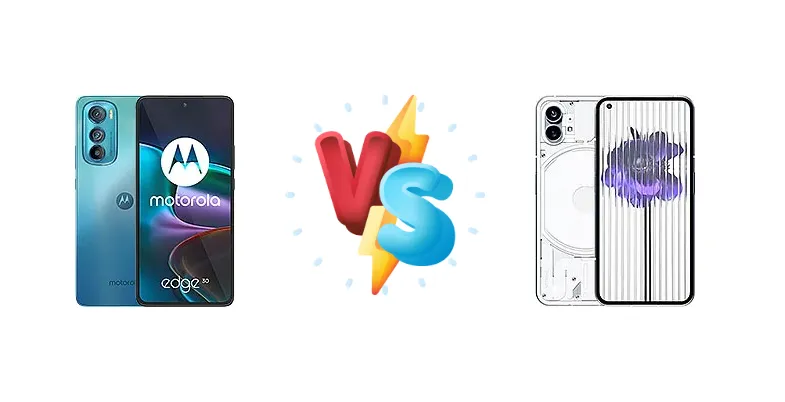
|
🏆 Quick Verdict
For the average user prioritizing battery life and versatile charging options, the Nothing Phone (1) emerges as the better choice. Its 15W wireless charging and 5W reverse wireless capabilities, coupled with a slightly better endurance rating, provide added convenience. However, the Motorola Edge 30 remains a strong contender for those seeking a more traditional smartphone experience.
| PHONES | ||
|---|---|---|
| Phone Names | Motorola Edge 30 | Nothing Phone (1) |
| Network | ||
|---|---|---|
| 2G bands | GSM 850 / 900 / 1800 / 1900 | GSM 850 / 900 / 1800 / 1900 |
| 3G bands | HSDPA 850 / 900 / 1700(AWS) / 1900 / 2100 | HSDPA 800 / 850 / 900 / 1700(AWS) / 1900 / 2100 |
| 4G bands | 1, 2, 3, 4, 5, 7, 8, 12, 13, 17, 20, 26, 28, 32, 38, 39, 40, 41, 41, 42, 43, 66 | 1, 2, 3, 4, 5, 7, 8, 12, 17, 18, 19, 20, 26, 28, 32, 34, 38, 39, 40, 41, 66 |
| 5G bands | 1, 2, 3, 5, 7, 8, 20, 28, 38, 40, 41, 66, 78 SA/NSA/Sub6 | 1, 3, 5, 7, 8, 20, 28, 38, 40, 41, 77, 78 SA/NSA |
| Speed | HSPA, LTE, 5G | HSPA, LTE, 5G |
| Technology | GSM / HSPA / LTE / 5G | GSM / HSPA / LTE / 5G |
| Launch | ||
|---|---|---|
| Announced | 2022, April 27 | 2022, July 12 |
| Status | Available. Released 2022, May 12 | Available. Released 2022, July 16 |
| Body | ||
|---|---|---|
| Build | Glass front (Gorilla Glass 3), plastic frame, plastic back | Glass front (Gorilla Glass 5), glass back (Gorilla Glass 5), aluminum frame |
| Dimensions | 159.4 x 74.2 x 6.8 mm (6.28 x 2.92 x 0.27 in) | 159.2 x 75.8 x 8.3 mm (6.27 x 2.98 x 0.33 in) |
| SIM | · Nano-SIM· Nano-SIM + Nano-SIM | Nano-SIM + Nano-SIM |
| Weight | 155 g (5.47 oz) | 193.5 g (6.84 oz) |
| Water-repellent design | - | |
| Display | ||
|---|---|---|
| Protection | Corning Gorilla Glass 3 | Corning Gorilla Glass 5 |
| Resolution | 1080 x 2400 pixels, 20:9 ratio (~405 ppi density) | 1080 x 2400 pixels, 20:9 ratio (~402 ppi density) |
| Size | 6.5 inches, 102.0 cm2 (~86.2% screen-to-body ratio) | 6.55 inches, 103.6 cm2 (~85.8% screen-to-body ratio) |
| Type | AMOLED, 1B colors, 144Hz, HDR10+ | OLED, 1B colors, 120Hz, 1440Hz PWM, HDR10+, 500 nits (typ), 1200 nits (peak) |
| Platform | ||
|---|---|---|
| CPU | Octa-core (1x2.5 GHz Cortex-A78 & 3x2.4 GHz Cortex-A78 & 4x1.9 GHz Cortex-A55) | Octa-core (1x2.5 GHz Cortex-A78 & 3x2.4 GHz Cortex-A78 & 4x1.9 GHz Cortex-A55) |
| Chipset | Qualcomm SM7325-AE Snapdragon 778G+ 5G (6 nm) | Qualcomm SM7325-AE Snapdragon 778G+ 5G (6 nm) |
| GPU | Adreno 642L | Adreno 642L |
| OS | Android 12, upgradable to Android 14 | Android 12, upgradable to Android 15, up to 3 major Android upgrades, Nothing OS 3.0 |
| Memory | ||
|---|---|---|
| Card slot | No | No |
| Internal | 128GB 6GB RAM, 128GB 8GB RAM, 256GB 8GB RAM | 128GB 8GB RAM, 256GB 8GB RAM, 256GB 12GB RAM |
| Main Camera | ||
|---|---|---|
| Dual | - | 50 MP, f/1.9, 24mm (wide), 1/1.56", 1.0µm, PDAF, OIS 50 MP, f/2.2, 114˚ (ultrawide), 1/2.76", 0.64µm, AF |
| Features | Dual-LED flash, HDR, panorama | LED flash, panorama, HDR |
| Triple | 50 MP, f/1.8, (wide), 1/1.55", 1.0µm, multi-directional PDAF, OIS 50 MP, f/2.2, 118˚ (ultrawide), 1/2.76", 0.64µm, PDAF Auxiliary lens | - |
| Video | 4K@30fps, 1080p@30/60/120fps, 720p@960fps, HDR10, gyro-EIS | 4K@30fps, 1080p@30/60fps, gyro-EIS, live HDR |
| Selfie camera | ||
|---|---|---|
| Features | HDR | - |
| Single | 32 MP, f/2.3, (wide), 0.7µm | 16 MP, f/2.5, (wide), 1/3.1", 1.0µm |
| Video | 4K@30fps, 1080p@30/120fps | 1080p@30fps |
| Sound | ||
|---|---|---|
| 3.5mm jack | No | - |
| 35mm jack | No | No |
| Loudspeaker | Yes, with stereo speakers | Yes, with stereo speakers |
| Comms | ||
|---|---|---|
| Bluetooth | 5.2, A2DP, LE, aptX HD, aptX Adaptive | 5.2, A2DP, LE |
| NFC | Yes | Yes |
| Positioning | GPS, GLONASS, BDS, GALILEO | GPS (L1), GLONASS (L1), BDS (B1I+B1c), GALILEO (E1), QZSS (L1) |
| Radio | No | No |
| USB | USB Type-C 2.0 | USB Type-C 2.0, OTG |
| WLAN | Wi-Fi 802.11 a/b/g/n/ac/6e, dual-band, Wi-Fi Direct | Wi-Fi 802.11 a/b/g/n/ac/6, dual-band |
| Features | ||
|---|---|---|
| Sensors | Fingerprint (under display, optical), accelerometer, gyro, proximity, compass | Fingerprint (under display, optical), accelerometer, proximity, gyro, compass |
| Battery | ||
|---|---|---|
| Charging | 33W wired | 33W wired, PD3.0, QC4, 50% in 30 min, 100% in 70 min 15W wireless 5W reverse wireless |
| Type | Li-Po 4020 mAh | Li-Ion 4500 mAh (17.42 Wh) |
| Misc | ||
|---|---|---|
| Colors | Meteor Grey, Supermoon Silver, Aurora Green | White, Black |
| Models | XT2203-1 | A063 |
| Price | $ 529.00 / € 168.00 | $ 539.00 / £ 234.77 / € 249.95 / ₹ 17,990 |
| SAR | - | 1.29 W/kg (head) 1.09 W/kg (body) |
| SAR EU | - | 0.99 W/kg (head) 1.48 W/kg (body) |
Motorola Edge 30
- Clean Android experience
- Strong CPU performance (Snapdragon 778G+)
- Potentially more affordable
- Lacks wireless charging
- Battery endurance data unavailable
Nothing Phone (1)
- Unique Glyph Interface
- Wireless and reverse wireless charging
- Higher peak display brightness
- More polarizing design
- Potentially higher price
Display Comparison
Both phones utilize OLED panels, but the Nothing Phone (1) boasts a measured peak brightness of 663 nits, suggesting a more visible display in direct sunlight compared to the Motorola Edge 30 (brightness data unavailable). While both likely offer excellent color reproduction, the Nothing Phone (1)'s higher peak brightness provides a tangible advantage for outdoor usability. The absence of LTPO technology on either device means refresh rate adjustments aren't as dynamic as on flagship phones, potentially impacting battery life during variable usage.
Camera Comparison
Detailed camera analysis is hampered by limited context data. Both phones likely employ multi-camera systems, but the specifics are unknown. The Nothing Phone (1) emphasizes photo and video capabilities, suggesting a focus on image processing algorithms. Without sensor size or aperture information, it's difficult to definitively assess image quality. The presence of a 2MP macro camera on either device is likely a marketing feature with limited practical benefit, as image quality will be significantly lower than the main sensor. The quality of the primary sensor and image processing will be the key differentiators.
Performance
Both the Motorola Edge 30 and Nothing Phone (1) are powered by the Qualcomm SM7325-AE Snapdragon 778G+ 5G (6 nm) chipset, featuring an octa-core CPU configuration with 1x2.5 GHz Cortex-A78, 3x2.4 GHz Cortex-A78, and 4x1.9 GHz Cortex-A55 cores. This means CPU performance will be virtually identical. The real-world difference will likely come down to thermal management and sustained performance. While neither manufacturer details advanced cooling solutions, the Nothing Phone (1)'s larger chassis *could* offer slightly better heat dissipation, preventing throttling during extended gaming sessions. Both devices benefit from 5G connectivity, ensuring fast download and upload speeds.
Battery Life
The Nothing Phone (1) claims an endurance rating of 108 hours, indicating a longer-lasting battery life compared to the Motorola Edge 30 (endurance rating unavailable). Both support 33W wired charging, but the Nothing Phone (1) adds the convenience of 15W wireless charging and 5W reverse wireless charging. The Nothing Phone (1) can reach 50% charge in 30 minutes and 100% in 70 minutes, while the Motorola Edge 30's charging time is unspecified. The addition of wireless charging on the Nothing Phone (1) is a significant advantage for users who prefer cable-free charging.
Buying Guide
Buy the Motorola Edge 30 if you need a streamlined Android experience with a focus on core performance and a more understated aesthetic. It's ideal for users who don't prioritize wireless charging or unique design elements. Buy the Nothing Phone (1) if you prefer a distinctive, eye-catching design with the added benefits of wireless charging, reverse wireless charging, and the unique Glyph Interface for notifications – appealing to those who want a phone that stands out.