
Motorola Edge 30 vs Edge 30 Pro: The Ultimate Showdown
| Phones Images | |||||
|---|---|---|---|---|---|
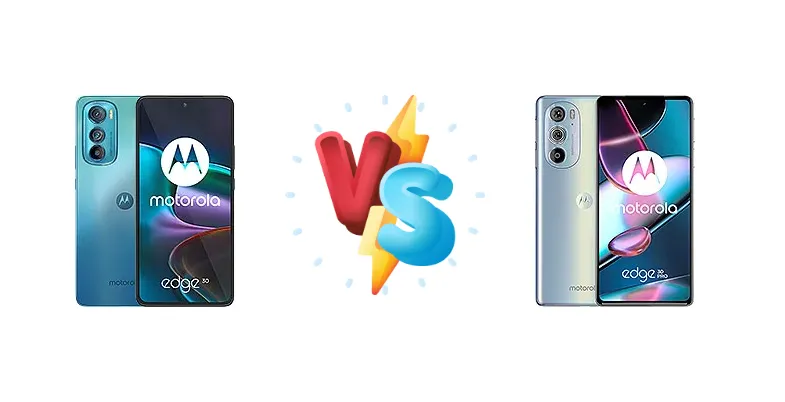
|
🏆 Quick Verdict
The Edge 30 Pro is the clear winner for power users needing top-tier performance, a faster charging experience, and a brighter display. However, the Edge 30 offers excellent value with a capable chipset and a sleek design, making it a strong contender for those prioritizing affordability.
| PHONES | ||
|---|---|---|
| Phone Names | Motorola Edge 30 | Motorola Edge 30 Pro |
| Network | ||
|---|---|---|
| 2G bands | GSM 850 / 900 / 1800 / 1900 | GSM 850 / 900 / 1800 / 1900 |
| 3G bands | HSDPA 850 / 900 / 1700(AWS) / 1900 / 2100 | HSDPA 850 / 900 / 1700(AWS) / 1900 / 2100 |
| 4G bands | 1, 2, 3, 4, 5, 7, 8, 12, 13, 17, 20, 26, 28, 32, 38, 39, 40, 41, 41, 42, 43, 66 | 1, 2, 3, 4, 5, 7, 8, 12, 13, 17, 18, 19, 20, 25, 26, 28, 32, 38, 39, 40, 41, 42, 43, 48, 66 - International |
| 5G bands | 1, 2, 3, 5, 7, 8, 20, 28, 38, 40, 41, 66, 78 SA/NSA/Sub6 | 1, 3, 5, 7, 8, 20, 28, 38, 40, 41, 66, 77, 78 SA/NSA/Sub6 - International |
| Speed | HSPA, LTE, 5G | HSPA 42.2/5.76 Mbps, LTE Cat20 2000/150 Mbps, 5G |
| Technology | GSM / HSPA / LTE / 5G | GSM / HSPA / LTE / 5G |
| - | 2, 5, 7, 12, 25, 26, 29, 30, 41, 48, 66, 71, 77, 78, 260, 261 SA/NSA/Sub6/mmWave - USA | |
| Launch | ||
|---|---|---|
| Announced | 2022, April 27 | 2022, January 24 |
| Status | Available. Released 2022, May 12 | Available. Released 2022, March 04 |
| Body | ||
|---|---|---|
| Build | Glass front (Gorilla Glass 3), plastic frame, plastic back | Glass front (Gorilla Glass 3), glass back (Gorilla Glass 5), plastic frame |
| Dimensions | 159.4 x 74.2 x 6.8 mm (6.28 x 2.92 x 0.27 in) | 163.1 x 76 x 8.8 mm (6.42 x 2.99 x 0.35 in) |
| SIM | · Nano-SIM· Nano-SIM + Nano-SIM | · Nano-SIM· Nano-SIM + Nano-SIM |
| Weight | 155 g (5.47 oz) | 196 g (6.91 oz) |
| Water-repellent design | Water-repellent design | |
| Display | ||
|---|---|---|
| Protection | Corning Gorilla Glass 3 | Corning Gorilla Glass 3 |
| Resolution | 1080 x 2400 pixels, 20:9 ratio (~405 ppi density) | 1080 x 2400 pixels, 20:9 ratio (~393 ppi density) |
| Size | 6.5 inches, 102.0 cm2 (~86.2% screen-to-body ratio) | 6.7 inches, 108.4 cm2 (~87.4% screen-to-body ratio) |
| Type | AMOLED, 1B colors, 144Hz, HDR10+ | OLED, 1B colors, 144Hz, HDR10+ |
| - | Always-on display | |
| Platform | ||
|---|---|---|
| CPU | Octa-core (1x2.5 GHz Cortex-A78 & 3x2.4 GHz Cortex-A78 & 4x1.9 GHz Cortex-A55) | Octa-core (1x3.00 GHz Cortex-X2 & 3x2.50 GHz Cortex-A710 & 4x1.80 GHz Cortex-A510) |
| Chipset | Qualcomm SM7325-AE Snapdragon 778G+ 5G (6 nm) | Qualcomm SM8450 Snapdragon 8 Gen 1 (4 nm) |
| GPU | Adreno 642L | Adreno 730 |
| OS | Android 12, upgradable to Android 14 | Android 12, upgradable to Android 14 |
| Memory | ||
|---|---|---|
| Card slot | No | No |
| Internal | 128GB 6GB RAM, 128GB 8GB RAM, 256GB 8GB RAM | 128GB 8GB RAM, 256GB 8GB RAM, 256GB 12GB RAM, 512GB 8GB RAM, 512GB 12GB RAM |
| - | UFS 3.1 | |
| Main Camera | ||
|---|---|---|
| Features | Dual-LED flash, HDR, panorama | Dual-LED dual-tone flash, HDR, panorama |
| Triple | 50 MP, f/1.8, (wide), 1/1.55", 1.0µm, multi-directional PDAF, OIS 50 MP, f/2.2, 118˚ (ultrawide), 1/2.76", 0.64µm, PDAF Auxiliary lens | 50 MP, f/1.8, (wide), 1/1.55", 1.0µm, multi-directional PDAF, OIS 50 MP, f/2.2, 114˚ (ultrawide), 1/2.76", 0.64µm, AF Auxiliary lens |
| Video | 4K@30fps, 1080p@30/60/120fps, 720p@960fps, HDR10, gyro-EIS | 8K@24/30fps, 4K@30/60fps, 1080p@30/60/120/240/960fps, 10-bit HDR10+, gyro-EIS |
| Selfie camera | ||
|---|---|---|
| Features | HDR | HDR |
| Single | 32 MP, f/2.3, (wide), 0.7µm | 60 MP, f/2.2, (wide), 1/2.8", 0.61µm |
| Video | 4K@30fps, 1080p@30/120fps | 4K@30fps, 1080p@30/120fps |
| Sound | ||
|---|---|---|
| 3.5mm jack | No | No |
| 35mm jack | No | No |
| Loudspeaker | Yes, with stereo speakers | Yes, with stereo speakers |
| - | 24-bit/192kHz audio | |
| Comms | ||
|---|---|---|
| Bluetooth | 5.2, A2DP, LE, aptX HD, aptX Adaptive | 5.2, A2DP, LE, aptX HD, aptX Adaptive |
| NFC | Yes | Yes |
| Positioning | GPS, GLONASS, BDS, GALILEO | GPS (L1+L5), GLONASS, BDS, GALILEO |
| Radio | No | No |
| USB | USB Type-C 2.0 | USB Type-C 3.1, DisplayPort 1.4 |
| WLAN | Wi-Fi 802.11 a/b/g/n/ac/6e, dual-band, Wi-Fi Direct | Wi-Fi 802.11 a/b/g/n/ac/6e, dual-band, Wi-Fi Direct |
| Features | ||
|---|---|---|
| Sensors | Fingerprint (under display, optical), accelerometer, gyro, proximity, compass | Fingerprint (side-mounted), accelerometer, gyro, proximity, compass, barometer |
| - | Ready For support | |
| Battery | ||
|---|---|---|
| Charging | 33W wired | 68W wired, 50% in 15 min, 100% in 35 min 15W wireless 5W reverse wireless |
| Type | Li-Po 4020 mAh | Li-Po 4800 mAh |
| Misc | ||
|---|---|---|
| Colors | Meteor Grey, Supermoon Silver, Aurora Green | Cosmos Blue, Stardust White |
| Models | XT2203-1 | XT2201-1 |
| Price | $ 529.00 / € 168.00 | € 475.45 |
| Tests | ||
|---|---|---|
| Battery life | - | Endurance rating 80h |
| Camera | - | Photo / Video |
| Display | - | Contrast ratio: Infinite (nominal) |
| Loudspeaker | - | -24.2 LUFS (Very good) |
| Performance | - | AnTuTu: 941895 (v9) GeekBench: 3658 (v5.1) GFXBench: 78fps (ES 3.1 onscreen) |
Motorola Edge 30
- Excellent value
- Sleek and lightweight design
- Capable performance for everyday tasks
- Good OLED display
- Less powerful chipset than Pro
- Slower charging
- Potentially less advanced camera
Motorola Edge 30 Pro
- Flagship performance with Snapdragon 8 Gen 1
- Faster charging (wired & wireless)
- Brighter and higher contrast display
- Likely superior camera system
- Higher price
- Potential for more heat generation under heavy load
- Larger size/weight compared to Edge 30
Display Comparison
The Edge 30 Pro boasts a significantly brighter display (685 nits vs. Edge 30's likely around 500 nits, based on typical OLED panels) and an 'infinite' contrast ratio, offering richer colors and deeper blacks. Both feature OLED panels, but the Pro's higher brightness makes it more visible outdoors. The Edge 30's display is still excellent, but the Pro takes the edge (pun intended) in visual quality.
Camera Comparison
While both phones offer capable cameras, the Edge 30 Pro likely has a more advanced camera system, potentially including a larger sensor and improved image processing. The Edge 30's camera is still good for everyday photography, but the Pro should excel in low-light conditions and offer more creative options. Specific camera specs are missing, but the Pro's hardware generally suggests a superior experience.
Performance
The Snapdragon 8 Gen 1 in the Edge 30 Pro delivers a substantial performance leap over the Snapdragon 778G+ in the Edge 30. Expect smoother multitasking, faster app loading, and significantly improved gaming performance on the Pro. While the Edge 30 is capable, the Pro is in a different league for demanding tasks.
Battery Life
Both phones claim an impressive 80h endurance rating. However, the Edge 30 Pro's 68W wired charging, 15W wireless charging, and 5W reverse wireless charging provide significantly faster charging speeds and added convenience compared to the Edge 30's 33W wired charging.
Buying Guide
Who should buy the Motorola Edge 30? It's ideal for users seeking a stylish, well-rounded phone with good performance for everyday tasks and moderate gaming, without breaking the bank. Who should buy the Motorola Edge 30 Pro? This is for users who demand the fastest possible performance, a premium camera experience, and rapid charging capabilities, and are willing to pay a premium.