
Motorola Edge 30 vs Edge 30 Fusion: The Ultimate Showdown
| Phones Images | |||||
|---|---|---|---|---|---|
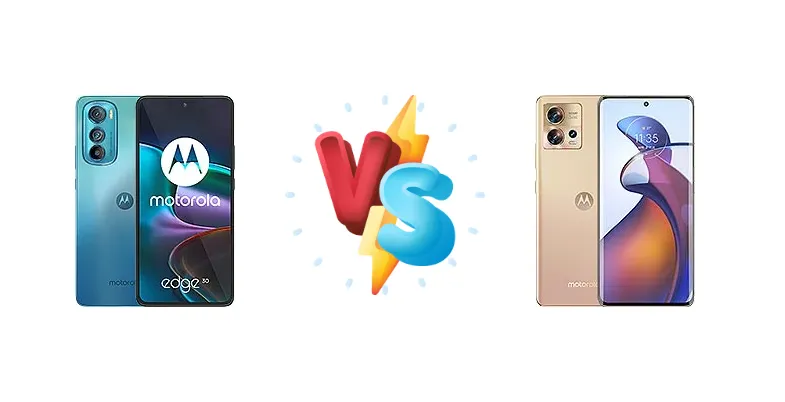
|
🏆 Quick Verdict
The Edge 30 Fusion takes the crown thanks to its significantly faster Snapdragon 888+ chipset, brighter display, and faster charging. While the Edge 30 is a capable device, the Fusion's performance and display advantages make it the better overall value, especially for those prioritizing speed and visual quality.
| PHONES | ||
|---|---|---|
| Phone Names | Motorola Edge 30 | Motorola Edge 30 Fusion |
| Network | ||
|---|---|---|
| 2G bands | GSM 850 / 900 / 1800 / 1900 | GSM 850 / 900 / 1800 / 1900 |
| 3G bands | HSDPA 850 / 900 / 1700(AWS) / 1900 / 2100 | HSDPA 850 / 900 / 1700(AWS) / 1900 / 2100 - International |
| 4G bands | 1, 2, 3, 4, 5, 7, 8, 12, 13, 17, 20, 26, 28, 32, 38, 39, 40, 41, 41, 42, 43, 66 | 1, 2, 3, 4, 5, 7, 8, 12, 13, 17, 18, 19, 20, 25, 26, 28, 32, 38, 39, 40, 41, 42, 43, 66 - International |
| 5G bands | 1, 2, 3, 5, 7, 8, 20, 28, 38, 40, 41, 66, 78 SA/NSA/Sub6 | 1, 3, 5, 7, 8, 20, 28, 38, 40, 41, 66, 77, 78 SA/NSA - International |
| Speed | HSPA, LTE, 5G | HSPA, LTE, 5G |
| Technology | GSM / HSPA / LTE / 5G | GSM / CDMA / HSPA / CDMA2000 / LTE / 5G |
| - | 1, 2, 3, 5, 7, 8, 20, 28, 38, 41, 77, 78 SA/NSA - PRC | |
| Launch | ||
|---|---|---|
| Announced | 2022, April 27 | 2022, September 08 |
| Status | Available. Released 2022, May 12 | Available. Released 2022, September 08 |
| Body | ||
|---|---|---|
| Build | Glass front (Gorilla Glass 3), plastic frame, plastic back | Glass front (Gorilla Glass 5), glass back (Gorilla Glass 5), aluminum frame |
| Dimensions | 159.4 x 74.2 x 6.8 mm (6.28 x 2.92 x 0.27 in) | 158.5 x 72 x 7.5 mm or 7.7 mm |
| SIM | · Nano-SIM· Nano-SIM + Nano-SIM | · Nano-SIM· Nano-SIM + Nano-SIM |
| Weight | 155 g (5.47 oz) | 168 g / 175 g (5.93 oz) |
| Water-repellent design | Splash and dust resistant | |
| Display | ||
|---|---|---|
| Protection | Corning Gorilla Glass 3 | Corning Gorilla Glass 5 |
| Resolution | 1080 x 2400 pixels, 20:9 ratio (~405 ppi density) | 1080 x 2400 pixels, 20:9 ratio (~402 ppi density) |
| Size | 6.5 inches, 102.0 cm2 (~86.2% screen-to-body ratio) | 6.55 inches, 103.6 cm2 (~90.8% screen-to-body ratio) |
| Type | AMOLED, 1B colors, 144Hz, HDR10+ | P-OLED, 1B colors, 144Hz, HDR10+, 1100 nits (peak) |
| Platform | ||
|---|---|---|
| CPU | Octa-core (1x2.5 GHz Cortex-A78 & 3x2.4 GHz Cortex-A78 & 4x1.9 GHz Cortex-A55) | Octa-core (1x2.99 GHz Cortex-X1 & 3x2.42 GHz Cortex-A78 & 4x1.80 GHz Cortex-A55) |
| Chipset | Qualcomm SM7325-AE Snapdragon 778G+ 5G (6 nm) | Qualcomm SM8350 Snapdragon 888+ 5G (5 nm) |
| GPU | Adreno 642L | Adreno 660 |
| OS | Android 12, upgradable to Android 14 | Android 12, upgradable to Android 14 |
| Memory | ||
|---|---|---|
| Card slot | No | No |
| Internal | 128GB 6GB RAM, 128GB 8GB RAM, 256GB 8GB RAM | 128GB 8GB RAM, 256GB 6GB RAM, 256GB 8GB RAM, 256GB 12GB RAM, 512GB 12GB RAM |
| - | UFS 3.1 | |
| Main Camera | ||
|---|---|---|
| Features | Dual-LED flash, HDR, panorama | LED flash, panorama, HDR |
| Triple | 50 MP, f/1.8, (wide), 1/1.55", 1.0µm, multi-directional PDAF, OIS 50 MP, f/2.2, 118˚ (ultrawide), 1/2.76", 0.64µm, PDAF Auxiliary lens | 50 MP, f/1.8, (wide), 1/1.55", 1.0µm, multi-directional PDAF, OIS 13 MP, f/2.2, 120˚ (ultrawide), 1.12µm, AF Auxiliary lens |
| Video | 4K@30fps, 1080p@30/60/120fps, 720p@960fps, HDR10, gyro-EIS | 8K@30fps, 4K@30fps, 1080p@30/60/120fps, 720p@960fps, gyro-EIS |
| Selfie camera | ||
|---|---|---|
| Features | HDR | HDR |
| Single | 32 MP, f/2.3, (wide), 0.7µm | 32 MP, f/2.5, (wide), 1/2.8", 0.8µm, AF |
| Video | 4K@30fps, 1080p@30/120fps | 4K@30fps, 1080p@30fps |
| Sound | ||
|---|---|---|
| 3.5mm jack | No | No |
| 35mm jack | No | No |
| Loudspeaker | Yes, with stereo speakers | Yes, with stereo speakers |
| Comms | ||
|---|---|---|
| Bluetooth | 5.2, A2DP, LE, aptX HD, aptX Adaptive | 5.2, A2DP, LE, aptX HD, aptX Adaptive |
| NFC | Yes | Yes |
| Positioning | GPS, GLONASS, BDS, GALILEO | GPS (L1+L5), GLONASS, BDS (B1I+B1c), GALILEO |
| Radio | No | No |
| USB | USB Type-C 2.0 | USB Type-C 3.1, OTG |
| WLAN | Wi-Fi 802.11 a/b/g/n/ac/6e, dual-band, Wi-Fi Direct | Wi-Fi 802.11 a/b/g/n/ac/6e, tri-band, Wi-Fi Direct |
| Features | ||
|---|---|---|
| Sensors | Fingerprint (under display, optical), accelerometer, gyro, proximity, compass | Fingerprint (under display, optical), accelerometer, gyro, proximity, compass |
| - | Ready For 3.5 support | |
| Battery | ||
|---|---|---|
| Charging | 33W wired | 68W wired, 50% in 10 min |
| Type | Li-Po 4020 mAh | Li-Po 4400 mAh |
| Misc | ||
|---|---|---|
| Colors | Meteor Grey, Supermoon Silver, Aurora Green | Neptune Blue, Cosmic Grey, Solar Gold, Aurora White, Viva Magenta |
| Models | XT2203-1 | XT2243-1 |
| Price | $ 529.00 / € 168.00 | About 150 EUR |
| Tests | ||
|---|---|---|
| Battery life | - | Endurance rating 101h |
| Camera | - | Photo / Video |
| Display | - | Contrast ratio: Infinite (nominal) |
| Loudspeaker | - | -24.6 LUFS (Very good) |
| Performance | - | AnTuTu: 827929 (v9) GeekBench: 3458 (v5.1) GFXBench: 62fps (ES 3.1 onscreen) |
Motorola Edge 30
- Stylish Design
- Good Value
- Compact Size
- Decent Performance
- Slower Charging
- Less Powerful Chipset
- Lower Display Brightness
Motorola Edge 30 Fusion
- Flagship Chipset (Snapdragon 888+)
- Brighter Display
- Fast Charging (68W)
- Excellent Battery Life
- Potentially Larger Size
- May be slightly more expensive
Display Comparison
The Edge 30 Fusion's display is a clear winner. It boasts a measured peak brightness of 946 nits, significantly brighter than the Edge 30 (estimated around 500-600 nits). The Fusion's 'infinite' contrast ratio (nominal) suggests excellent blacks and vibrant colors. While the Edge 30 has a good display, the Fusion offers a superior visual experience.
Camera Comparison
Both phones offer capable camera systems, but detailed camera comparisons require more in-depth testing. The Edge 30 Fusion likely benefits from the more powerful image signal processor (ISP) within the Snapdragon 888+, potentially leading to slightly better image processing and low-light performance. Both are expected to deliver good quality photos and videos for their price range.
Performance
The Snapdragon 888+ in the Edge 30 Fusion provides a substantial performance advantage over the Edge 30's Snapdragon 778G+. Expect smoother multitasking, faster app loading times, and significantly better gaming performance on the Fusion. The 888+ is a flagship-level chip, while the 778G+ is a strong mid-range performer.
Battery Life
Both phones claim impressive endurance ratings (101h), suggesting excellent battery life. However, the Edge 30 Fusion's 68W charging is a game-changer, allowing for a 50% charge in just 10 minutes – a significant advantage over the Edge 30's 33W charging.
Buying Guide
The Motorola Edge 30 is ideal for users seeking a stylish, well-rounded phone with a good balance of features and price. It's a great choice for everyday tasks and moderate gaming. The Motorola Edge 30 Fusion is best suited for power users, gamers, and anyone who values a premium display and fast charging. It offers a noticeable performance boost and a more immersive viewing experience.