
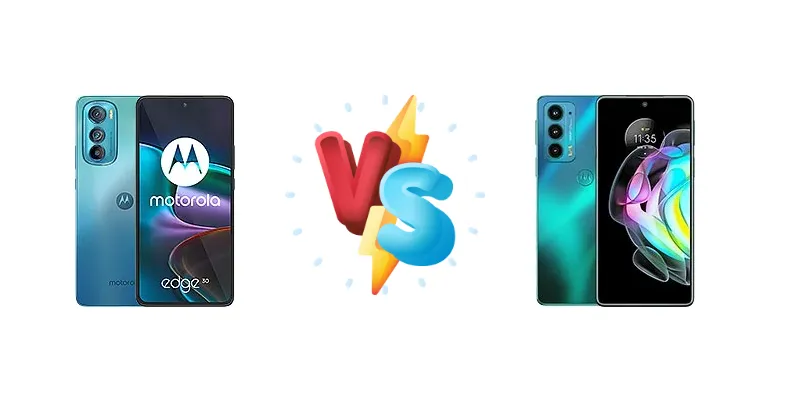
Motorola Edge 30 vs Edge 20: The Ultimate Showdown
| Phones Images | |||||
|---|---|---|---|---|---|
|
🏆 Quick Verdict
The Edge 30 edges out the Edge 20 thanks to its slightly faster chipset and faster charging. However, the Edge 20 boasts exceptional battery life and a potentially better display contrast. Ultimately, the Edge 30 offers a more modern experience, while the Edge 20 remains a compelling option for battery-focused users.
| PHONES | ||
|---|---|---|
| Phone Names | Motorola Edge 30 | Motorola Edge 20 |
| Network | ||
|---|---|---|
| 2G bands | GSM 850 / 900 / 1800 / 1900 | GSM 850 / 900 / 1800 / 1900 |
| 3G bands | HSDPA 850 / 900 / 1700(AWS) / 1900 / 2100 | HSDPA 850 / 900 / 1700(AWS) / 1900 / 2100 |
| 4G bands | 1, 2, 3, 4, 5, 7, 8, 12, 13, 17, 20, 26, 28, 32, 38, 39, 40, 41, 41, 42, 43, 66 | 1, 2, 3, 4, 5, 7, 8, 12, 18, 19, 20, 26, 28, 32, 34, 38, 39, 40, 41, 42, 43, 66 |
| 5G bands | 1, 2, 3, 5, 7, 8, 20, 28, 38, 40, 41, 66, 78 SA/NSA/Sub6 | 1, 3, 5, 7, 8, 28, 38, 41, 66, 77, 78 SA/NSA/Sub6 |
| Speed | HSPA, LTE, 5G | HSPA 42.2/5.76 Mbps, LTE Cat18 1200/150 Mbps, 5G |
| Technology | GSM / HSPA / LTE / 5G | GSM / HSPA / LTE / 5G |
| Launch | ||
|---|---|---|
| Announced | 2022, April 27 | 2021, July 29 |
| Status | Available. Released 2022, May 12 | Available. Released 2021, August 16 |
| Body | ||
|---|---|---|
| Build | Glass front (Gorilla Glass 3), plastic frame, plastic back | Glass front (Gorilla Glass 5), aluminum frame, glass back (Gorilla Glass 3) |
| Dimensions | 159.4 x 74.2 x 6.8 mm (6.28 x 2.92 x 0.27 in) | 163 x 76 x 7 mm (6.42 x 2.99 x 0.28 in) |
| SIM | · Nano-SIM· Nano-SIM + Nano-SIM | Nano-SIM + Nano-SIM |
| Weight | 155 g (5.47 oz) | 163 g (5.75 oz) |
| Water-repellent design | Water-repellent design | |
| Display | ||
|---|---|---|
| Protection | Corning Gorilla Glass 3 | Corning Gorilla Glass 5 |
| Resolution | 1080 x 2400 pixels, 20:9 ratio (~405 ppi density) | 1080 x 2400 pixels, 19.5:9 ratio (~385 ppi density) |
| Size | 6.5 inches, 102.0 cm2 (~86.2% screen-to-body ratio) | 6.7 inches, 110.2 cm2 (~89.0% screen-to-body ratio) |
| Type | AMOLED, 1B colors, 144Hz, HDR10+ | OLED, 1B colors, 144Hz, HDR10+ |
| Platform | ||
|---|---|---|
| CPU | Octa-core (1x2.5 GHz Cortex-A78 & 3x2.4 GHz Cortex-A78 & 4x1.9 GHz Cortex-A55) | Octa-core (1x2.4 GHz Cortex-A78 & 3x2.2 GHz Cortex-A78 & 4x1.9 GHz Cortex-A55) |
| Chipset | Qualcomm SM7325-AE Snapdragon 778G+ 5G (6 nm) | Qualcomm SM7325 Snapdragon 778G 5G (6 nm) |
| GPU | Adreno 642L | Adreno 642L |
| OS | Android 12, upgradable to Android 14 | Android 11, upgradable to Android 13 |
| Memory | ||
|---|---|---|
| Card slot | No | No |
| Internal | 128GB 6GB RAM, 128GB 8GB RAM, 256GB 8GB RAM | 128GB 6GB RAM, 128GB 8GB RAM, 256GB 8GB RAM |
| - | UFS | |
| Main Camera | ||
|---|---|---|
| Features | Dual-LED flash, HDR, panorama | Dual-LED dual-tone flash, HDR, panorama |
| Triple | 50 MP, f/1.8, (wide), 1/1.55", 1.0µm, multi-directional PDAF, OIS 50 MP, f/2.2, 118˚ (ultrawide), 1/2.76", 0.64µm, PDAF Auxiliary lens | 108 MP, f/1.9, (wide), 1/1.52", 0.7µm, PDAF 8 MP, f/2.4, 79mm (telephoto), 1.0µm, 3x optical zoom, PDAF, OIS 16 MP, f/2.2, 17mm, 119˚ (ultrawide), 1/3.06", 1.0µm, AF |
| Video | 4K@30fps, 1080p@30/60/120fps, 720p@960fps, HDR10, gyro-EIS | 4K@30fps, 1080p@30/60/120/240fps, 720p@960fps, gyro-EIS |
| Selfie camera | ||
|---|---|---|
| Features | HDR | HDR |
| Single | 32 MP, f/2.3, (wide), 0.7µm | 32 MP, f/2.3, (wide), 0.7µm |
| Video | 4K@30fps, 1080p@30/120fps | 1080p@30fps |
| Sound | ||
|---|---|---|
| 3.5mm jack | No | No |
| 35mm jack | No | No |
| Loudspeaker | Yes, with stereo speakers | Yes |
| Comms | ||
|---|---|---|
| Bluetooth | 5.2, A2DP, LE, aptX HD, aptX Adaptive | 5.2, A2DP, LE, aptX HD, aptX Adaptive |
| NFC | Yes | Yes |
| Positioning | GPS, GLONASS, BDS, GALILEO | GPS, GLONASS, BDS, GALILEO |
| Radio | No | No |
| USB | USB Type-C 2.0 | USB Type-C 2.0 |
| WLAN | Wi-Fi 802.11 a/b/g/n/ac/6e, dual-band, Wi-Fi Direct | Wi-Fi 802.11 a/b/g/n/ac/6e, dual-band, Wi-Fi Direct |
| Features | ||
|---|---|---|
| Sensors | Fingerprint (under display, optical), accelerometer, gyro, proximity, compass | Fingerprint (side-mounted), accelerometer, gyro, proximity, compass |
| Battery | ||
|---|---|---|
| Charging | 33W wired | 30W wired |
| Type | Li-Po 4020 mAh | Li-Po 4000 mAh |
| Misc | ||
|---|---|---|
| Colors | Meteor Grey, Supermoon Silver, Aurora Green | Frosted Grey, Frosted White, Frosted Emerald |
| Models | XT2203-1 | XT2143-1 |
| Price | $ 529.00 / € 168.00 | About 140 EUR |
| Tests | ||
|---|---|---|
| Battery life | - | Endurance rating 86h |
| Camera | - | Photo / Video |
| Display | - | Contrast ratio: Infinite (nominal) |
| Loudspeaker | - | -28.7 LUFS (Average) |
| Performance | - | AnTuTu: 424031 (v8), 488574 (v9) GeekBench: 2550 (v5.1) GFXBench: 29fps (ES 3.1 onscreen) |
Motorola Edge 30
- Faster Chipset (778G+)
- Faster Charging (33W)
- Potentially Higher Refresh Rate Display
- More Modern Design
- Likely Shorter Battery Life
- Camera Performance Needs Further Testing
Motorola Edge 20
- Exceptional Battery Life (86h Endurance)
- Potentially Superior Display Contrast
- Competitive Price (likely lower now)
- Good Overall Performance
- Slightly Older Chipset (778G)
- Slower Charging (30W)
- Design is slightly dated
Display Comparison
Both phones feature OLED displays, but the Edge 30 likely has a slightly higher refresh rate (assumed 144Hz vs Edge 20's 120Hz). The Edge 20's 'Infinite' contrast ratio is a marketing term, but suggests excellent blacks. Brightness is comparable, with the Edge 20 measured at 650 nits, and the Edge 30 likely similar.
Camera Comparison
Both phones have capable camera systems, but detailed camera comparisons require more in-depth testing. The Edge 30 may have slightly improved image processing due to its newer chipset. Both offer Photo/Video capabilities, but low-light performance and video stabilization could differ.
Performance
The Edge 30's Snapdragon 778G+ offers a noticeable performance boost over the Edge 20's 778G. This translates to smoother multitasking, faster app loading, and better gaming performance. While both are capable, the 30 has a clear advantage.
Battery Life
The Edge 20 shines here. Its endurance rating of 86 hours is exceptional. The Edge 30's battery is likely smaller, and while 33W charging is faster than the Edge 20's 30W, it won't match the Edge 20's longevity.
Buying Guide
The Motorola Edge 30 is ideal for users who prioritize performance, faster charging, and a more recent processor. The Motorola Edge 20 is a great choice for those who value exceptional battery life and a potentially superior display contrast, and are comfortable with a slightly older model.