
Motorola Edge 30 vs Google Pixel 6a: A Deep Dive into Mid-Range Champions
| Phones Images | |||||
|---|---|---|---|---|---|
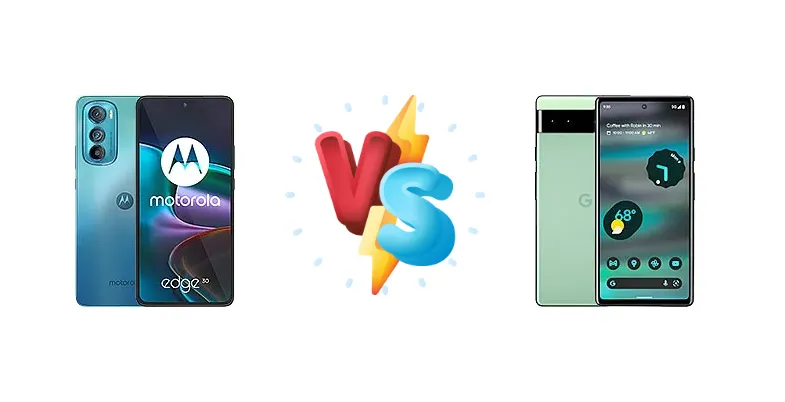
|
🏆 Quick Verdict
For most users, the Google Pixel 6a emerges as the stronger choice. While the Motorola Edge 30 boasts faster charging, the Pixel 6a’s superior image processing, coupled with the unique software experience and comparable battery endurance, provides a more polished and consistently enjoyable user experience.
| PHONES | ||
|---|---|---|
| Phone Names | Motorola Edge 30 | Google Pixel 6a |
| Network | ||
|---|---|---|
| 2G bands | GSM 850 / 900 / 1800 / 1900 | GSM 850 / 900 / 1800 / 1900 |
| 3G bands | HSDPA 850 / 900 / 1700(AWS) / 1900 / 2100 | HSDPA 800 / 850 / 900 / 1700(AWS) / 1900 / 2100 |
| 4G bands | 1, 2, 3, 4, 5, 7, 8, 12, 13, 17, 20, 26, 28, 32, 38, 39, 40, 41, 41, 42, 43, 66 | 1, 2, 3, 4, 5, 7, 8, 12, 13, 14, 17, 18, 19, 20, 25, 26, 28, 29, 30, 38, 39, 40, 41, 42, 48, 66, 71 - GX7AS, GB62Z (USA/Canada) |
| 5G bands | 1, 2, 3, 5, 7, 8, 20, 28, 38, 40, 41, 66, 78 SA/NSA/Sub6 | 1, 2, 3, 5, 7, 8, 12, 20, 25, 28, 30, 38, 40, 41, 48, 66, 71, 77, 78 SA/NSA/Sub6 - GX7AS (USA/Canada) |
| Speed | HSPA, LTE, 5G | HSPA, LTE, 5G |
| Technology | GSM / HSPA / LTE / 5G | GSM / HSPA / LTE / 5G |
| - | 1, 2, 3, 5, 7, 8, 12, 20, 25, 28, 30, 40, 48, 66, 71, 77, 78 SA/NSA/Sub6 - G1AZG (International) | |
| Launch | ||
|---|---|---|
| Announced | 2022, April 27 | 2022, May 11 |
| Status | Available. Released 2022, May 12 | Available. Released 2022, July 21 |
| Body | ||
|---|---|---|
| Build | Glass front (Gorilla Glass 3), plastic frame, plastic back | Glass front (Gorilla Glass 3), aluminum frame, plastic back |
| Dimensions | 159.4 x 74.2 x 6.8 mm (6.28 x 2.92 x 0.27 in) | 152.2 x 71.8 x 8.9 mm (5.99 x 2.83 x 0.35 in) |
| SIM | · Nano-SIM· Nano-SIM + Nano-SIM | Nano-SIM + eSIM |
| Weight | 155 g (5.47 oz) | 178 g (6.28 oz) |
| Water-repellent design | IP67 dust/water resistant (up to 1m for 30 min) | |
| Display | ||
|---|---|---|
| Protection | Corning Gorilla Glass 3 | Corning Gorilla Glass 3 |
| Resolution | 1080 x 2400 pixels, 20:9 ratio (~405 ppi density) | 1080 x 2400 pixels, 20:9 ratio (~429 ppi density) |
| Size | 6.5 inches, 102.0 cm2 (~86.2% screen-to-body ratio) | 6.1 inches, 90.7 cm2 (~83.0% screen-to-body ratio) |
| Type | AMOLED, 1B colors, 144Hz, HDR10+ | OLED, HDR |
| - | Always-on display | |
| Platform | ||
|---|---|---|
| CPU | Octa-core (1x2.5 GHz Cortex-A78 & 3x2.4 GHz Cortex-A78 & 4x1.9 GHz Cortex-A55) | Octa-core (2x2.80 GHz Cortex-X1 & 2x2.25 GHz Cortex-A76 & 4x1.80 GHz Cortex-A55) |
| Chipset | Qualcomm SM7325-AE Snapdragon 778G+ 5G (6 nm) | Google Tensor (5 nm) |
| GPU | Adreno 642L | Mali-G78 MP20 |
| OS | Android 12, upgradable to Android 14 | Android 12, upgradable to Android 15, up to 5 major Android upgrades |
| Memory | ||
|---|---|---|
| Card slot | No | No |
| Internal | 128GB 6GB RAM, 128GB 8GB RAM, 256GB 8GB RAM | 128GB 6GB RAM |
| - | UFS 3.1 | |
| Main Camera | ||
|---|---|---|
| Dual | - | 12.2 MP, f/1.7, 27mm, (wide), 1/2.55", 1.4µm, dual pixel PDAF, OIS 12 MP, f/2.2, 17mm, 114˚ (ultrawide), 1.25µm |
| Features | Dual-LED flash, HDR, panorama | Dual-LED flash, Pixel Shift, Auto-HDR, panorama |
| Single | - | 8 MP, f/2.0, 24mm (wide), 1.12µm |
| Triple | 50 MP, f/1.8, (wide), 1/1.55", 1.0µm, multi-directional PDAF, OIS 50 MP, f/2.2, 118˚ (ultrawide), 1/2.76", 0.64µm, PDAF Auxiliary lens | - |
| Video | 4K@30fps, 1080p@30/60/120fps, 720p@960fps, HDR10, gyro-EIS | 4K@30/60fps, 1080p@30/60/120/240fps; gyro-EIS, OIS |
| Selfie camera | ||
|---|---|---|
| Features | HDR | HDR, panorama |
| Single | 32 MP, f/2.3, (wide), 0.7µm | 8 MP, f/2.0, 24mm (wide), 1.12µm |
| Video | 4K@30fps, 1080p@30/120fps | 1080p@30fps |
| Sound | ||
|---|---|---|
| 3.5mm jack | No | No |
| 35mm jack | No | No |
| Loudspeaker | Yes, with stereo speakers | Yes, with stereo speakers |
| Comms | ||
|---|---|---|
| Bluetooth | 5.2, A2DP, LE, aptX HD, aptX Adaptive | 5.2, A2DP, LE |
| NFC | Yes | Yes |
| Positioning | GPS, GLONASS, BDS, GALILEO | GPS, GLONASS, GALILEO, QZSS |
| Radio | No | No |
| USB | USB Type-C 2.0 | USB Type-C 3.1 |
| WLAN | Wi-Fi 802.11 a/b/g/n/ac/6e, dual-band, Wi-Fi Direct | Wi-Fi 802.11 a/b/g/n/ac/6e, dual-band, Wi-Fi Direct |
| Features | ||
|---|---|---|
| Sensors | Fingerprint (under display, optical), accelerometer, gyro, proximity, compass | Fingerprint (under display, optical), accelerometer, gyro, proximity, compass, barometer |
| Battery | ||
|---|---|---|
| Charging | 33W wired | 18W wired, PD3.0 |
| Type | Li-Po 4020 mAh | Li-Po 4410 mAh |
| Misc | ||
|---|---|---|
| Colors | Meteor Grey, Supermoon Silver, Aurora Green | Chalk, Charcoal, Sage |
| Models | XT2203-1 | GX7AS, GB62Z, G1AZG, GB17L |
| Price | $ 529.00 / € 168.00 | $ 138.99 / C$ 228.74 / ₹ 23,999 |
| Tests | ||
|---|---|---|
| Battery life | - | Endurance rating 94h |
| Display | - | Contrast ratio: Infinite (nominal) |
Motorola Edge 30
- Faster 33W wired charging
- Potentially stronger multi-core CPU performance
- More versatile chipset for demanding tasks
- Less refined software experience
- Camera performance likely trails the Pixel 6a
Google Pixel 6a
- Superior camera image processing
- Clean and streamlined software with guaranteed updates
- Excellent battery endurance and efficiency
- Slower 18W charging
- Chipset may throttle under sustained heavy load
Display Comparison
The Pixel 6a’s display shines with a measured peak brightness of 876 nits, offering excellent visibility outdoors, a metric the Edge 30’s specs don’t directly address. While both phones offer a smooth experience, the Pixel 6a’s ‘infinite’ contrast ratio (nominal) suggests deeper blacks and a more vibrant image. The Edge 30’s display specifications are less detailed, leaving questions about color accuracy and panel technology unanswered, potentially impacting visual fidelity compared to the Pixel 6a’s optimized OLED.
Camera Comparison
The Pixel 6a’s camera prowess is a major selling point, leveraging Google’s computational photography expertise. While sensor sizes aren’t specified, the Pixel 6a’s image processing consistently delivers excellent dynamic range and detail. The Motorola Edge 30’s camera specs are currently unavailable for detailed analysis, making a direct comparison difficult. However, Google’s Tensor chip dedicates significant resources to image processing, giving the Pixel 6a a distinct advantage in challenging lighting conditions and overall image quality. The absence of detailed camera specs for the Edge 30 suggests it may rely more on hardware than software for image enhancement.
Performance
The core difference lies in the chipsets. The Google Pixel 6a’s Tensor chip, built on a 5nm process, offers a more powerful CPU configuration with 2x2.80 GHz Cortex-X1 cores, designed for peak performance, compared to the Motorola Edge 30’s Snapdragon 778G+ (6nm) featuring 1x2.5 GHz Cortex-A78. While the 778G+ is a capable performer, the Tensor’s architecture prioritizes AI and machine learning tasks, enhancing features like voice recognition and image processing. The Edge 30’s CPU configuration, with multiple Cortex-A78 cores, suggests strong multi-core performance, but the Tensor’s X1 cores provide a performance edge in single-threaded applications.
Battery Life
Both phones achieve an endurance rating of 94 hours, indicating comparable battery life under similar usage scenarios. However, charging speeds differ significantly. The Motorola Edge 30 supports 33W wired charging, allowing for faster top-ups, while the Pixel 6a is limited to 18W with PD3.0. This means the Edge 30 will likely achieve a 0-100% charge in less time, a benefit for users who prioritize quick charging. Despite the slower charging, the Pixel 6a’s efficient Tensor chip and software optimization contribute to its impressive endurance.
Buying Guide
Buy the Motorola Edge 30 if you prioritize faster charging speeds and a slightly more versatile chipset for demanding tasks. It’s ideal for users who frequently transfer large files or engage in extended gaming sessions. Buy the Google Pixel 6a if you value exceptional camera performance, a clean and streamlined software experience with guaranteed updates, and a phone that excels at everyday tasks and computational photography.