
Asus ROG Phone 6 Diablo Immortal Edition vs. Motorola Edge 30: A Deep Dive
| Phones Images | |||||
|---|---|---|---|---|---|
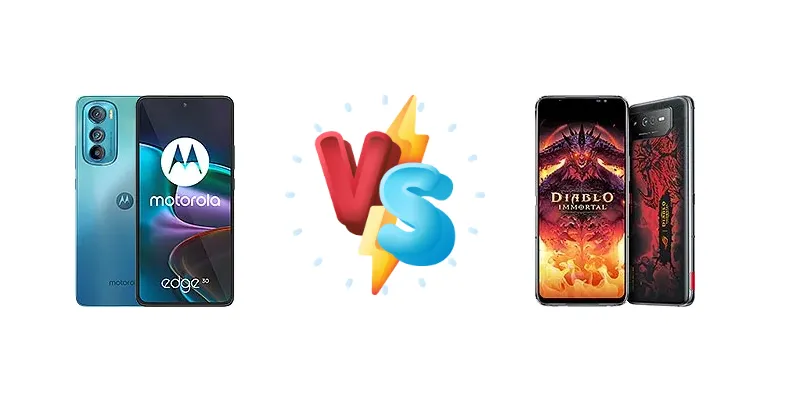
|
🏆 Quick Verdict
For the average user prioritizing a sleek design and all-around functionality, the Motorola Edge 30 provides a compelling experience. However, the Asus ROG Phone 6 Diablo Immortal Edition is the clear winner for dedicated mobile gamers, offering significantly superior processing power and gaming-centric features that justify its higher cost.
| PHONES | ||
|---|---|---|
| Phone Names | Motorola Edge 30 | Asus ROG Phone 6 Diablo Immortal Edition |
| Network | ||
|---|---|---|
| 2G bands | GSM 850 / 900 / 1800 / 1900 | GSM 850 / 900 / 1800 / 1900 |
| 3G bands | HSDPA 850 / 900 / 1700(AWS) / 1900 / 2100 | HSDPA 800 / 850 / 900 / 1700(AWS) / 1900 / 2100 - A version, C version |
| 4G bands | 1, 2, 3, 4, 5, 7, 8, 12, 13, 17, 20, 26, 28, 32, 38, 39, 40, 41, 41, 42, 43, 66 | 1, 2, 3, 4, 5, 7, 8, 12, 13, 17, 18, 19, 20, 25, 26, 28, 29, 30, 32, 34, 38, 39, 40, 41, 42, 43, 48, 66, 71 - A version |
| 5G bands | 1, 2, 3, 5, 7, 8, 20, 28, 38, 40, 41, 66, 78 SA/NSA/Sub6 | 1, 2, 3, 5, 7, 8, 12, 13, 18, 20, 25, 26, 28, 38, 40, 41, 48, 66, 71, 77, 78, 79 SA/NSA - A version |
| Speed | HSPA, LTE, 5G | HSPA, LTE, 5G |
| Technology | GSM / HSPA / LTE / 5G | GSM / CDMA / HSPA / LTE / 5G |
| - | 1, 3, 5, 8, 28, 41, 77, 78, 79 SA/NSA - C version | |
| Launch | ||
|---|---|---|
| Announced | 2022, April 27 | 2022, November 17 |
| Status | Available. Released 2022, May 12 | Available. Released 2022, November 18 |
| Body | ||
|---|---|---|
| Build | Glass front (Gorilla Glass 3), plastic frame, plastic back | Glass front (Gorilla Glass Victus), glass back (Gorilla Glass 3), aluminum frame |
| Dimensions | 159.4 x 74.2 x 6.8 mm (6.28 x 2.92 x 0.27 in) | 173 x 77 x 10.4 mm (6.81 x 3.03 x 0.41 in) |
| SIM | · Nano-SIM· Nano-SIM + Nano-SIM | Nano-SIM + Nano-SIM |
| Weight | 155 g (5.47 oz) | 239 g (8.43 oz) |
| Water-repellent design | IPX4 water resistant Illuminated RGB logo (on the back) Pressure sensitive zones (Gaming triggers) | |
| Display | ||
|---|---|---|
| Protection | Corning Gorilla Glass 3 | Corning Gorilla Glass Victus |
| Resolution | 1080 x 2400 pixels, 20:9 ratio (~405 ppi density) | 1080 x 2448 pixels (~395 ppi density) |
| Size | 6.5 inches, 102.0 cm2 (~86.2% screen-to-body ratio) | 6.78 inches, 109.5 cm2 (~82.2% screen-to-body ratio) |
| Type | AMOLED, 1B colors, 144Hz, HDR10+ | AMOLED, 1B colors, 165Hz, HDR10+, 800 nits (typ), 1200 nits (peak) |
| Platform | ||
|---|---|---|
| CPU | Octa-core (1x2.5 GHz Cortex-A78 & 3x2.4 GHz Cortex-A78 & 4x1.9 GHz Cortex-A55) | Octa-core (1x3.19 GHz Cortex-X2 & 3x2.75 GHz Cortex-A710 & 4x1.80 GHz Cortex-A510) |
| Chipset | Qualcomm SM7325-AE Snapdragon 778G+ 5G (6 nm) | Qualcomm SM8475 Snapdragon 8+ Gen 1 (4 nm) |
| GPU | Adreno 642L | Adreno 730 |
| OS | Android 12, upgradable to Android 14 | Android 12 |
| Memory | ||
|---|---|---|
| Card slot | No | No |
| Internal | 128GB 6GB RAM, 128GB 8GB RAM, 256GB 8GB RAM | 512GB 16GB RAM |
| - | UFS 3.1 NTFS support for external storage | |
| Main Camera | ||
|---|---|---|
| Features | Dual-LED flash, HDR, panorama | LED flash, HDR, panorama |
| Triple | 50 MP, f/1.8, (wide), 1/1.55", 1.0µm, multi-directional PDAF, OIS 50 MP, f/2.2, 118˚ (ultrawide), 1/2.76", 0.64µm, PDAF Auxiliary lens | 50 MP, f/1.9, 24mm (wide), 1/1.56", 1.0µm, PDAF 13 MP, f/2.2, 13mm (ultrawide) 5 MP (macro) |
| Video | 4K@30fps, 1080p@30/60/120fps, 720p@960fps, HDR10, gyro-EIS | 8K@24fps, 4K@30/60fps, 4K@120fps, 1080p@30/60/120/240fps, 720p@480fps; gyro-EIS, HDR10+ |
| Selfie camera | ||
|---|---|---|
| Features | HDR | Panorama, HDR |
| Single | 32 MP, f/2.3, (wide), 0.7µm | 12 MP, 28mm (wide) |
| Video | 4K@30fps, 1080p@30/120fps | 1080p@30fps |
| Sound | ||
|---|---|---|
| 3.5mm jack | No | Yes |
| 35mm jack | No | Yes |
| Loudspeaker | Yes, with stereo speakers | Yes, with stereo speakers (2 amplifiers) |
| - | 32-bit/384kHz audio | |
| Comms | ||
|---|---|---|
| Bluetooth | 5.2, A2DP, LE, aptX HD, aptX Adaptive | 5.2, A2DP, LE, aptX HD, aptX Adaptive |
| NFC | Yes | Yes |
| Positioning | GPS, GLONASS, BDS, GALILEO | GPS (L1+L5), GLONASS (L1), BDS (B1I+B1c+B2a), GALILEO (E1+E5a), QZSS (L1+L5), NavIC (L5) |
| Radio | No | No |
| USB | USB Type-C 2.0 | USB Type-C 3.1 (side), USB Type-C 2.0 (bottom), OTG, accessory connector |
| WLAN | Wi-Fi 802.11 a/b/g/n/ac/6e, dual-band, Wi-Fi Direct | Wi-Fi 802.11 a/b/g/n/ac/6e, tri-band, Wi-Fi Direct |
| Features | ||
|---|---|---|
| Sensors | Fingerprint (under display, optical), accelerometer, gyro, proximity, compass | Fingerprint (under display, optical), accelerometer, gyro, proximity, compass |
| Battery | ||
|---|---|---|
| Charging | 33W wired | 65W wired, PD3.0, QC5 10W reverse wired |
| Type | Li-Po 4020 mAh | Li-Po 6000 mAh |
| Misc | ||
|---|---|---|
| Colors | Meteor Grey, Supermoon Silver, Aurora Green | Hellfire Red |
| Models | XT2203-1 | - |
| Price | $ 529.00 / € 168.00 | About 860 EUR |
Motorola Edge 30
- Sleek and lightweight design
- More affordable price point
- Balanced performance for everyday tasks
- Less powerful processor for demanding games
- Slower charging speed
Asus ROG Phone 6 Diablo Immortal Edition
- Unmatched gaming performance with Snapdragon 8+ Gen 1
- 65W fast charging with multiple protocols
- Gaming-centric features (likely including triggers and advanced cooling)
- Higher price tag
- Bulkier and heavier design
Display Comparison
While both phones likely feature high refresh rate displays (data not provided, but standard for both brands), the core difference lies in their intended use. The ROG Phone 6 Diablo Edition prioritizes a display optimized for gaming, likely with a higher peak brightness and potentially a faster response time. The Motorola Edge 30, while still offering a vibrant experience, will likely focus on color accuracy and power efficiency. The ROG Phone's display is likely tuned for lower persistence, reducing motion blur during fast-paced games.
Camera Comparison
Without specific sensor details, it's difficult to make a definitive judgment. However, the ROG Phone 6 Diablo Edition, being a higher-priced device, likely incorporates a larger main sensor with optical image stabilization (OIS) for improved low-light performance and video stabilization. The Motorola Edge 30 will likely focus on a balanced camera system suitable for everyday photography. The ROG Phone’s image processing will likely prioritize vibrant colors and dynamic range, while the Edge 30 may aim for a more natural look. We can assume the ROG Phone will have more advanced video recording capabilities.
Performance
The performance gap is substantial. The Asus ROG Phone 6 Diablo Edition’s Qualcomm SM8475 Snapdragon 8+ Gen 1 (4nm) is a flagship processor built for demanding tasks. Its Cortex-X2 prime core, clocked at 3.19 GHz, delivers significantly higher single-core performance than the Motorola Edge 30’s Snapdragon 778G+ (6nm). The 8+ Gen 1’s more efficient 4nm process also translates to better thermal management, allowing for sustained peak performance during extended gaming sessions. The Edge 30’s Snapdragon 778G+ is a capable mid-range chip, but it will struggle to maintain consistent frame rates in graphically intensive titles compared to the ROG Phone. The ROG Phone also benefits from potentially faster LPDDR5X RAM, further boosting performance.
Battery Life
The Asus ROG Phone 6 Diablo Edition’s 65W wired charging with PD3.0 and QC5 support is a significant advantage. This allows for a much faster 0-100% charge time compared to the Motorola Edge 30’s 33W charging. While the ROG Phone’s battery capacity is unknown, the faster charging speed mitigates any potential disadvantage in mAh. The ROG Phone also includes 10W reverse wired charging, a feature absent on the Edge 30, allowing it to charge accessories or other devices. The ROG Phone’s power management is also optimized for gaming, potentially extending battery life during gameplay.
Buying Guide
Buy the Motorola Edge 30 if you need a stylish, lightweight phone with solid performance for everyday tasks, social media, and casual gaming. It's ideal for users who value portability and a clean software experience. Buy the Asus ROG Phone 6 Diablo Immortal Edition if you prioritize uncompromising gaming performance, extended play sessions, and a feature-rich ecosystem designed specifically for mobile esports. This is the phone for those who demand the highest frame rates and lowest latency.